Study of Gas Laws — Flashcards
ICSE · Class 9 · Chemistry
35 flashcards for Study of Gas Laws (ICSE Class 9 Chemistry) to test yourself on key terms and facts. Sample: "What is a gas?"
Interactive on Super Tutor
Studying Study of Gas Laws? Get the full interactive chapter.
Quizzes, flashcards, AI doubt-solver and a step-by-step study plan — built for flashcards and more.
Free trial, no card needed.
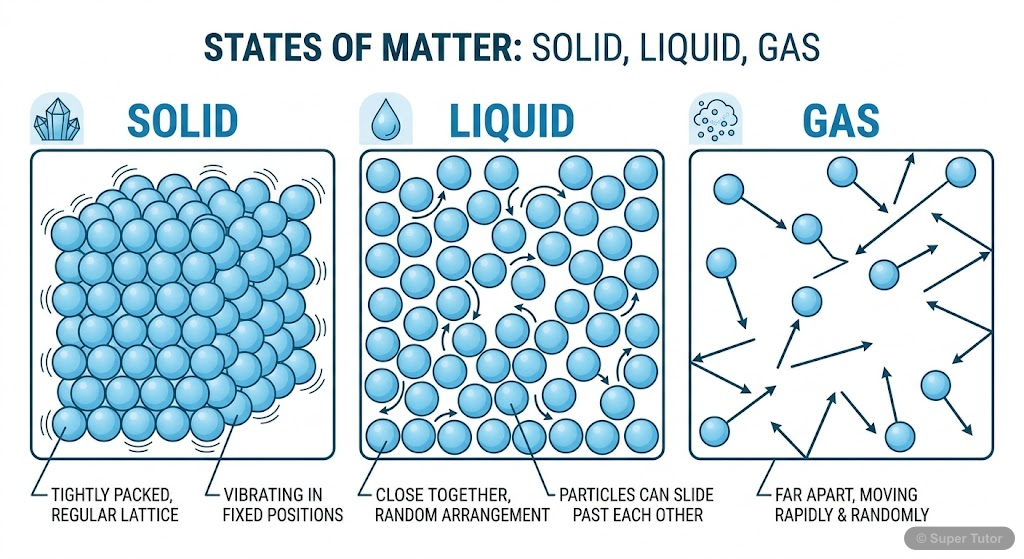
One of 12 illustrations for Study of Gas Laws in Super Tutor — alongside flashcards, concept maps and practice questions.
What is a gas?
Answer
Gas is the state of matter in which inter-particle attraction is weak and inter-particle space is very large, so particles move freely and randomly in the entire available space.
Why do gases take the shape of their container?
Answer
Gas particles move freely in all directions because the force of attraction between them is very weak. So a gas occupies the entire space of the vessel and takes its shape.
Why do gases exert pressure in all directions?
Answer
Gas molecules are in constant random motion. They collide with each other and with the walls of the container, and these collisions produce pressure in all directions.
What is diffusion?
Answer
Diffusion is the process of gradual mixing of two substances, kept in contact, by molecular motion. It happens because gas particles move randomly and mix quickly.
Why does chlorine spread through a room even though it is heavier than air?
Answer
Although chlorine is heavier than air, it does not remain at the floor but spreads throughout the room. This happens due to diffusion, which causes gas particles to mix throughout the available space.
State Boyle's law.
Answer
Boyle's law: Volume of a given mass of a dry gas is inversely proportional to its pressure at constant temperature. Equation: P1V1 = P2V2 = k This is a pressure-volume relationship at constant temper…
What happens to the volume of a gas when pressure is increased at constant temperature?
Answer
At constant temperature, an increase in pressure causes a decrease in the volume of a gas. This is the inverse relationship described by Boyle's law.
A gas occupies 800 cm3 at 760 mm Hg. Find the pressure when the volume becomes 380 cm3 at constant temperature.
Answer
Given: P1 = 760 mm Hg, V1 = 800 cm3, V2 = 380 cm3 Boyle's law: P1V1 = P2V2 760 × 800 = P2 × 380 P2 = (760 × 800) / 380 = 1600 mm Hg Answer: 1600 mm Hg…
+27 more flashcards
Practise AllFrequently Asked Questions
What are the important topics in Study of Gas Laws for ICSE Class 9 Chemistry?
How many flashcards are available for Study of Gas Laws?
How should I revise Study of Gas Laws for Class 9 exams?
Sources & Official References
Content is aligned to the official syllabus. Refer to the board website for the latest curriculum.
More resources for Study of Gas Laws
Practice Quiz
Test yourself with a quick quiz
Important Questions
Exam-style questions with answers
Revision Notes
Key points for last-minute revision
Formula Sheet
The chapter's formulas in one place
Chapter Summary
Understand the chapter at a glance
Concept Maps
See how topics connect
Study Plan
Step-by-step plan for this chapter
Syllabus
What topics to cover
For serious students
Get the full Study of Gas Laws chapter — start free.
Quizzes, flashcards, an AI doubt solver and a study plan for ICSE Class 9 Chemistry. Free to start, no card needed.