Atomic Structure and Chemical Bonding — Practice Quiz
ICSE · Class 9 · Chemistry
Try a 4-question quiz on Atomic Structure and Chemical Bonding for ICSE Class 9 Chemistry: tap an answer to check it and see why.
Interactive on Super Tutor
Studying Atomic Structure and Chemical Bonding? Get the full interactive chapter.
Quizzes, flashcards, AI doubt-solver and a step-by-step study plan — built for practice quiz and more.
Free trial, no card needed.
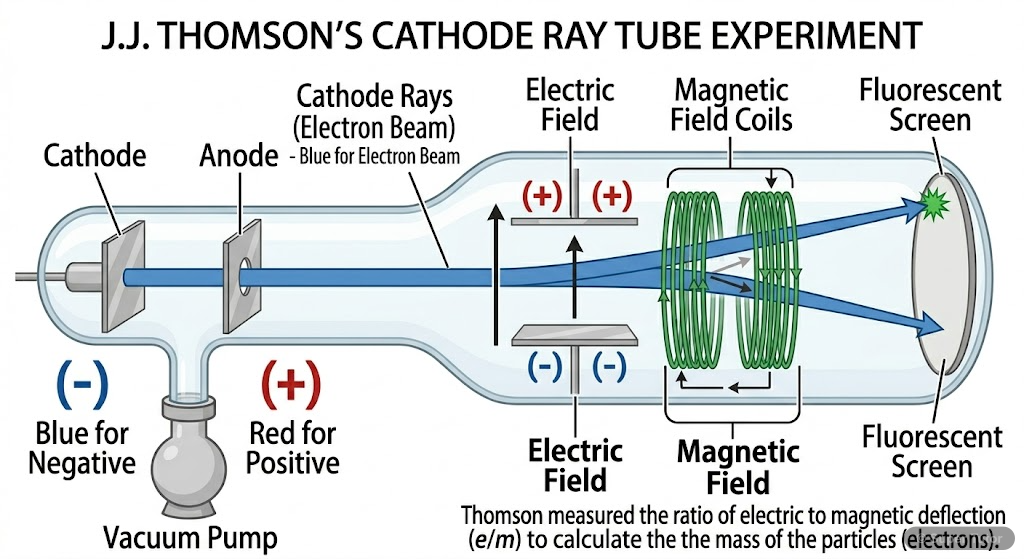
Learn better with visuals Super Tutor pairs illustrations like this with notes and quizzes for Atomic Structure and Chemical Bonding.
Quick Quiz: Atomic Structure and Chemical Bonding
0/4Tap an answer to check it instantly. No sign-up needed for these 4.
What is the atomic number of an element?
What is the maximum number of electrons that can be accommodated in the L shell?
In the formation of NaCl, what happens to the sodium atom?
The electronic configuration of magnesium (atomic number 12) is:
Sample Questions
Which of the following particles are found in the nucleus of an atom?
Show answer
Protons, Neutrons
The nucleus contains protons (positively charged) and neutrons (neutral). Electrons revolve around the nucleus in orbits. Alpha particles are not fundamental particles of atoms.
Isotopes are atoms that have the same atomic number but different mass numbers.
Show answer
True
Isotopes are atoms of the same element with the same number of protons (same atomic number) but different number of neutrons (different mass numbers).
Which of the following statements about noble gases are correct?
Show answer
They have complete outermost electron shells, They are chemically inactive
Noble gases have complete outermost shells (8 electrons except helium which has 2) making them stable and chemically inactive. They don't readily form compounds.
What type of bond is formed between two non-metals?
Show answer
Covalent bond
When two non-metals combine, they share electrons to achieve stable configuration, forming covalent bonds. Ionic bonds form between metals and non-metals.
+38 more questions on Atomic Structure and Chemical Bonding (ICSE Class 9 Chemistry)
Practise AllFrequently Asked Questions
What are the important topics in Atomic Structure and Chemical Bonding for ICSE Class 9 Chemistry?
How many practice questions are there for Atomic Structure and Chemical Bonding?
Sources & Official References
Content is aligned to the official syllabus. Refer to the board website for the latest curriculum.
More resources for Atomic Structure and Chemical Bonding
Important Questions
Exam-style questions with answers
Revision Notes
Key points for last-minute revision
Formula Sheet
The chapter's formulas in one place
Chapter Summary
Understand the chapter at a glance
Concept Maps
See how topics connect
Study Plan
Step-by-step plan for this chapter
Flashcards
Quick-fire cards for active recall
Syllabus
What topics to cover
For serious students
Get the full Atomic Structure and Chemical Bonding chapter — start free.
Quizzes, flashcards, an AI doubt solver and a study plan for ICSE Class 9 Chemistry. Free to start, no card needed.