Study of Gas Laws — Revision Notes
ICSE · Class 9 · Chemistry
Study of Gas Laws revision notes for ICSE Class 9 Chemistry: 4 topics in quick points. Part of the ICSE Class 9 Chemistry syllabus.
Interactive on Super Tutor
Studying Study of Gas Laws? Get the full interactive chapter.
Quizzes, flashcards, AI doubt-solver and a step-by-step study plan — built for revision notes and more.
Free trial, no card needed.
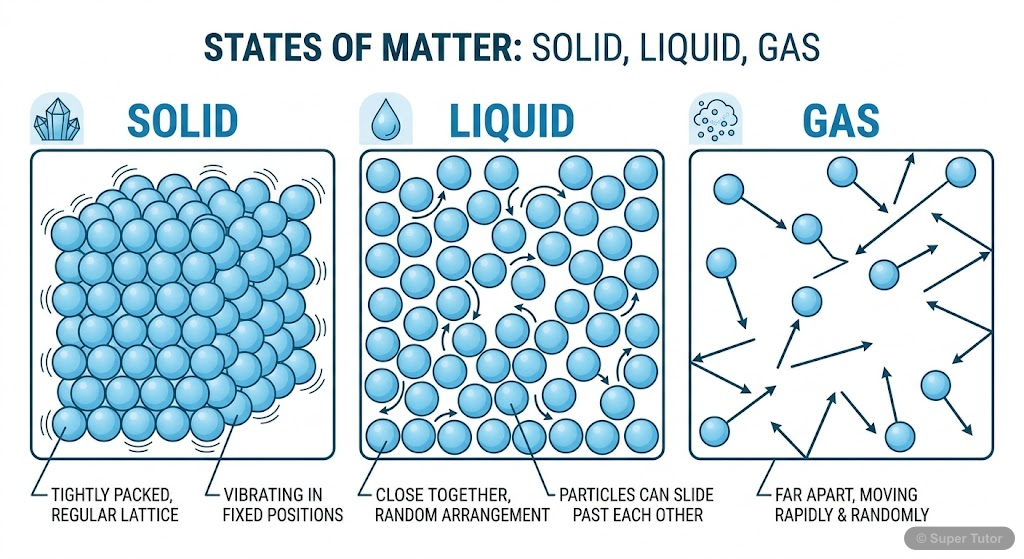
One of 12 illustrations for Study of Gas Laws in Super Tutor — alongside flashcards, concept maps and practice questions.
Key Topics to Revise
Nature and Behaviour of Gases
- Gas is the state of matter in which inter-particle attraction is weak and inter-particle space is large, so particles move freely and randomly.
- Gases occupy the entire space of the vessel and take its shape.
- All gases show uniform behaviour under similar conditions of temperature and pressure, no matter what their chemical nature, colour, or odour is.
Pressure, Volume, and Gas Pressure Units
- Pressure of a gas is the force exerted by the gas per unit area on the walls of the container.
- Standard pressure of one atmosphere is defined as the pressure exerted by 76 cm of mercury at 0°C and standard gravity of 9.8 m s-2, with mercury density 13.5951 g cm-3.
- The SI unit of pressure is Pascal.
Boyle's Law
- Robert Boyle systematically studied the pressure-volume relationship of gases.
- Boyle's law states that the volume of a given mass of a dry gas is inversely proportional to its pressure at constant temperature.
- For a fixed mass of gas at constant temperature, if pressure increases, volume decreases.
Charles's Law
- Jacques Charles studied the temperature-volume relationship of gases, and Joseph Gay-Lussac further extended this work.
- Charles's law states that, at constant pressure, the volume of a given mass of a dry gas increases or decreases by 1/273 of its volume at 0°C for each 1°C rise or fall in temperature.
- If temperature is doubled at constant pressure, volume doubles.
Get complete notes with diagrams and examples
Full NotesKey Concepts
Frequently Asked Questions
What are the important topics in Study of Gas Laws for ICSE Class 9 Chemistry?
How should I revise Study of Gas Laws for Class 9 exams?
Sources & Official References
Content is aligned to the official syllabus. Refer to the board website for the latest curriculum.
More resources for Study of Gas Laws
Practice Quiz
Test yourself with a quick quiz
Important Questions
Exam-style questions with answers
Formula Sheet
The chapter's formulas in one place
Chapter Summary
Understand the chapter at a glance
Concept Maps
See how topics connect
Study Plan
Step-by-step plan for this chapter
Flashcards
Quick-fire cards for active recall
Syllabus
What topics to cover
For serious students
Get the full Study of Gas Laws chapter — start free.
Quizzes, flashcards, an AI doubt solver and a study plan for ICSE Class 9 Chemistry. Free to start, no card needed.