Synthesis of Sentences — Important Questions
ICSE · Class 9 · English Language - Archer
44 important questions from Synthesis of Sentences for ICSE Class 9 English Language - Archer, with answers. Includes multiple choice, multiple correct.
Interactive on Super Tutor
Studying Synthesis of Sentences? Get the full interactive chapter.
Quizzes, flashcards, AI doubt-solver and a step-by-step study plan — built for important questions and more.
Free trial, no card needed.
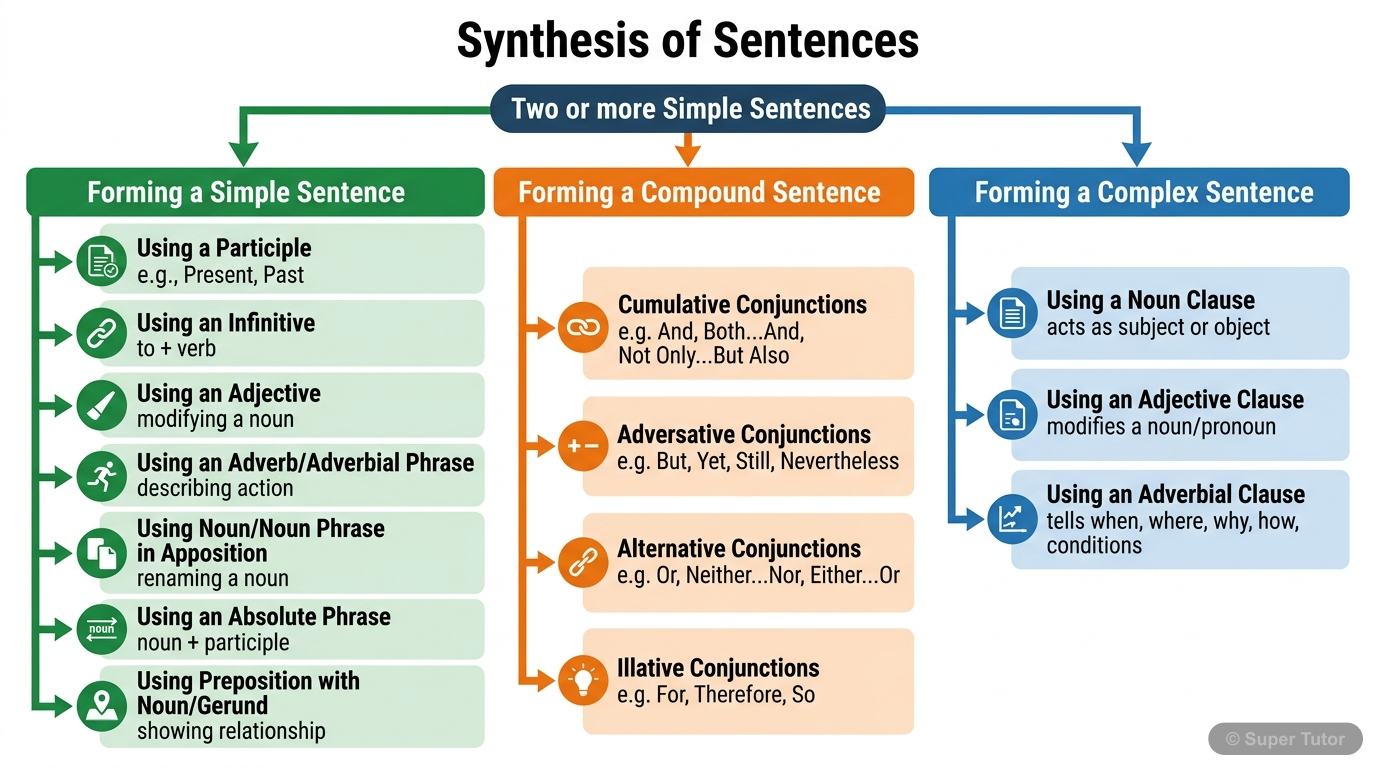
One of 2 illustrations for Synthesis of Sentences in Super Tutor — alongside flashcards, concept maps and practice questions.
Important Questions from Synthesis of Sentences
What type of clause begins with words like 'who', 'which', 'where'?
Show answer
Adjective clause
Adjective clauses begin with relative pronouns like 'who', 'which', 'where', 'that', 'whom', 'whose'. These clauses describe or give more information about nouns, just like adjectives do. For example: 'The house where I grew up' - 'where I grew up' describes 'house'. Noun clauses begin with words like 'that', 'what', 'how'. Adverb clauses begin with words like 'because', 'when', 'if'.
Which word correctly completes the synthesis: 'We have to go to the market _____ buy vegetables'?
Show answer
to
This is an example of synthesis using an infinitive. 'To buy' is an infinitive (to + base form of verb) that shows purpose. The original sentences were 'We have to go to the market' and 'We will buy vegetables'. The infinitive 'to buy' efficiently combines these ideas. 'For', 'and', and 'because' would create different sentence structures but not the intended infinitive construction.
What is the synthesis method in: 'Mumbai, my favourite city, is very crowded'?
Show answer
Using a noun in apposition
Apposition means placing a noun or noun phrase next to another noun to explain or identify it. 'My favourite city' is in apposition to 'Mumbai' - both refer to the same thing. The original sentences were 'Mumbai is my favourite city' and 'It is very crowded'. The phrase 'my favourite city' is set off by commas and renames Mumbai. This is not an adjective, adverb, or participle construction.
Which conjunction shows reason or cause in compound sentences?
Show answer
for
'For' is used as a coordinating conjunction to show reason or cause in compound sentences. Example: 'Rana went upstairs for it was his bedtime' - 'for' explains why he went upstairs. 'But' shows contrast, 'or' shows choice/alternative, and 'yet' shows contrast despite expectation. Only 'for' indicates the reason behind an action.
+40 more questions on Synthesis of Sentences (ICSE Class 9 English Language - Archer)
Practise AllFrequently Asked Questions
What are the important topics in Synthesis of Sentences for ICSE Class 9 English Language - Archer?
How many important questions are there in Synthesis of Sentences?
Sources & Official References
Content is aligned to the official syllabus. Refer to the board website for the latest curriculum.
More resources for Synthesis of Sentences
For serious students
Get the full Synthesis of Sentences chapter — start free.
Quizzes, flashcards, an AI doubt solver and a study plan for ICSE Class 9 English Language - Archer. Free to start, no card needed.