Direct and Indirect Speech — Important Questions
ICSE · Class 9 · English Language - Archer
45 important questions from Direct and Indirect Speech for ICSE Class 9 English Language - Archer, with answers.
Interactive on Super Tutor
Studying Direct and Indirect Speech? Get the full interactive chapter.
Quizzes, flashcards, AI doubt-solver and a step-by-step study plan — built for important questions and more.
Free trial, no card needed.
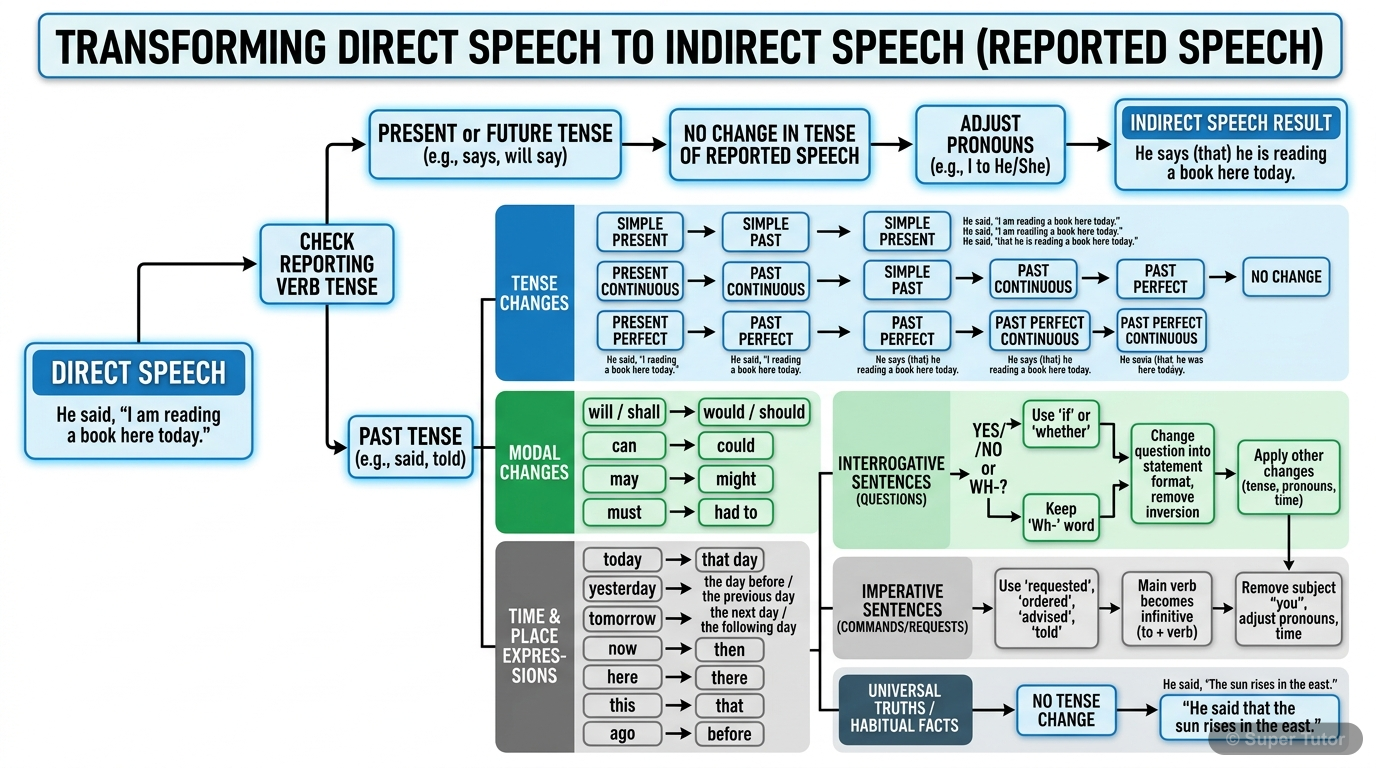
One of 2 illustrations for Direct and Indirect Speech in Super Tutor — alongside flashcards, concept maps and practice questions.
Important Questions from Direct and Indirect Speech
Convert: 'Can you help me?' she asked.
Show answer
She asked if I could help her.
For yes/no questions in indirect speech: 1) Use 'if' or 'whether' to introduce the question, 2) Change 'can' to 'could' following backshift rules, 3) Change pronouns: 'you' becomes 'I', 'me' becomes 'her'. Option A keeps 'can' incorrectly, Option C doesn't use proper indirect structure, Option D uses wrong reporting verb and structure.
What does 'here' become in indirect speech?
Show answer
there
Place expressions change perspective in indirect speech. 'Here' refers to the speaker's current location in direct speech, but when reported later, it becomes 'there' from the reporter's perspective. Similarly, 'this' becomes 'that', and 'these' become 'those'. Options A, C, and D don't follow the standard conversion rules for place adverbs.
Convert: The teacher said, 'The sun rises in the east.'
Show answer
The teacher said that the sun rises in the east.
Universal truths and scientific facts remain in simple present tense even in indirect speech, regardless of the reporting verb tense. 'The sun rises in the east' is a universal truth, so it stays in present tense. Options A, C, and D incorrectly change the tense when the rule states that universal truths don't follow the backshift rule.
Which reporting verb is suitable for: 'Please help me,' he said.
Show answer
requested
The word 'Please' indicates politeness and a request, not a command or order. 'Requested' is the appropriate reporting verb for polite requests. 'Ordered' and 'commanded' suggest authority and force, which don't match the polite tone. 'Declared' is used for statements, not requests. The reporting verb should match the tone and intent of the original speech.
+41 more questions on Direct and Indirect Speech (ICSE Class 9 English Language - Archer)
Practise AllFrequently Asked Questions
What are the important topics in Direct and Indirect Speech for ICSE Class 9 English Language - Archer?
How many important questions are there in Direct and Indirect Speech?
Sources & Official References
Content is aligned to the official syllabus. Refer to the board website for the latest curriculum.
More resources for Direct and Indirect Speech
Practice Quiz
Test yourself with a quick quiz
Revision Notes
Key points for last-minute revision
Formula Sheet
The chapter's formulas in one place
Chapter Summary
Understand the chapter at a glance
Concept Maps
See how topics connect
Study Plan
Step-by-step plan for this chapter
Flashcards
Quick-fire cards for active recall
Syllabus
What topics to cover
For serious students
Get the full Direct and Indirect Speech chapter — start free.
Quizzes, flashcards, an AI doubt solver and a study plan for ICSE Class 9 English Language - Archer. Free to start, no card needed.