Transformation of Sentences — Important Questions
ICSE · Class 9 · English Language - Archer
43 important questions from Transformation of Sentences for ICSE Class 9 English Language - Archer, with answers.
Interactive on Super Tutor
Studying Transformation of Sentences? Get the full interactive chapter.
Quizzes, flashcards, AI doubt-solver and a step-by-step study plan — built for important questions and more.
Free trial, no card needed.
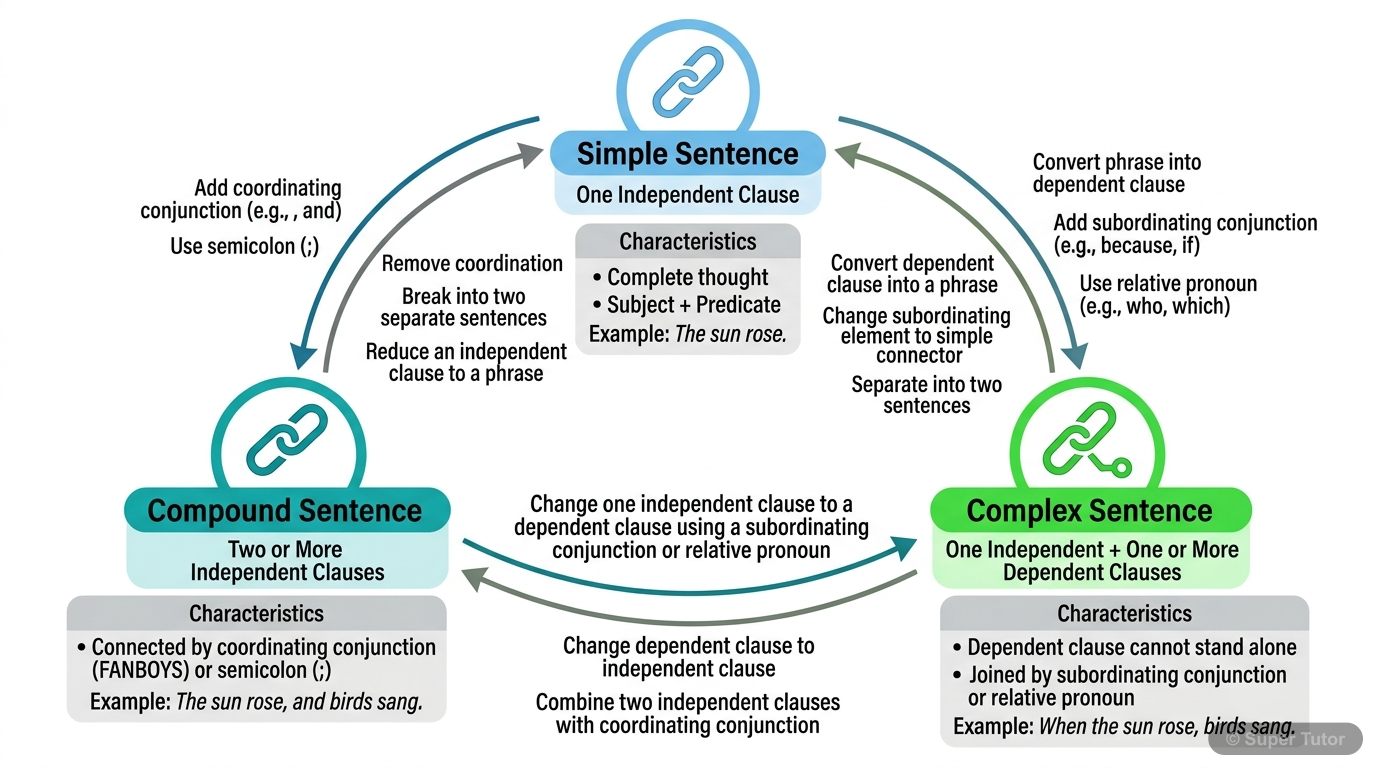
Learn better with visuals Super Tutor pairs illustrations like this with notes and quizzes for Transformation of Sentences.
Important Questions from Transformation of Sentences
Convert this complex sentence to simple: 'When the bell rang, the students rushed out.'
Show answer
At the ringing of the bell, the students rushed out.
Step 1: Identify the complex structure - The sentence has a dependent clause 'When the bell rang' and main clause 'the students rushed out'. Step 2: Convert dependent clause to phrase - Change 'When the bell rang' to the prepositional phrase 'At the ringing of the bell'. Step 3: Maintain meaning - The time relationship is preserved through the preposition 'at'. Step 4: Check other options - Options A and D create compound sentences, Option C remains complex. Step 5: Verify simple structure - The correct answer has one main clause with a prepositional phrase.
Which type of clause is: 'whoever comes first'?
Show answer
Noun clause
Step 1: Identify the function - The clause 'whoever comes first' acts as a noun in the sentence. Step 2: Check the beginning word - 'Whoever' is a typical noun clause starter, along with 'what', 'that', 'where', etc. Step 3: Test substitution - You can replace this clause with a noun like 'the person' or 'someone'. Step 4: Eliminate other options - Adjective clauses modify nouns, adverb clauses modify verbs/adjectives, independent clauses stand alone. Step 5: Confirm noun function - Noun clauses can serve as subjects, objects, or complements in sentences.
What conjunction would you use to transform 'He is rich but unhappy' into a complex sentence?
Show answer
although
Step 1: Identify the original relationship - 'But' shows contrast between being rich and being unhappy. Step 2: Choose subordinating conjunction - 'Although' is a subordinating conjunction that expresses the same contrasting relationship. Step 3: Create complex structure - 'Although he is rich, he is unhappy' has one dependent and one independent clause. Step 4: Check other options - 'And', 'or', and 'so' are coordinating conjunctions that maintain compound structure. Step 5: Verify transformation - The subordinating conjunction creates the required complex sentence structure.
Identify the sentence type: 'The book that I bought yesterday is very interesting.'
Show answer
Complex sentence
Step 1: Identify the main clause - 'The book is very interesting' is the independent clause. Step 2: Find the dependent clause - 'that I bought yesterday' is a dependent clause modifying 'book'. Step 3: Recognize the subordinating word - 'That' introduces the dependent adjective clause. Step 4: Apply definition - A complex sentence has one independent clause and one or more dependent clauses. Step 5: Eliminate other options - Simple sentences have one clause, compound sentences have multiple independent clauses, compound-complex has both features.
+39 more questions on Transformation of Sentences (ICSE Class 9 English Language - Archer)
Practise AllFrequently Asked Questions
What are the important topics in Transformation of Sentences for ICSE Class 9 English Language - Archer?
How many important questions are there in Transformation of Sentences?
Sources & Official References
Content is aligned to the official syllabus. Refer to the board website for the latest curriculum.
More resources for Transformation of Sentences
For serious students
Get the full Transformation of Sentences chapter — start free.
Quizzes, flashcards, an AI doubt solver and a study plan for ICSE Class 9 English Language - Archer. Free to start, no card needed.