Simultaneous (Linear) Equations — Practice Quiz
ICSE · Class 9 · Mathematics
Try a 4-question quiz on Simultaneous (Linear) Equations for ICSE Class 9 Mathematics: tap an answer to check it and see why.
Interactive on Super Tutor
Studying Simultaneous (Linear) Equations? Get the full interactive chapter.
Quizzes, flashcards, AI doubt-solver and a step-by-step study plan — built for practice quiz and more.
Free trial, no card needed.
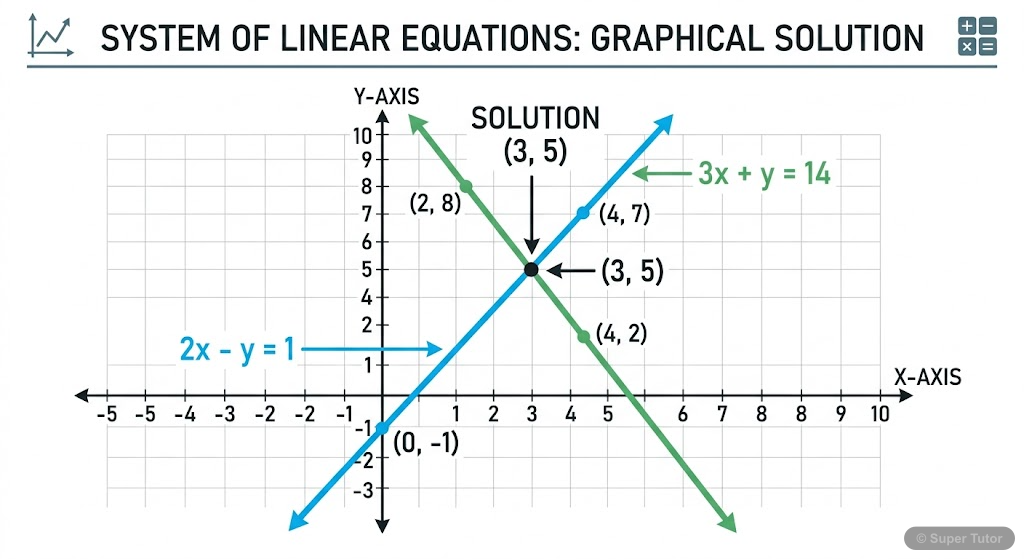
One of 6 illustrations for Simultaneous (Linear) Equations in Super Tutor — alongside flashcards, concept maps and practice questions.
Quick Quiz: Simultaneous (Linear) Equations
0/4Tap an answer to check it instantly. No sign-up needed for these 4.
Solve the system: x + y = 8 and x - y = 2. What is the value of x?
Solve: 2x + 3y = 13 and 4x + 6y = 26. What can you conclude about this system?
Solve using cross-multiplication: 2x + 3y - 12 = 0 and x - 2y + 1 = 0. What is y?
If 3/x + 4/y = 2 and 9/x - 8/y = 1, find x.
Sample Questions
Using substitution method, solve: y = 2x and x + y = 9. Find the values of x and y.
Show answer
x = 3, y = 6
Substitute y = 2x into x + y = 9: x + 2x = 9 → 3x = 9 → x = 3. Then y = 2(3) = 6. Check: 3 + 6 = 9 ✓
The sum of two numbers is 20 and their difference is 8. Which of the following are correct?
Show answer
The larger number is 14, The smaller number is 6, The product of numbers is 84
Let numbers be x and y where x > y. Then x + y = 20 and x - y = 8. Adding: 2x = 28 → x = 14. Subtracting: 2y = 12 → y = 6. Product = 14 × 6 = 84.
In a fraction, the numerator is 3 less than the denominator. If 2 is added to both numerator and denominator, the fraction becomes 3/4. Find the original denominator.
Show answer
10
Let denominator = y, then numerator = y - 3. Original fraction = (y-3)/y. After adding 2: (y-3+2)/(y+2) = (y-1)/(y+2) = 3/4. Cross multiply: 4(y-1) = 3(y+2) → 4y - 4 = 3y + 6 → y = 10.
True or False: The system x + y = 5 and 2x + 2y = 11 has no solution.
Show answer
True
The first equation gives x + y = 5. The second equation 2x + 2y = 11 can be written as 2(x + y) = 11, or x + y = 5.5. Since x + y cannot be both 5 and 5.5 simultaneously, the system has no solution.
+21 more questions on Simultaneous (Linear) Equations (ICSE Class 9 Mathematics)
Practise AllFrequently Asked Questions
What are the important topics in Simultaneous (Linear) Equations for ICSE Class 9 Mathematics?
How many practice questions are there for Simultaneous (Linear) Equations?
Sources & Official References
Content is aligned to the official syllabus. Refer to the board website for the latest curriculum.
More resources for Simultaneous (Linear) Equations
Important Questions
Exam-style questions with answers
Revision Notes
Key points for last-minute revision
Formula Sheet
The chapter's formulas in one place
Chapter Summary
Understand the chapter at a glance
Concept Maps
See how topics connect
Study Plan
Step-by-step plan for this chapter
Flashcards
Quick-fire cards for active recall
Syllabus
What topics to cover
For serious students
Get the full Simultaneous (Linear) Equations chapter — start free.
Quizzes, flashcards, an AI doubt solver and a study plan for ICSE Class 9 Mathematics. Free to start, no card needed.