Triangles — Practice Quiz
ICSE · Class 9 · Mathematics
Try a 4-question quiz on Triangles for ICSE Class 9 Mathematics: tap an answer to check it and see why. 40 questions in the full chapter test.
Interactive on Super Tutor
Studying Triangles? Get the full interactive chapter.
Quizzes, flashcards, AI doubt-solver and a step-by-step study plan — built for practice quiz and more.
Free trial, no card needed.
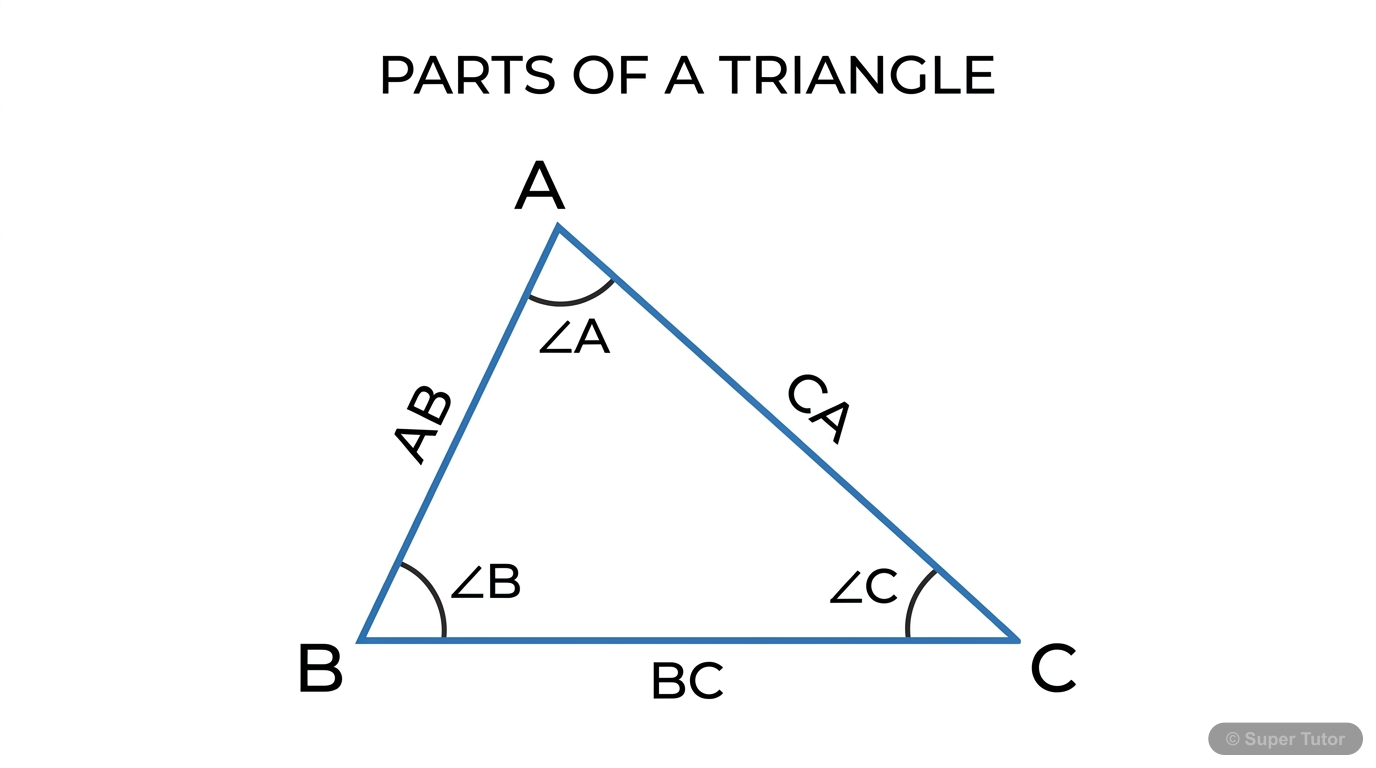
One of 13 illustrations for Triangles in Super Tutor — alongside flashcards, concept maps and practice questions.
Quick Quiz: Triangles
0/4Tap an answer to check it instantly. No sign-up needed for these 4.
Two triangles ABC and DEF have AB = DE = 6 cm, BC = EF = 4 cm, and ∠B = ∠E = 60°. By which congruence criterion are they congruent?
In a triangle, the sum of any two sides must be:
If in triangle PQR, ∠P = 70° and ∠Q = 50°, find ∠R:
In an isosceles triangle ABC with AB = AC, if ∠A = 40°, find ∠B:
Sample Questions
Which of the following are valid congruence criteria for triangles? (Select all that apply)
Show answer
SSS, SAS, ASA, RHS
Valid congruence criteria are: SSS (Side-Side-Side), SAS (Side-Angle-Side), ASA (Angle-Side-Angle), AAS (Angle-Angle-Side), and RHS (Right angle-Hypotenuse-Side). AAA only ensures similarity, not congruence. SSA is not a valid criterion as it can lead to ambiguous cases.
The exterior angle of a triangle is 120°. If one of the interior opposite angles is 50°, find the other interior opposite angle:
Show answer
70°
By the exterior angle theorem, an exterior angle equals the sum of the two non-adjacent interior angles. So: Exterior angle = Sum of two opposite interior angles. 120° = 50° + other angle. Therefore, other angle = 120° - 50° = 70°.
If triangle ABC ≅ triangle PQR, and AB = 5 cm, BC = 7 cm, which of the following must be true?
Show answer
PQ = 5 cm, QR = 7 cm, ∠A = ∠P, Area of ABC = Area of PQR
When triangles are congruent (ABC ≅ PQR), corresponding parts are equal: AB = PQ = 5 cm, BC = QR = 7 cm, ∠A = ∠P, ∠B = ∠Q (not ∠R), ∠C = ∠R. Congruent triangles have equal areas.
A triangle can have at most how many obtuse angles?
Show answer
1
A triangle can have at most one obtuse angle. If a triangle had two obtuse angles, their sum would exceed 180° (since each obtuse angle > 90°), but the sum of all three angles in a triangle must be exactly 180°. Therefore, maximum one obtuse angle is possible.
+36 more questions on Triangles (ICSE Class 9 Mathematics)
Practise AllFrequently Asked Questions
What are the important topics in Triangles for ICSE Class 9 Mathematics?
How many practice questions are there for Triangles?
Sources & Official References
Content is aligned to the official syllabus. Refer to the board website for the latest curriculum.
More resources for Triangles
Important Questions
Exam-style questions with answers
Revision Notes
Key points for last-minute revision
Formula Sheet
The chapter's formulas in one place
Chapter Summary
Understand the chapter at a glance
Concept Maps
See how topics connect
Study Plan
Step-by-step plan for this chapter
Flashcards
Quick-fire cards for active recall
Syllabus
What topics to cover
For serious students
Get the full Triangles chapter — start free.
Quizzes, flashcards, an AI doubt solver and a study plan for ICSE Class 9 Mathematics. Free to start, no card needed.