Construction of Polygons — Practice Quiz
ICSE · Class 9 · Mathematics
Try a 4-question quiz on Construction of Polygons for ICSE Class 9 Mathematics: tap an answer to check it and see why.
Interactive on Super Tutor
Studying Construction of Polygons? Get the full interactive chapter.
Quizzes, flashcards, AI doubt-solver and a step-by-step study plan — built for practice quiz and more.
Free trial, no card needed.
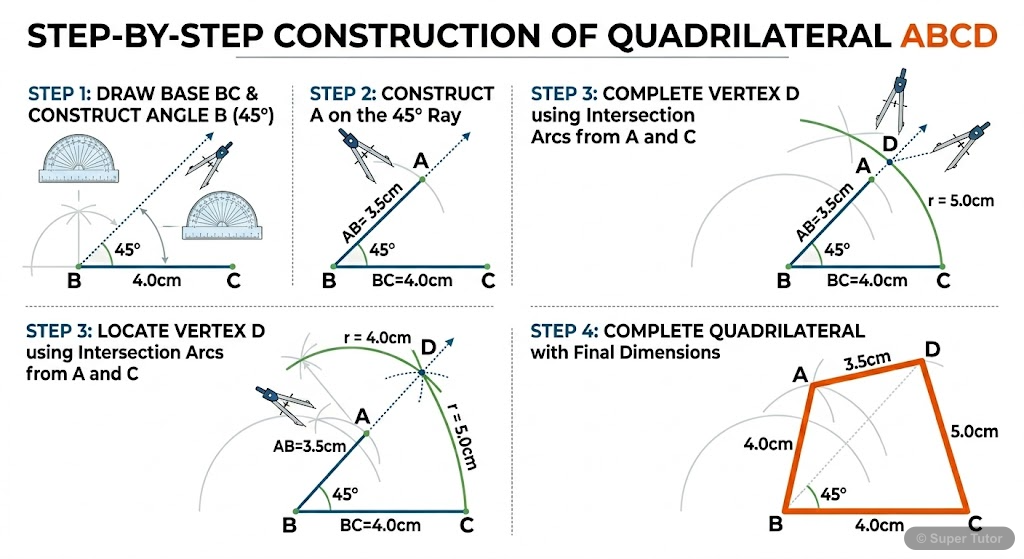
One of 17 illustrations for Construction of Polygons in Super Tutor — alongside flashcards, concept maps and practice questions.
Quick Quiz: Construction of Polygons
0/4Tap an answer to check it instantly. No sign-up needed for these 4.
How many measurements are required to construct a quadrilateral when four sides and one angle are given?
In constructing a rhombus with diagonals 6 cm and 4 cm, what is the distance from the center to each vertex?
What is the measure of each interior angle of a regular hexagon?
In a trapezium ABCD where AD || BC, if BC = 8 cm and the construction requires drawing BE = 5 cm, what is the length of AD?
Sample Questions
Which of the following are required to construct a parallelogram? (Select all correct options)
Show answer
Two consecutive sides and included angle, One side and both diagonals, Two diagonals and included angle, Two adjacent sides and height
Multiple methods exist for parallelogram construction: (1) Two consecutive sides + included angle, (2) One side + both diagonals, (3) Two diagonals + included angle, (4) Two adjacent sides + height. Four sides alone are insufficient as opposite sides are automatically equal in a parallelogram.
Which construction methods can be used for a regular hexagon? (Select all correct)
Show answer
Using interior angles of 120°, Using circumcircle with radius equal to side, Using central angles of 60°
Three methods exist: (1) Using 120° interior angles, (2) Circumcircle method where radius = side length, (3) Central angle method using 60° angles (360°/6). Ruler alone cannot construct accurate regular hexagon.
What is the central angle subtended by each side of a regular hexagon at its center?
Show answer
60°
For any regular polygon, central angle = 360°/n. For hexagon, n = 6, so central angle = 360°/6 = 60°. This is why the circumcircle construction method works using 60° angles.
True or False: A square can be constructed using the same method as a rhombus construction.
Show answer
True
A square is a special rhombus where all sides are equal and all angles are 90°. Since a square's diagonals are equal and bisect each other at right angles (like a rhombus), the same diagonal construction method applies.
+38 more questions on Construction of Polygons (ICSE Class 9 Mathematics)
Practise AllFrequently Asked Questions
What are the important topics in Construction of Polygons for ICSE Class 9 Mathematics?
How many practice questions are there for Construction of Polygons?
Sources & Official References
Content is aligned to the official syllabus. Refer to the board website for the latest curriculum.
More resources for Construction of Polygons
Important Questions
Exam-style questions with answers
Revision Notes
Key points for last-minute revision
Formula Sheet
The chapter's formulas in one place
Chapter Summary
Understand the chapter at a glance
Concept Maps
See how topics connect
Study Plan
Step-by-step plan for this chapter
Flashcards
Quick-fire cards for active recall
Syllabus
What topics to cover
For serious students
Get the full Construction of Polygons chapter — start free.
Quizzes, flashcards, an AI doubt solver and a study plan for ICSE Class 9 Mathematics. Free to start, no card needed.