Motion in one Dimension — Practice Quiz
ICSE · Class 9 · Physics
Try a 4-question quiz on Motion in one Dimension for ICSE Class 9 Physics: tap an answer to check it and see why. 45 questions in the full chapter test.
Interactive on Super Tutor
Studying Motion in one Dimension? Get the full interactive chapter.
Quizzes, flashcards, AI doubt-solver and a step-by-step study plan — built for practice quiz and more.
Free trial, no card needed.
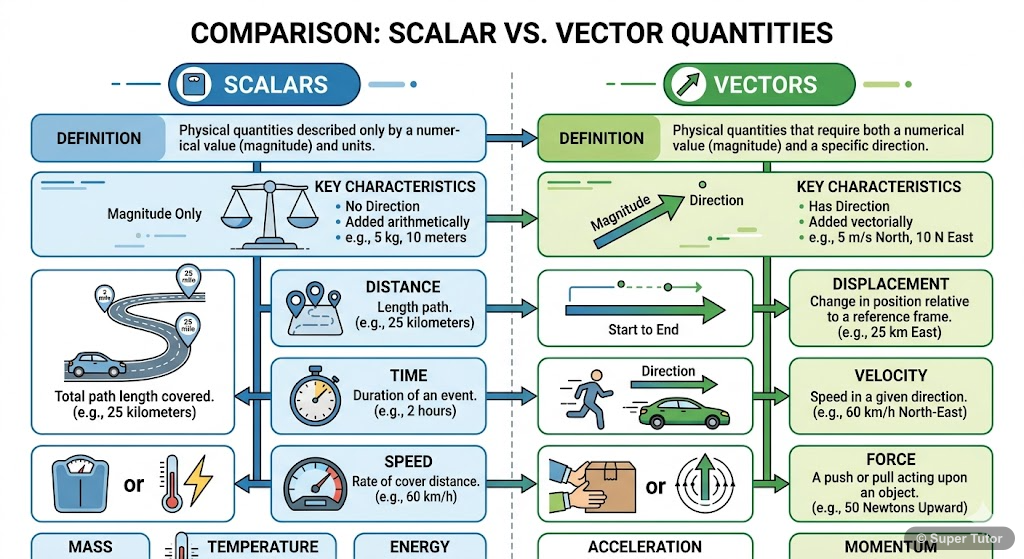
Learn better with visuals Super Tutor pairs illustrations like this with notes and quizzes for Motion in one Dimension.
Quick Quiz: Motion in one Dimension
0/4Tap an answer to check it instantly. No sign-up needed for these 4.
Which of the following is a scalar quantity?
A body is said to be at rest when:
The SI unit of velocity is:
If a body moves 4 km east and then 3 km north, what is the magnitude of displacement?
Sample Questions
Which of the following are vector quantities? (Select all correct answers)
Show answer
Displacement, Velocity, Acceleration
Displacement, velocity, and acceleration are vector quantities as they have both magnitude and direction. Speed, distance, and time are scalar quantities with only magnitude.
Speed is 36 km/h. Convert this to m/s:
Show answer
10 m/s
To convert km/h to m/s, multiply by 5/18. So 36 km/h = 36 × (5/18) = 10 m/s. Alternatively, 36 km/h = (36 × 1000)/(60 × 60) = 36000/3600 = 10 m/s.
A car travels 200 km in 4 hours. What is its average speed?
Show answer
50 km/h
Average speed = Total distance / Total time = 200 km / 4 h = 50 km/h. This is the basic formula for calculating average speed.
The slope of distance-time graph gives:
Show answer
Speed
The slope of distance-time graph represents the rate of change of distance with time, which is speed. Speed = distance/time, so slope = rise/run = distance/time = speed.
+41 more questions on Motion in one Dimension (ICSE Class 9 Physics)
Practise AllFrequently Asked Questions
What are the important topics in Motion in one Dimension for ICSE Class 9 Physics?
How many practice questions are there for Motion in one Dimension?
Sources & Official References
Content is aligned to the official syllabus. Refer to the board website for the latest curriculum.
More resources for Motion in one Dimension
Important Questions
Exam-style questions with answers
Revision Notes
Key points for last-minute revision
Formula Sheet
The chapter's formulas in one place
Chapter Summary
Understand the chapter at a glance
Concept Maps
See how topics connect
Study Plan
Step-by-step plan for this chapter
Flashcards
Quick-fire cards for active recall
Syllabus
What topics to cover
For serious students
Get the full Motion in one Dimension chapter — start free.
Quizzes, flashcards, an AI doubt solver and a study plan for ICSE Class 9 Physics. Free to start, no card needed.