Motion in one Dimension — Flashcards
ICSE · Class 9 · Physics
34 flashcards for Motion in one Dimension (ICSE Class 9 Physics) to test yourself on key terms and facts. Sample: "What is a scalar quantity?"
Interactive on Super Tutor
Studying Motion in one Dimension? Get the full interactive chapter.
Quizzes, flashcards, AI doubt-solver and a step-by-step study plan — built for flashcards and more.
Free trial, no card needed.
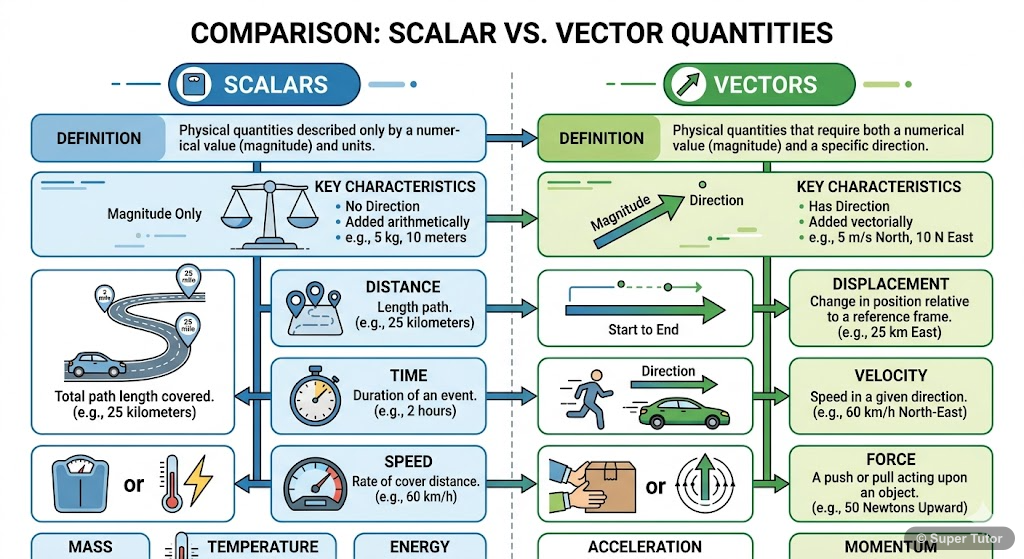
Learn better with visuals Super Tutor pairs illustrations like this with notes and quizzes for Motion in one Dimension.
What is a scalar quantity?
Answer
A scalar quantity is a physical quantity expressed only by magnitude. It needs a unit and a numerical value, but no direction. Examples: mass, length, time, distance, speed, work, energy.
What is a vector quantity?
Answer
A vector quantity needs magnitude and direction to be complete. It is expressed using a unit, numerical value, and direction. Examples: displacement, velocity, acceleration, force, momentum, weight.
A body moves 4 km east and then 3 km north. Find the distance travelled and the displacement.
Answer
Given: 4 km east, then 3 km north Distance = 4 km + 3 km = 7 km Displacement forms a right triangle. Displacement = sqrt((4 km)^2 + (3 km)^2) Displacement = sqrt(16 + 9) km = sqrt(25) km = 5 km Answer…
Why is displacement never greater than distance?
Answer
Distance is the total path length travelled, while displacement is the shortest straight-line distance from initial position to final position. A straight line is always the shortest path between two …
A body travels 120 m in 2 s. Find its speed.
Answer
Given: Distance S = 120 m, Time t = 2 s Formula: v = S / t Step 1: v = 120 m / 2 s Step 2: v = 60 m/s Answer: 60 m/s…
State the formula for speed and its SI unit.
Answer
Formula: v = S / t Here, v = speed, S = distance, t = time SI unit of speed = m/s CGS unit of speed = cm/s…
A body moves with uniform speed 20 m/s for 5 minutes. Find the distance travelled.
Answer
Given: speed v = 20 m/s, time t = 5 min = 300 s Formula: S = v t Step 1: S = 20 m/s × 300 s Step 2: S = 6000 m Step 3: S = 6 km Answer: 6000 m or 6 km…
What is uniform speed?
Answer
A body is said to be moving with uniform speed if it covers equal distances in equal intervals of time throughout its motion. A ball on a frictionless plane surface is an example.
+26 more flashcards
Practise AllFrequently Asked Questions
What are the important topics in Motion in one Dimension for ICSE Class 9 Physics?
How many flashcards are available for Motion in one Dimension?
How should I revise Motion in one Dimension for Class 9 exams?
Sources & Official References
Content is aligned to the official syllabus. Refer to the board website for the latest curriculum.
More resources for Motion in one Dimension
Practice Quiz
Test yourself with a quick quiz
Important Questions
Exam-style questions with answers
Revision Notes
Key points for last-minute revision
Formula Sheet
The chapter's formulas in one place
Chapter Summary
Understand the chapter at a glance
Concept Maps
See how topics connect
Study Plan
Step-by-step plan for this chapter
Syllabus
What topics to cover
For serious students
Get the full Motion in one Dimension chapter — start free.
Quizzes, flashcards, an AI doubt solver and a study plan for ICSE Class 9 Physics. Free to start, no card needed.