Laws of Motion — Practice Quiz
ICSE · Class 9 · Physics
Try a 4-question quiz on Laws of Motion for ICSE Class 9 Physics: tap an answer to check it and see why. 43 questions in the full chapter test.
Interactive on Super Tutor
Studying Laws of Motion? Get the full interactive chapter.
Quizzes, flashcards, AI doubt-solver and a step-by-step study plan — built for practice quiz and more.
Free trial, no card needed.
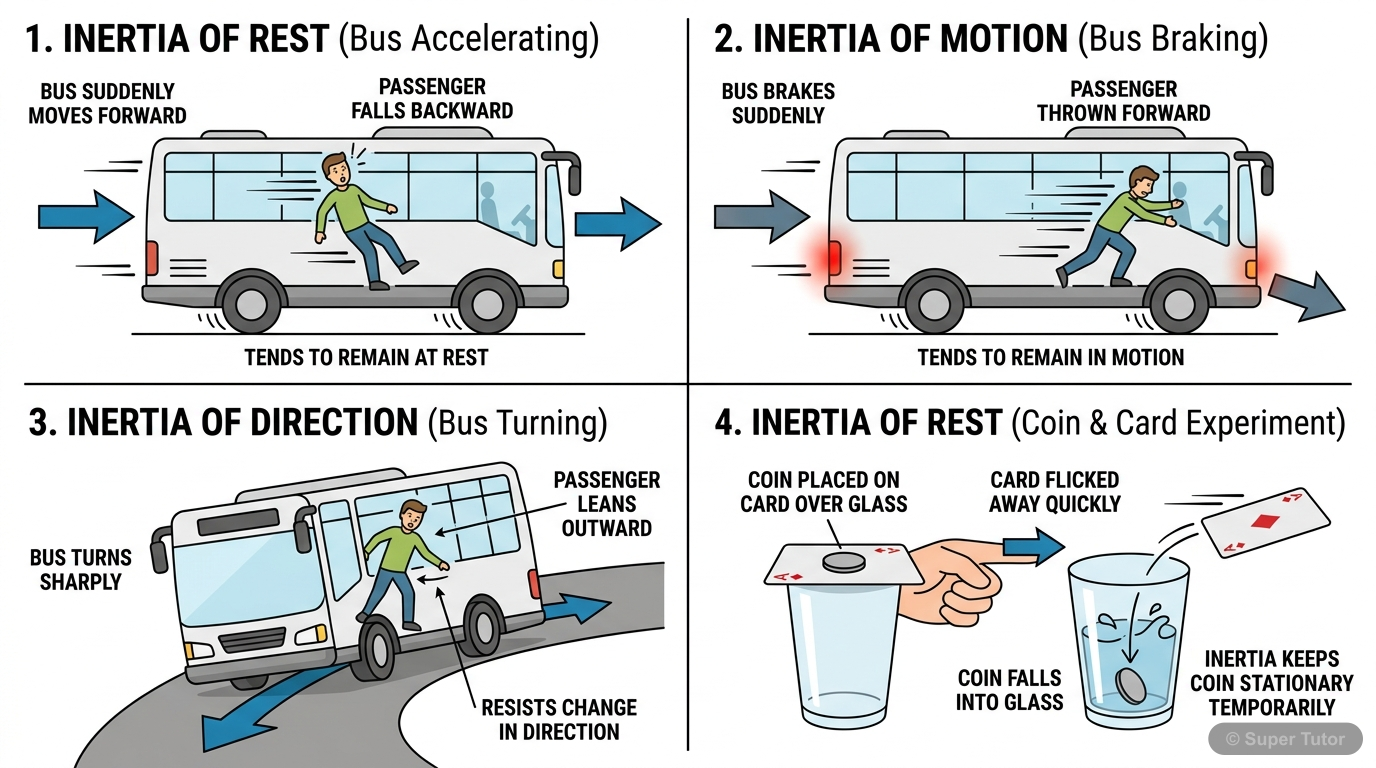
One of 25 illustrations for Laws of Motion in Super Tutor — alongside flashcards, concept maps and practice questions.
Quick Quiz: Laws of Motion
0/4Tap an answer to check it instantly. No sign-up needed for these 4.
Which of the following is an example of a contact force?
According to Newton's first law of motion, a body at rest will:
The property of a body to resist change in its state of motion is called:
The SI unit of force is:
Sample Questions
Which of the following are examples of non-contact forces?
Show answer
Gravitational force, Magnetic force, Electrostatic force
Non-contact forces act at a distance without physical contact. Gravitational, magnetic, and electrostatic forces are non-contact forces. Tension and normal forces require physical contact.
Linear momentum is defined as:
Show answer
Mass × Velocity
Linear momentum is defined as the product of mass and velocity (p = mv). It is a vector quantity in the direction of motion.
Newton's second law of motion is mathematically expressed as:
Show answer
F = ma
Newton's second law states that force is equal to mass times acceleration (F = ma). This gives us the quantitative relationship between force, mass, and acceleration.
Which of the following statements about action and reaction forces are correct?
Show answer
They are equal in magnitude, They are opposite in direction, They act simultaneously
According to Newton's third law, action and reaction forces are equal in magnitude, opposite in direction, and act simultaneously on different bodies. They cannot cancel each other as they act on different bodies.
+39 more questions on Laws of Motion (ICSE Class 9 Physics)
Practise AllFrequently Asked Questions
What are the important topics in Laws of Motion for ICSE Class 9 Physics?
How many practice questions are there for Laws of Motion?
Sources & Official References
Content is aligned to the official syllabus. Refer to the board website for the latest curriculum.
More resources for Laws of Motion
Important Questions
Exam-style questions with answers
Revision Notes
Key points for last-minute revision
Formula Sheet
The chapter's formulas in one place
Chapter Summary
Understand the chapter at a glance
Concept Maps
See how topics connect
Study Plan
Step-by-step plan for this chapter
Flashcards
Quick-fire cards for active recall
Syllabus
What topics to cover
For serious students
Get the full Laws of Motion chapter — start free.
Quizzes, flashcards, an AI doubt solver and a study plan for ICSE Class 9 Physics. Free to start, no card needed.