Propagation of Sound waves — Practice Quiz
ICSE · Class 9 · Physics
Try a 4-question quiz on Propagation of Sound waves for ICSE Class 9 Physics: tap an answer to check it and see why. 40 questions in the full chapter test.
Interactive on Super Tutor
Studying Propagation of Sound waves? Get the full interactive chapter.
Quizzes, flashcards, AI doubt-solver and a step-by-step study plan — built for practice quiz and more.
Free trial, no card needed.
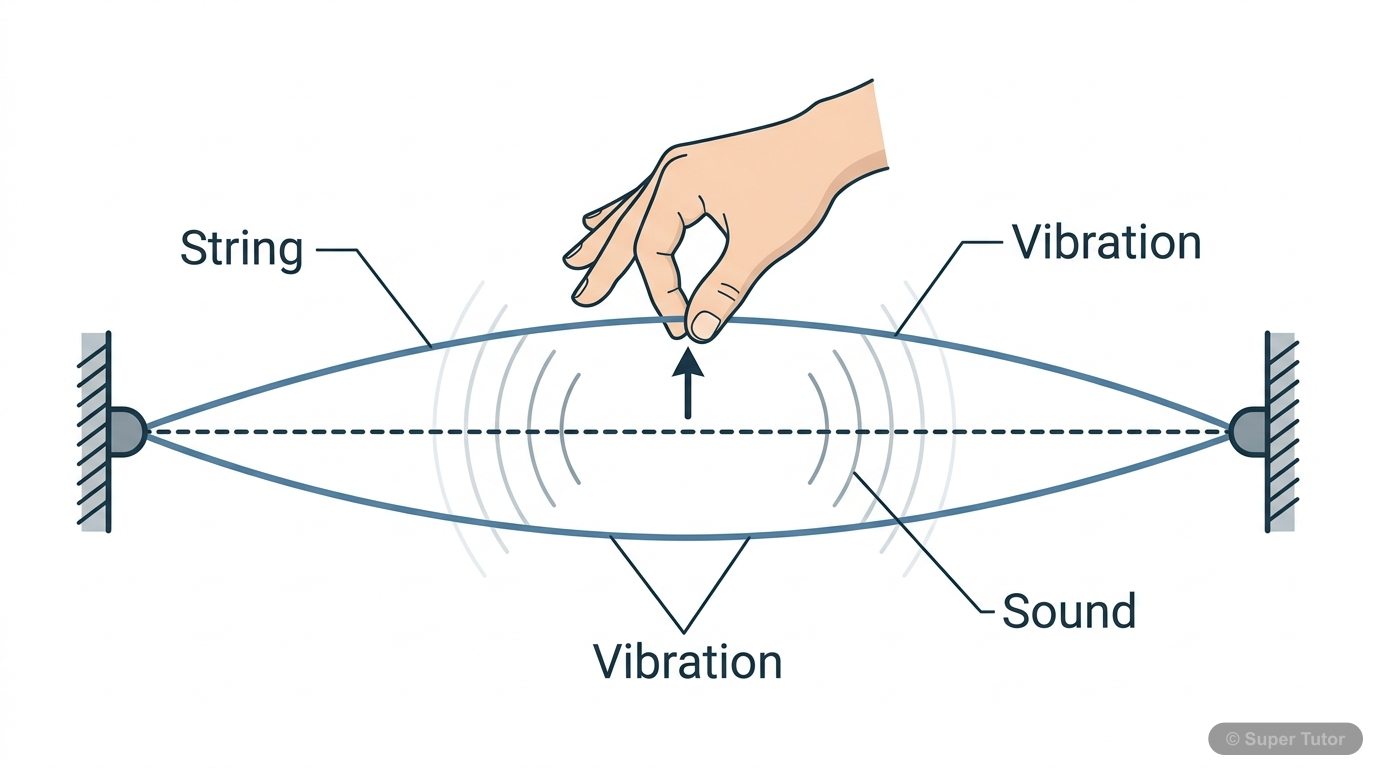
Learn better with visuals Super Tutor pairs illustrations like this with notes and quizzes for Propagation of Sound waves.
Quick Quiz: Propagation of Sound waves
0/4Tap an answer to check it instantly. No sign-up needed for these 4.
What causes the production of sound?
Sound waves require which of the following to travel?
The relationship between wave velocity (V), frequency (f), and wavelength (λ) is:
In which medium does sound travel fastest?
Sample Questions
What is the audible range of frequency for humans?
Show answer
20 Hz to 20,000 Hz
The human ear can detect sound frequencies from 20 Hz to 20,000 Hz (20 kHz). Sounds below 20 Hz are infrasonic, and sounds above 20 kHz are ultrasonic, both of which humans cannot hear.
Which factors affect the speed of sound in air?
Show answer
Temperature, Humidity, Wind direction
Temperature, humidity, and wind direction all affect sound speed in air. Higher temperature increases speed, humidity increases speed, and wind can increase or decrease speed depending on direction. Amplitude and pressure do not affect sound speed.
Ultrasonic waves have frequency:
Show answer
Above 20,000 Hz
Ultrasonic waves have frequencies above 20,000 Hz (20 kHz), which is beyond human hearing range. These waves are used in medical imaging, cleaning, and SONAR applications due to their high energy and directional properties.
Why do we see lightning before hearing thunder?
Show answer
Light travels much faster than sound
Light travels at 3×10⁸ m/s while sound travels at only 330 m/s in air. This huge difference means light reaches us almost instantly while sound takes time to travel the same distance, causing the delay between seeing lightning and hearing thunder.
+36 more questions on Propagation of Sound waves (ICSE Class 9 Physics)
Practise AllFrequently Asked Questions
What are the important topics in Propagation of Sound waves for ICSE Class 9 Physics?
How many practice questions are there for Propagation of Sound waves?
Sources & Official References
Content is aligned to the official syllabus. Refer to the board website for the latest curriculum.
More resources for Propagation of Sound waves
Important Questions
Exam-style questions with answers
Revision Notes
Key points for last-minute revision
Formula Sheet
The chapter's formulas in one place
Chapter Summary
Understand the chapter at a glance
Concept Maps
See how topics connect
Study Plan
Step-by-step plan for this chapter
Flashcards
Quick-fire cards for active recall
Syllabus
What topics to cover
For serious students
Get the full Propagation of Sound waves chapter — start free.
Quizzes, flashcards, an AI doubt solver and a study plan for ICSE Class 9 Physics. Free to start, no card needed.