How do Organisms Reproduce? — Chapter Summary
Madhya Pradesh Board · Class 10 · Science
Summary of How do Organisms Reproduce? for Madhya Pradesh Board Class 10 Science. Part of the Madhya Pradesh Board Class 10 Science syllabus.
Interactive on Super Tutor
Studying How do Organisms Reproduce?? Get the full interactive chapter.
Quizzes, flashcards, AI doubt-solver and a step-by-step study plan — built for chapter summary and more.
Free trial, no card needed.
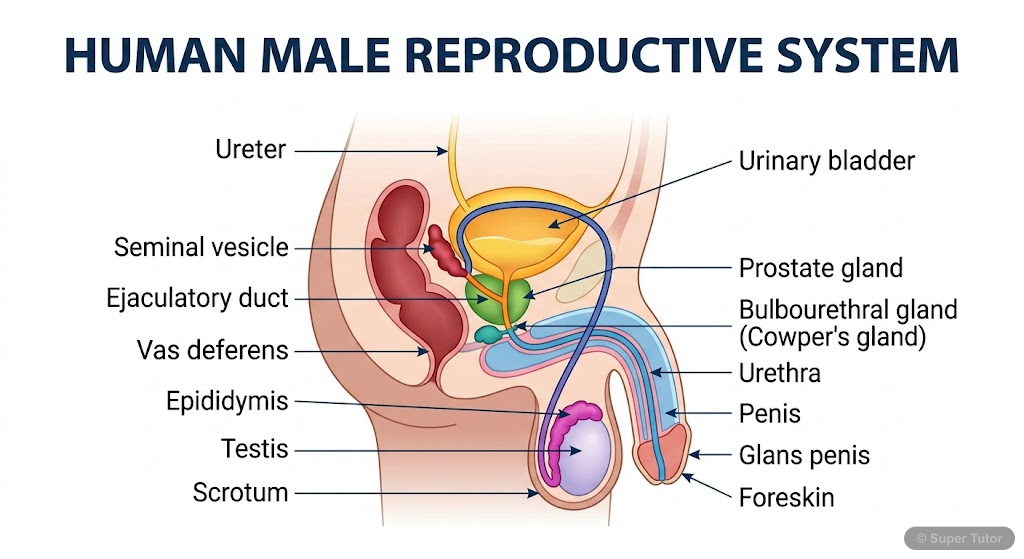
One of 20 illustrations for How do Organisms Reproduce? in Super Tutor — alongside flashcards, concept maps and practice questions.
Overview
Reproduction is the process by which living organisms produce new individuals of their own kind. It is not needed for the survival of a single organism, but it is essential for the continuation of a species. Reproduction keeps populations stable, passes genetic information from parents to offspring,
Key Concepts
Reproduction creates new individuals and maintains
Reproduction creates new individuals and maintains the continuity of a species. It also helps preserve body design through DNA copying. Small changes
Before a cell divides
Before a cell divides, its DNA is copied and additional cellular apparatus is formed. DNA copying is not absolutely perfect, so variations appear in t
Asexual reproduction creates a new generation
Asexual reproduction creates a new generation from a single individual. It includes fission, budding, fragmentation, vegetative propagation, and spore
In Amoeba
In Amoeba, binary fission can occur in any plane. In Leishmania, binary fission occurs in a definite orientation because of its whip-like structure. T
Plasmodium divides into many daughter cells
Plasmodium divides into many daughter cells simultaneously by multiple fission.
Learning Objectives
- Understand why reproduction is important for living organisms.
- Distinguish between asexual and sexual reproduction.
- Describe major asexual methods such as fission, fragmentation, regeneration, budding, vegetative propagation, and spore formation.
- Explain why variation occurs during reproduction and why it is useful.
- Describe sexual reproduction in flowering plants and human beings.
Frequently Asked Questions
What are the important topics in How do Organisms Reproduce? for Madhya Pradesh Board Class 10 Science?
How should I revise How do Organisms Reproduce? for the Madhya Pradesh Board Class 10 board exam?
Sources & Official References
Content is aligned to the official syllabus. Refer to the board website for the latest curriculum.
More resources for How do Organisms Reproduce?
Practice Quiz
Test yourself with a quick quiz
Important Questions
Exam-style questions with answers
Revision Notes
Key points for last-minute revision
Concept Maps
See how topics connect
Study Plan
Step-by-step plan for this chapter
Flashcards
Quick-fire cards for active recall
Syllabus
What topics to cover
NCERT Solutions
Every textbook question solved step by step
For serious students
Get the full How do Organisms Reproduce? chapter — start free.
Quizzes, flashcards, an AI doubt solver and a study plan for Madhya Pradesh Board Class 10 Science. Free to start, no card needed.