Electricity — Chapter Summary
Madhya Pradesh Board · Class 10 · Science
Summary of Electricity for Madhya Pradesh Board Class 10 Science. Part of the Madhya Pradesh Board Class 10 Science syllabus.
Interactive on Super Tutor
Studying Electricity? Get the full interactive chapter.
Quizzes, flashcards, AI doubt-solver and a step-by-step study plan — built for chapter summary and more.
Free trial, no card needed.
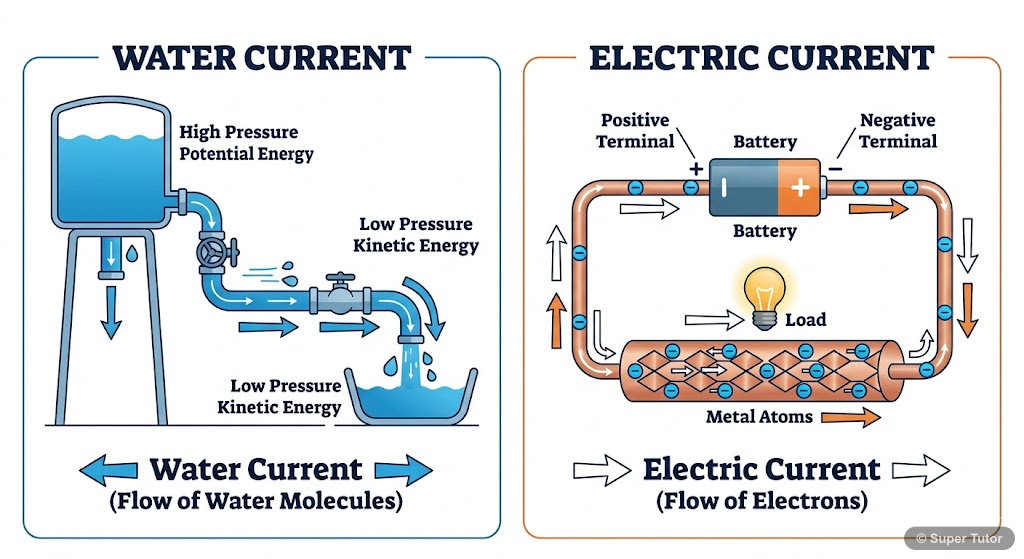
One of 19 illustrations for Electricity in Super Tutor — alongside flashcards, concept maps and practice questions.
Overview
Electricity is a controllable and convenient form of energy used in homes, schools, hospitals, and industries. It involves the flow of electric charge through a conductor, usually electrons in a metallic wire. The chapter explains how current flows in a circuit, how potential difference drives curre
Key Concepts
Electric current is the rate
Electric current is the rate of flow of electric charge through a conductor. It is given by I = Q/t, where I is current, Q is charge, and t is time. T
A continuous and closed path through
A continuous and closed path through which current flows is called an electric circuit. If the path is broken, current stops and the bulb does not glo
Potential difference is the work done
Potential difference is the work done per unit charge in moving charge between two points. It is given by V = W/Q. One volt equals one joule per coulo
For a metallic conductor at constant
For a metallic conductor at constant temperature, potential difference is directly proportional to current. The relation is V = IR, so I = V/R and R =
Resistance is the opposition offered by
Resistance is the opposition offered by a conductor to the flow of current. For a uniform metallic conductor, R = ρl/A, so resistance increases with l
Learning Objectives
- Understand electric current, circuit, potential difference, resistance, and resistivity.
- Apply Ohm's law to relate voltage, current, and resistance.
- Compare series and parallel combinations of resistors.
- Explain the heating effect of electric current and Joule's law.
- Use electric power and energy relations in practical calculations.
Frequently Asked Questions
What are the important topics in Electricity for Madhya Pradesh Board Class 10 Science?
How should I revise Electricity for the Madhya Pradesh Board Class 10 board exam?
Sources & Official References
Content is aligned to the official syllabus. Refer to the board website for the latest curriculum.
More resources for Electricity
Practice Quiz
Test yourself with a quick quiz
Important Questions
Exam-style questions with answers
Revision Notes
Key points for last-minute revision
Formula Sheet
The chapter's formulas in one place
Concept Maps
See how topics connect
Study Plan
Step-by-step plan for this chapter
Flashcards
Quick-fire cards for active recall
Syllabus
What topics to cover
NCERT Solutions
Every textbook question solved step by step
For serious students
Get the full Electricity chapter — start free.
Quizzes, flashcards, an AI doubt solver and a study plan for Madhya Pradesh Board Class 10 Science. Free to start, no card needed.