Control and Coordination — Chapter Summary
Madhya Pradesh Board · Class 10 · Science
Summary of Control and Coordination for Madhya Pradesh Board Class 10 Science. Part of the Madhya Pradesh Board Class 10 Science syllabus.
Interactive on Super Tutor
Studying Control and Coordination? Get the full interactive chapter.
Quizzes, flashcards, AI doubt-solver and a step-by-step study plan — built for chapter summary and more.
Free trial, no card needed.
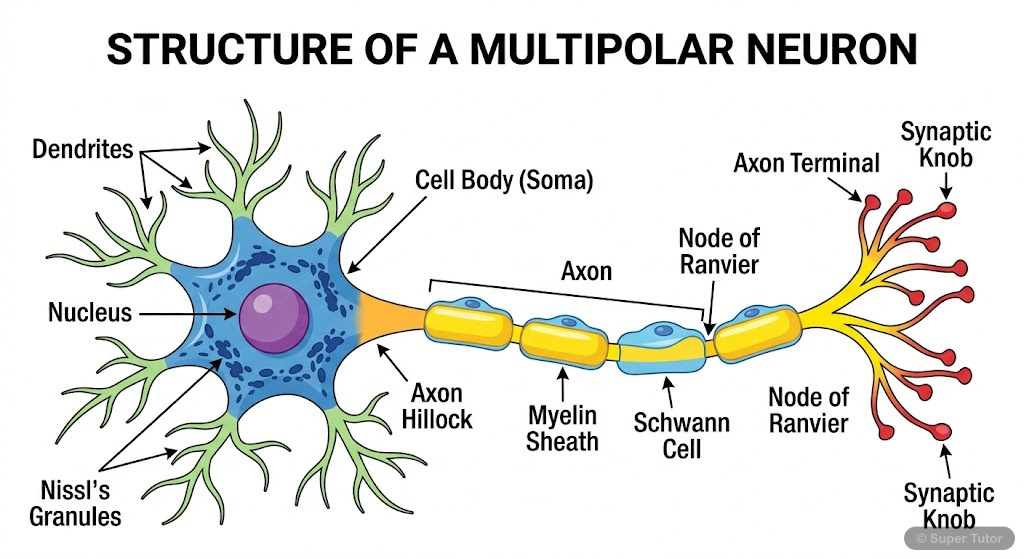
Learn better with visuals Super Tutor pairs illustrations like this with notes and quizzes for Control and Coordination.
Overview
Control and coordination are essential for living organisms because responses to changes in the environment must be organised, accurate, and timely. In animals, coordination happens through nervous tissue, muscles, and hormones. In plants, coordination happens through electrical-chemical signals and
Key Concepts
Nervous tissue is made of neurons
Nervous tissue is made of neurons, which are specialised nerve cells that conduct information as electrical impulses. Information is received at the d
A synapse is the gap between
A synapse is the gap between two neurons, or between a neuron and a muscle or gland cell. Chemicals released from the axon end cross this gap and star
A reflex arc is a simplified
A reflex arc is a simplified connection between sensory input and motor output formed in the spinal cord. It gives a quick response without involving
The brain and spinal cord form
The brain and spinal cord form the central nervous system. Cranial nerves and spinal nerves form the peripheral nervous system, which connects the cen
The brain is the main coordinating
The brain is the main coordinating centre and has three major parts: fore-brain, mid-brain, and hind-brain. The fore-brain is the main thinking part,
Learning Objectives
- Understand the need for control and coordination in living organisms
- Identify the structure and function of neurons, synapses, spinal cord, and brain parts
- Distinguish between reflex action, voluntary action, and involuntary action
- Explain how plants respond to stimuli through growth and non-growth movements
- Describe the roles of major plant hormones and animal hormones
Frequently Asked Questions
What are the important topics in Control and Coordination for Madhya Pradesh Board Class 10 Science?
How should I revise Control and Coordination for the Madhya Pradesh Board Class 10 board exam?
Sources & Official References
Content is aligned to the official syllabus. Refer to the board website for the latest curriculum.
More resources for Control and Coordination
Practice Quiz
Test yourself with a quick quiz
Important Questions
Exam-style questions with answers
Revision Notes
Key points for last-minute revision
Concept Maps
See how topics connect
Study Plan
Step-by-step plan for this chapter
Flashcards
Quick-fire cards for active recall
Syllabus
What topics to cover
NCERT Solutions
Every textbook question solved step by step
For serious students
Get the full Control and Coordination chapter — start free.
Quizzes, flashcards, an AI doubt solver and a study plan for Madhya Pradesh Board Class 10 Science. Free to start, no card needed.