The Human Eye and the Colourful World — Chapter Summary
Madhya Pradesh Board · Class 10 · Science
Summary of The Human Eye and the Colourful World for Madhya Pradesh Board Class 10 Science. Part of the Madhya Pradesh Board Class 10 Science syllabus.
Interactive on Super Tutor
Studying The Human Eye and the Colourful World? Get the full interactive chapter.
Quizzes, flashcards, AI doubt-solver and a step-by-step study plan — built for chapter summary and more.
Free trial, no card needed.
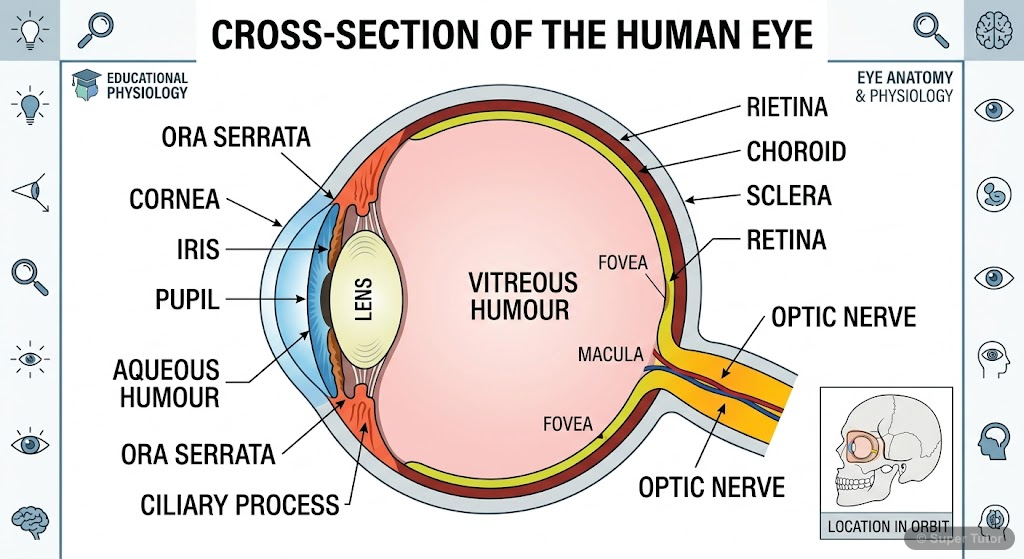
One of 14 illustrations for The Human Eye and the Colourful World in Super Tutor — alongside flashcards, concept maps and practice questions.
Overview
The human eye works like a camera and helps in seeing objects, colours, and details around us. Light enters through the cornea, the eye lens focuses the image on the retina, and the brain interprets the signals. The chapter also explains common defects of vision, prism refraction, dispersion of whit
Key Concepts
The eye is approximately spherical
The eye is approximately spherical with a diameter of about 2.3 cm. Light enters through the cornea, which is a thin transparent membrane forming the
The eye lens is fibrous
The eye lens is fibrous and jelly-like. Its curvature is changed by the ciliary muscles. When the muscles relax, the lens becomes thin and its focal l
The minimum distance at which
The minimum distance at which an object can be seen most distinctly without strain is called the least distance of distinct vision, or the near point.
In old age
In old age, the crystalline lens may become milky and cloudy. This condition is called cataract and can cause partial or complete loss of vision. Visi
Myopia
Myopia, or near-sightedness, is a defect in which nearby objects are seen clearly but distant objects are not seen distinctly. The far point is nearer
Learning Objectives
- Understand the structure and working of the human eye
- Explain the power of accommodation and the role of ciliary muscles
- Identify common defects of vision and their correction
- Describe refraction through a prism and dispersion of white light
- Explain rainbow formation and atmospheric refraction
Frequently Asked Questions
What are the important topics in The Human Eye and the Colourful World for Madhya Pradesh Board Class 10 Science?
How should I revise The Human Eye and the Colourful World for the Madhya Pradesh Board Class 10 board exam?
Sources & Official References
Content is aligned to the official syllabus. Refer to the board website for the latest curriculum.
More resources for The Human Eye and the Colourful World
Practice Quiz
Test yourself with a quick quiz
Important Questions
Exam-style questions with answers
Revision Notes
Key points for last-minute revision
Concept Maps
See how topics connect
Study Plan
Step-by-step plan for this chapter
Flashcards
Quick-fire cards for active recall
Syllabus
What topics to cover
NCERT Solutions
Every textbook question solved step by step
For serious students
Get the full The Human Eye and the Colourful World chapter — start free.
Quizzes, flashcards, an AI doubt solver and a study plan for Madhya Pradesh Board Class 10 Science. Free to start, no card needed.