Manufacturing Industries — Study Plan
Madhya Pradesh Board · Class 10 · Social Science
A step-by-step study plan for Manufacturing Industries, Madhya Pradesh Board Class 10 Social Science: what to learn first, what to practise and when.
Interactive on Super Tutor
Studying Manufacturing Industries? Get the full interactive chapter.
Quizzes, flashcards, AI doubt-solver and a step-by-step study plan — built for study plan and more.
Free trial, no card needed.
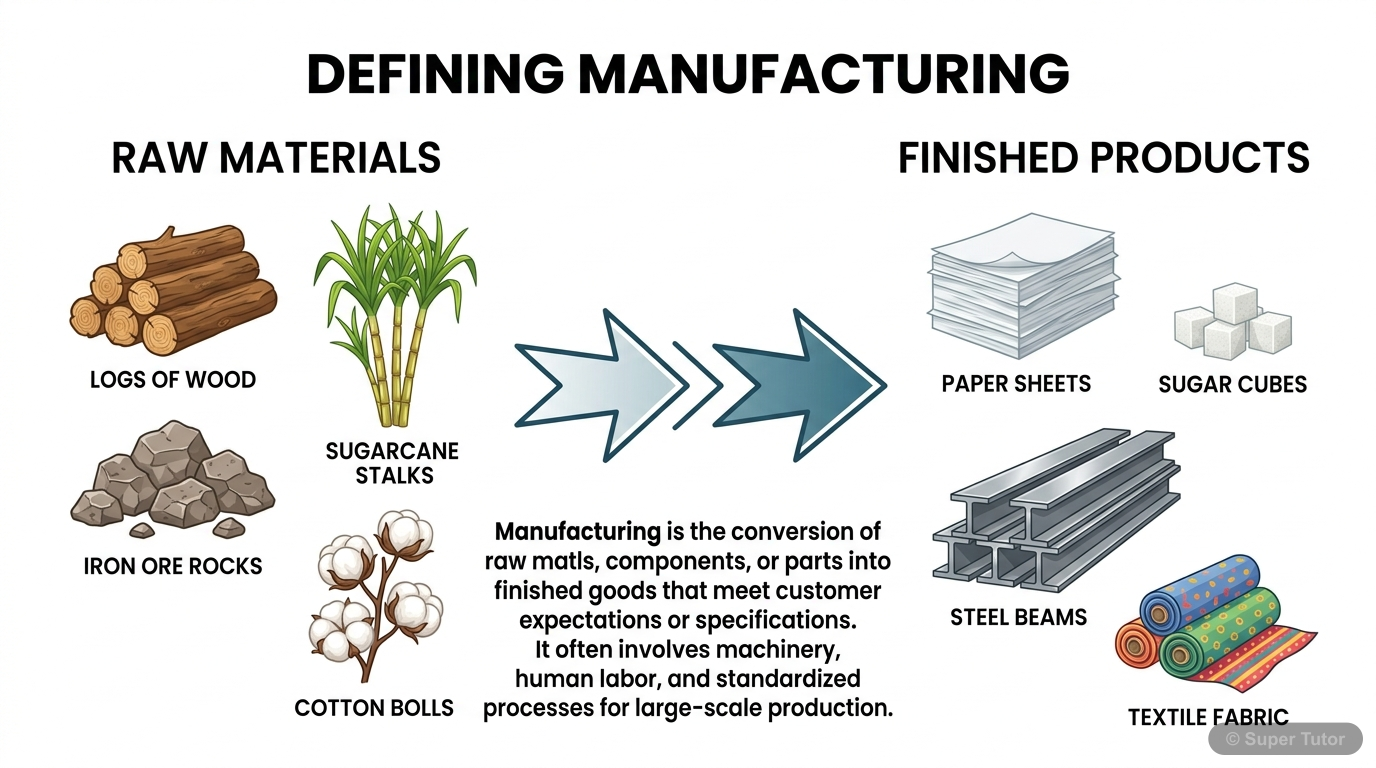
Learn better with visuals Super Tutor pairs illustrations like this with notes and quizzes for Manufacturing Industries.
Study Plan
Learn the Theory
Read the textbook chapter carefully. Note down definitions, formulas and key ideas. Focus on: 1. Meaning and Importance of Manufacturing, 2. Classification of Industries, 3. Cotton Textile Industry.
Practise
Solve the textbook exercises and extra practice questions. There are 57 questions available for this chapter.
Revise & Test
Revise key points without looking at your notes. Take a practice quiz and mark weak areas for another pass.
Spaced Revision
Come back to Manufacturing Industries after a week. Use flashcards for quick recall and try past exam questions on this chapter.
What to Focus On
- Manufacturing changes raw materials into finished, valuable goods.
- It is part of the secondary sector.
- It creates jobs in industries and related services.
- Industries are grouped by raw material, role, investment, ownership, and weight.
- Agro-based industries depend on farm products.
- Mineral-based industries depend on minerals and metals.
- The first successful textile mill was established in Mumbai in 1854.
- Cotton textile industry began in the Maharashtra and Gujarat cotton belt.
- Spinning is centralised in Maharashtra, Gujarat, and Tamil Nadu.
Common Mistakes to Avoid
Manufacturing means making finished goods without using raw materials.
Cotton textiles, jute, sugar, and edible oil are mineral-based industries because they are produced in factories.
Iron and steel is a light industry because steel products are used in many small items too.
Memory Tips
Definition of manufacturing
Manufacturing as the backbone of development
First successful textile mill in India
Cotton textile concentration and production pattern
Want a personalised study plan?
Super Tutor builds a day-by-day plan for Madhya Pradesh Board Class 10 Social Science that fits your exam date and pace.
Create My Study PlanFrequently Asked Questions
What are the important topics in Manufacturing Industries for Madhya Pradesh Board Class 10 Social Science?
How should I revise Manufacturing Industries for the Madhya Pradesh Board Class 10 board exam?
Sources & Official References
Content is aligned to the official syllabus. Refer to the board website for the latest curriculum.
More resources for Manufacturing Industries
Practice Quiz
Test yourself with a quick quiz
Important Questions
Exam-style questions with answers
Revision Notes
Key points for last-minute revision
Formula Sheet
The chapter's formulas in one place
Chapter Summary
Understand the chapter at a glance
Concept Maps
See how topics connect
Flashcards
Quick-fire cards for active recall
Syllabus
What topics to cover
NCERT Solutions
Every textbook question solved step by step
For serious students
Get the full Manufacturing Industries chapter — start free.
Quizzes, flashcards, an AI doubt solver and a study plan for Madhya Pradesh Board Class 10 Social Science. Free to start, no card needed.