Manufacturing Industries — NCERT Solutions
Madhya Pradesh Board · Class 10 · Social Science
NCERT Solutions for Manufacturing Industries, Madhya Pradesh Board Class 10 Social Science: 9 textbook questions solved step by step.
Interactive on Super Tutor
Studying Manufacturing Industries? Get the full interactive chapter.
Quizzes, flashcards, AI doubt-solver and a step-by-step study plan — built for NCERT solutions and more.
Free trial, no card needed.
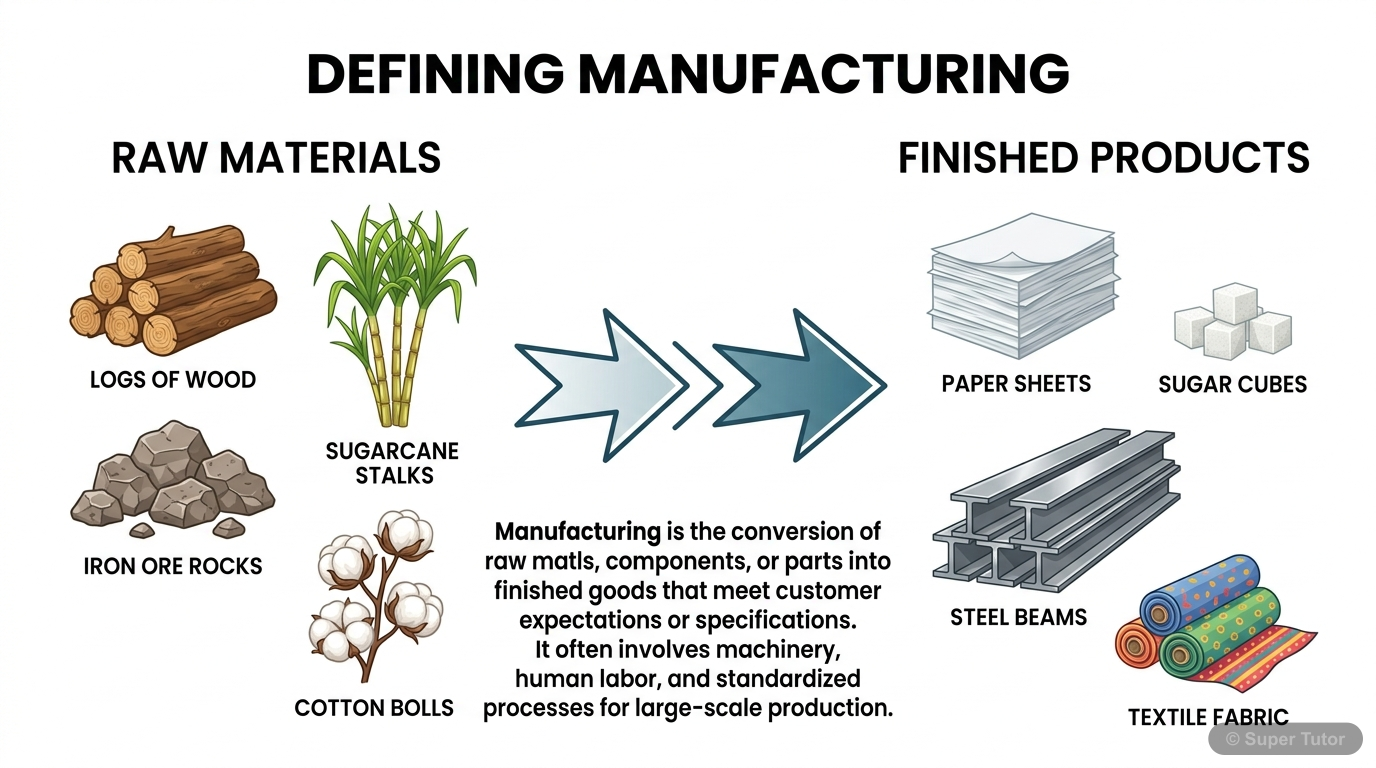
Learn better with visuals Super Tutor pairs illustrations like this with notes and quizzes for Manufacturing Industries.
The first 5 solutions are open to read. The other 4 are free with a Super Tutor account.
Exercises
1(i)Which one of the following industries uses bauxite as a raw material?
(a) Aluminium Smelting
(b) Cement
(c) Paper
(d) SteelShow solution
Correct Option: (a) Aluminium Smelting
Bauxite is the chief ore of aluminium. It is used as the primary raw material in aluminium smelting plants where it is processed (through the Bayer process and electrolytic reduction) to extract pure aluminium metal. Cement uses limestone, paper uses wood pulp, and steel uses iron ore as their respective raw materials.
1(ii)Which one of the following industries manufactures telephones, computers, etc.?
(a) Steel
(b) Electronic
(c) Aluminium Smelting
(d) Information TechnologyShow solution
Correct Option: (b) Electronic
The Electronic industry is responsible for manufacturing hardware products such as telephones, computers, televisions, and other electronic devices. Information Technology (IT) deals with software and services, not the physical manufacturing of these devices.
2(i)What is manufacturing?Show solution
Answer:
Manufacturing is the process of producing goods in large quantities by processing raw materials into finished products with the help of machines, labour, and energy.
For example, converting cotton fibre into cloth, or iron ore into steel, are acts of manufacturing. It adds value to the raw material and creates employment.
2(ii)What are basic industries? Give an example.Show solution
Answer:
Basic industries are those industries which supply their products or raw materials to other industries to manufacture further goods. They form the foundation of industrial development.
Example: The iron and steel industry is a basic industry because it supplies steel to automobile, machinery, construction, and many other industries.
3(i)How do industries pollute the environment?Show solution
Answer:
Industries pollute the environment in the following ways:
1. Air Pollution: Industries release smoke, dust, fumes, and harmful gases such as sulphur dioxide and carbon monoxide into the atmosphere. Burning of fossil fuels like coal in factories adds to air pollution.
2. Water Pollution: Industries discharge hot water, dyes, detergents, acids, and toxic chemicals into rivers and lakes. Paper, pulp, chemical, textile, and tannery industries are major water polluters.
3. Land/Soil Pollution: Dumping of industrial waste, fly ash, and chemical effluents on land degrades soil quality and makes it unfit for agriculture.
4. Noise Pollution: Industrial machinery, generators, and heavy equipment produce high levels of noise, which causes hearing impairment, stress, and other health problems for workers and nearby residents.
5. Thermal Pollution: Hot water discharged from industries into water bodies raises water temperature, harming aquatic life.
Free with a Super Tutor account
Activity — One Word Answers
(i) Used to drive machinery (5 letters) P_
(ii) People who work in a factory (6 letters) W_
(iii) Where the product is sold (6 letters) M_
(iv) A person who sells goods (8 letters) R_
(v) Thing produced (7 letters) P_
(vi) To make or produce (11 letters) M_
(vii) Land, Water and Air degraded (9 letters) P_
Free with a Super Tutor account
Activity — Puzzle Answers
1. Textiles, sugar, vegetable oil and plantation industries deriving raw materials from agriculture are called...
2. The basic raw material for sugar industry.
3. This fibre is also known as the 'Golden Fibre'.
4. Iron-ore, coking coal, and limestone are the chief raw materials of this industry.
5. A public sector steel plant located in Chhattisgarh.
6. Railway diesel engines are manufactured in Uttar Pradesh at this place.
Free with a Super Tutor account
Project Work
(i) What are the raw materials they use?
(ii) What are the other inputs in the process of manufacturing that involve transportation cost?
(iii) Are these factories following environmental norms?
Free with a Super Tutor account
4 more solved questions in Manufacturing Industries
They are free with a Super Tutor account, along with practice quizzes and flashcards for this chapter. Free to start, no card needed.
Frequently Asked Questions
What are the important topics in Manufacturing Industries for Madhya Pradesh Board Class 10 Social Science?
Are these NCERT Solutions for Manufacturing Industries free?
How should I revise Manufacturing Industries for the Madhya Pradesh Board Class 10 board exam?
Sources & Official References
Content is aligned to the official syllabus. Refer to the board website for the latest curriculum.
More resources for Manufacturing Industries
Practice Quiz
Test yourself with a quick quiz
Important Questions
Exam-style questions with answers
Revision Notes
Key points for last-minute revision
Formula Sheet
The chapter's formulas in one place
Chapter Summary
Understand the chapter at a glance
Concept Maps
See how topics connect
Study Plan
Step-by-step plan for this chapter
Flashcards
Quick-fire cards for active recall
Syllabus
What topics to cover
For serious students
Get the full Manufacturing Industries chapter — start free.
Quizzes, flashcards, an AI doubt solver and a study plan for Madhya Pradesh Board Class 10 Social Science. Free to start, no card needed.