Manufacturing Industries — Chapter Summary
Madhya Pradesh Board · Class 10 · Social Science
Summary of Manufacturing Industries for Madhya Pradesh Board Class 10 Social Science. Part of the Madhya Pradesh Board Class 10 Social Science syllabus.
Interactive on Super Tutor
Studying Manufacturing Industries? Get the full interactive chapter.
Quizzes, flashcards, AI doubt-solver and a step-by-step study plan — built for chapter summary and more.
Free trial, no card needed.
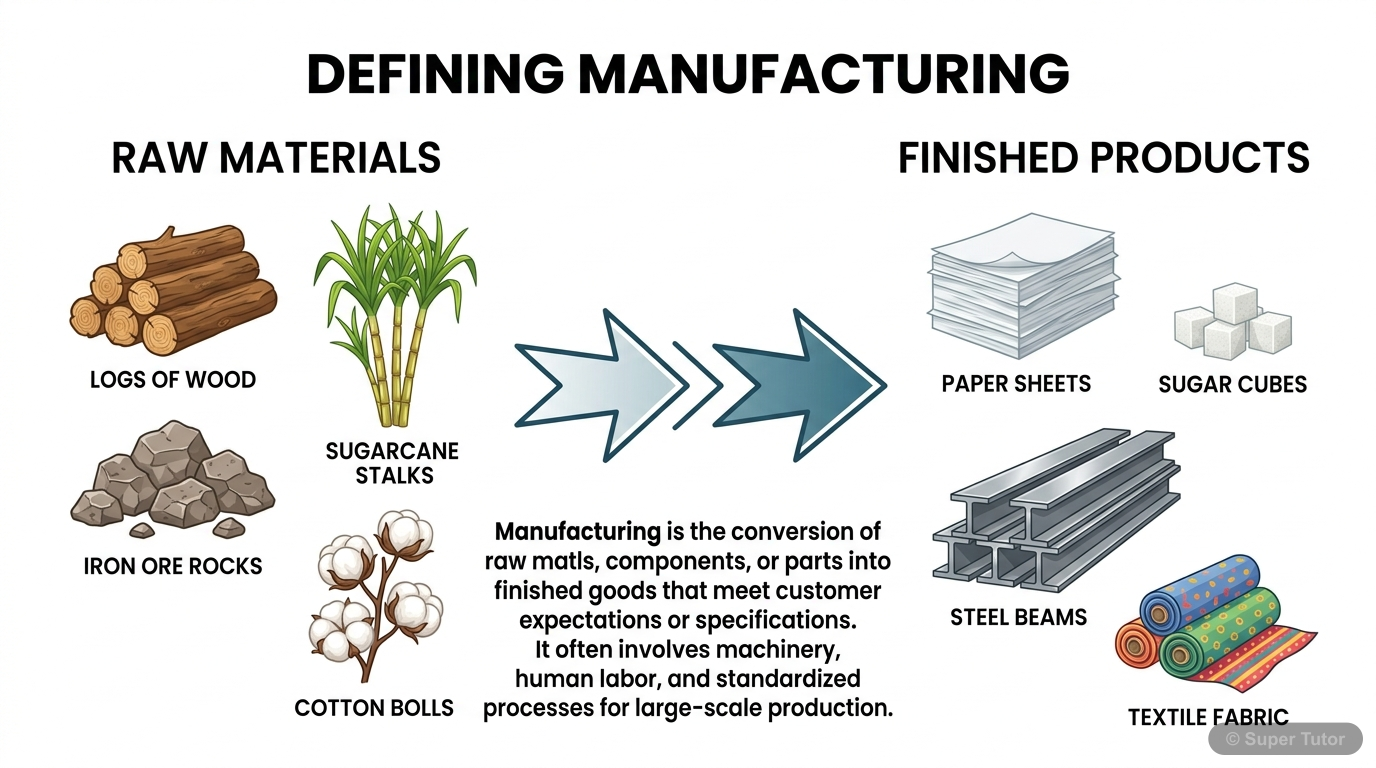
Learn better with visuals Super Tutor pairs illustrations like this with notes and quizzes for Manufacturing Industries.
Overview
Manufacturing means production of goods in large quantities after processing raw materials into more valuable products. It is a part of the secondary sector and is a major indicator of a country’s economic strength. Manufacturing industries support agriculture, create jobs, increase exports, and hel
Key Concepts
Manufacturing is the production of goods
Manufacturing is the production of goods in large quantities after processing raw materials into more valuable products. Examples include sugar from s
Manufacturing is considered the backbone
Manufacturing is considered the backbone of development because it modernises agriculture, reduces dependence on farming alone, creates jobs, supports
Industries are classified by raw materials
Industries are classified by raw materials, role, capital investment, ownership, and bulk of goods. Agro-based industries use farm products, mineral-b
The first successful textile mill
The first successful textile mill was established in Mumbai in 1854. The industry was originally concentrated in the Maharashtra-Gujarat cotton belt.
The first jute mill was set
The first jute mill was set up near Kolkata in 1855 at Rishra. Most jute mills are located along the banks of the Hugli river in West Bengal because o
Learning Objectives
- Understand the meaning of manufacturing and its role in the economy.
- Identify major classifications of industries based on raw materials, ownership, capital, and bulk.
- Explain the location and importance of major agro-based and mineral-based industries in India.
- Describe the structure, raw materials, and location factors of key industries such as cotton textile, jute, sugar, iron and steel, aluminium, chemicals, fertilizer, cement, automobiles, and electronics.
- Recognise the environmental problems caused by industries and the measures used to reduce pollution.
Frequently Asked Questions
What are the important topics in Manufacturing Industries for Madhya Pradesh Board Class 10 Social Science?
How should I revise Manufacturing Industries for the Madhya Pradesh Board Class 10 board exam?
Sources & Official References
Content is aligned to the official syllabus. Refer to the board website for the latest curriculum.
More resources for Manufacturing Industries
Practice Quiz
Test yourself with a quick quiz
Important Questions
Exam-style questions with answers
Revision Notes
Key points for last-minute revision
Formula Sheet
The chapter's formulas in one place
Concept Maps
See how topics connect
Study Plan
Step-by-step plan for this chapter
Flashcards
Quick-fire cards for active recall
Syllabus
What topics to cover
NCERT Solutions
Every textbook question solved step by step
For serious students
Get the full Manufacturing Industries chapter — start free.
Quizzes, flashcards, an AI doubt solver and a study plan for Madhya Pradesh Board Class 10 Social Science. Free to start, no card needed.