Money and Banking — NCERT Solutions
Madhya Pradesh Board · Class 12 · Economics
NCERT Solutions for Money and Banking, Madhya Pradesh Board Class 12 Economics: 11 textbook questions solved step by step.
Interactive on Super Tutor
Studying Money and Banking? Get the full interactive chapter.
Quizzes, flashcards, AI doubt-solver and a step-by-step study plan — built for NCERT solutions and more.
Free trial, no card needed.
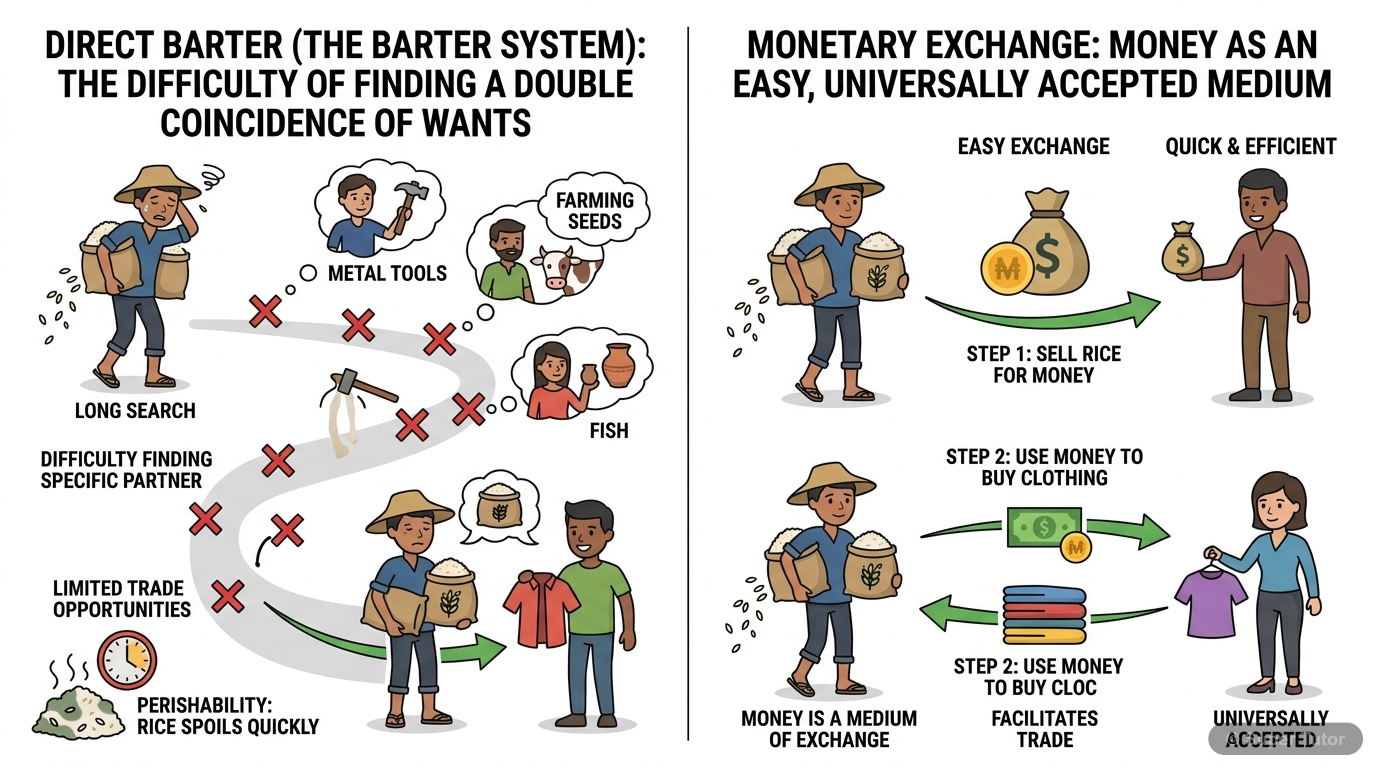
Learn better with visuals Super Tutor pairs illustrations like this with notes and quizzes for Money and Banking.
The first 6 solutions are open to read. The other 5 are free with a Super Tutor account.
Exercises — Money and Banking
1What is a barter system? What are its drawbacks?Show solution
What is a Barter System?
A barter system is a system of exchange in which goods and services are directly exchanged for other goods and services without the use of money as a medium of exchange. For example, a farmer may exchange wheat for cloth with a weaver.
Drawbacks of the Barter System:
- Lack of Double Coincidence of Wants: Barter requires that two parties must simultaneously want exactly what the other has to offer. For example, if a farmer wants cloth and has wheat, he must find a weaver who wants wheat and has cloth. This is very difficult in practice.
- Lack of a Common Measure of Value: In a barter system, there is no common unit in which the value of goods can be measured and compared. For example, how many kilograms of wheat equals one metre of cloth? This makes exchange very complicated.
- Lack of Store of Value: It is difficult to store wealth for future use in the form of commodities, as most goods are perishable and lose value over time.
- Lack of Divisibility: Some goods (like a cow) cannot be divided into smaller units for making change, making it difficult to exchange goods of unequal value.
- Difficulty in Deferred Payments: Barter makes it very difficult to make contracts for future payments, since the value of goods changes over time and there is no standard unit for such agreements.
Conclusion: These drawbacks made barter exchange highly inefficient, leading to the evolution of money as a medium of exchange.
2What are the main functions of money? How does money overcome the shortcomings of a barter system?Show solution
Main Functions of Money:
- Medium of Exchange: Money acts as an intermediary in the exchange of goods and services. A seller accepts money in exchange for goods, and uses that money to buy other goods.
- Unit of Account (Measure of Value): Money provides a common unit in which the value of all goods and services can be expressed (e.g., in rupees in India).
- Store of Value: Money can be stored for future use without losing its value (unlike perishable commodities). It allows people to save purchasing power over time.
- Standard of Deferred Payment: Money makes it possible to express future obligations (loans, contracts) in a standard unit, facilitating credit transactions.
How Money Overcomes the Shortcomings of Barter:
| Drawback of Barter | How Money Overcomes It |
|---|---|
| Double coincidence of wants | Money separates the act of buying from selling; a person can sell goods for money and use money to buy anything, anywhere, from anyone. |
| No common measure of value | Money serves as a unit of account — all goods are priced in monetary units, making comparison easy. |
| Lack of store of value | Money can be stored easily without deterioration, serving as a store of value. |
| Indivisibility of goods | Money is perfectly divisible into smaller units (e.g., rupees and paise), solving the problem of making change. |
| Difficulty in deferred payments | Contracts for future payments can be made in monetary terms, as money retains its value over time. |
Conclusion: Money, by acting as a medium of exchange, unit of account, store of value, and standard of deferred payment, effectively resolves all the major problems associated with the barter system.
3What is transaction demand for money? How is it related to the value of transactions over a specified period of time?Show solution
Transaction Demand for Money:
Transaction demand for money refers to the demand for money held by individuals and firms to carry out their day-to-day transactions — such as buying goods, paying wages, meeting household expenses, etc. People need to hold money in liquid form (cash) because income is received at discrete intervals (e.g., monthly salary) but expenditure occurs continuously throughout the period.
Relationship with Value of Transactions:
The transaction demand for money () is directly and positively related to the total value of transactions undertaken in the economy over a specified period of time.
This is expressed as:
where:
- = Transaction demand for money
- = Total value of transactions during the period
- = A positive fraction (the proportion of total transactions that people wish to hold as money)
Since the total value of transactions in an economy is closely related to the nominal income (GDP) of the economy, the transaction demand for money can also be written as:
where is the nominal national income.
Key Points:
- If the value of transactions (or income) increases, the transaction demand for money increases proportionally.
- If the value of transactions decreases, the transaction demand for money decreases.
- Thus, transaction demand for money is a positive function of the level of income/value of transactions.
Conclusion: The higher the level of economic activity and the value of transactions, the greater is the need to hold money for transaction purposes.
4What are the alternative definitions of money supply in India?Show solution
Alternative Definitions of Money Supply in India:
The Reserve Bank of India (RBI) has defined money supply in four alternative ways, classified from the narrowest to the broadest measure, based on decreasing order of liquidity:
1. (Narrow Money):
- This is the most liquid measure of money supply.
- Demand deposits are chequeable deposits that can be withdrawn on demand.
2. :
- Slightly broader than .
3. (Broad Money):
- Time deposits (fixed deposits) have a fixed maturity period and are less liquid than demand deposits.
- is the most commonly used measure of money supply and is referred to as broad money.
4. :
- This is the broadest and least liquid measure of money supply.
Summary Table:
| Measure | Components | Liquidity |
|---|---|---|
| Currency + Demand Deposits + Other Deposits with RBI | Highest | |
| + Post Office Savings Deposits | High | |
| + Time Deposits of Banks | Moderate | |
| + Post Office Total Deposits | Lowest |
Conclusion: and are called narrow money, while and are called broad money. The RBI primarily uses as the key indicator of money supply for policy purposes.
5What is a 'legal tender'? What is 'fiat money'?Show solution
Legal Tender:
Legal tender refers to money that is legally recognised by the government as an acceptable medium for settling debts and making payments. No person can legally refuse to accept legal tender in settlement of a debt.
- In India, currency notes and coins issued by the RBI and the Government of India are legal tender.
- Legal tender can be of two types:
- Limited legal tender: Money that can be used to pay debts only up to a certain limit (e.g., coins above a certain denomination).
- Unlimited legal tender: Money that can be used to pay debts of any amount (e.g., currency notes in India).
Fiat Money:
Fiat money is money that is declared by the government (by fiat or order) to be legal tender, but it has no intrinsic value of its own — it is not backed by any physical commodity like gold or silver.
- The value of fiat money comes entirely from government decree and public trust/acceptance.
- Modern currency notes (paper money) are the best example of fiat money.
- For example, a ₹500 note has no intrinsic value as a piece of paper, but it is accepted as money because the government has declared it to be legal tender.
Key Difference:
| Aspect | Legal Tender | Fiat Money |
|---|---|---|
| Meaning | Money legally accepted for payments | Money with no intrinsic value, backed by government order |
| Basis of value | Government law | Government decree and public trust |
| Example | Currency notes, coins | Paper currency notes |
Conclusion: All fiat money is legal tender, but the emphasis of fiat money is on the absence of intrinsic value, while legal tender emphasises legal enforceability of acceptance.
6What is High Powered Money?Show solution
High Powered Money (H):
High Powered Money, also called the monetary base or reserve money, refers to the money produced by the RBI and the Government of India. It consists of:
Or equivalently:
where includes both the Cash Reserve Ratio (CRR) deposits with RBI and the vault cash held by banks.
Why is it called 'High Powered'?
It is called high powered money because one rupee of H leads to the creation of more than one rupee of money supply in the economy through the process of credit creation (money multiplier).
The relationship between money supply () and high powered money () is given by:
where is the money multiplier, defined as:
Since , a given amount of high powered money supports a much larger amount of total money supply.
Sources of High Powered Money:
- Currency notes and coins issued by RBI
- Government currency (small coins)
- Deposits of commercial banks with RBI
Conclusion: High powered money is the foundation of the money supply in the economy. The RBI controls the money supply by regulating the stock of high powered money.
Free with a Super Tutor account
Free with a Super Tutor account
Free with a Super Tutor account
Free with a Super Tutor account
Free with a Super Tutor account
5 more solved questions in Money and Banking
They are free with a Super Tutor account, along with practice quizzes and flashcards for this chapter. Free to start, no card needed.
Frequently Asked Questions
What are the important topics in Money and Banking for Madhya Pradesh Board Class 12 Economics?
Are these NCERT Solutions for Money and Banking free?
How should I revise Money and Banking for the Madhya Pradesh Board Class 12 board exam?
Sources & Official References
Content is aligned to the official syllabus. Refer to the board website for the latest curriculum.
More resources for Money and Banking
Practice Quiz
Test yourself with a quick quiz
Important Questions
Exam-style questions with answers
Revision Notes
Key points for last-minute revision
Formula Sheet
The chapter's formulas in one place
Chapter Summary
Understand the chapter at a glance
Concept Maps
See how topics connect
Study Plan
Step-by-step plan for this chapter
Flashcards
Quick-fire cards for active recall
Syllabus
What topics to cover
For serious students
Get the full Money and Banking chapter — start free.
Quizzes, flashcards, an AI doubt solver and a study plan for Madhya Pradesh Board Class 12 Economics. Free to start, no card needed.