Mineral and Energy Resources — Revision Notes
Madhya Pradesh Board · Class 12 · Geography
Mineral and Energy Resources revision notes for Madhya Pradesh Board Class 12 Geography: 4 topics in quick points.
Interactive on Super Tutor
Studying Mineral and Energy Resources? Get the full interactive chapter.
Quizzes, flashcards, AI doubt-solver and a step-by-step study plan — built for revision notes and more.
Free trial, no card needed.
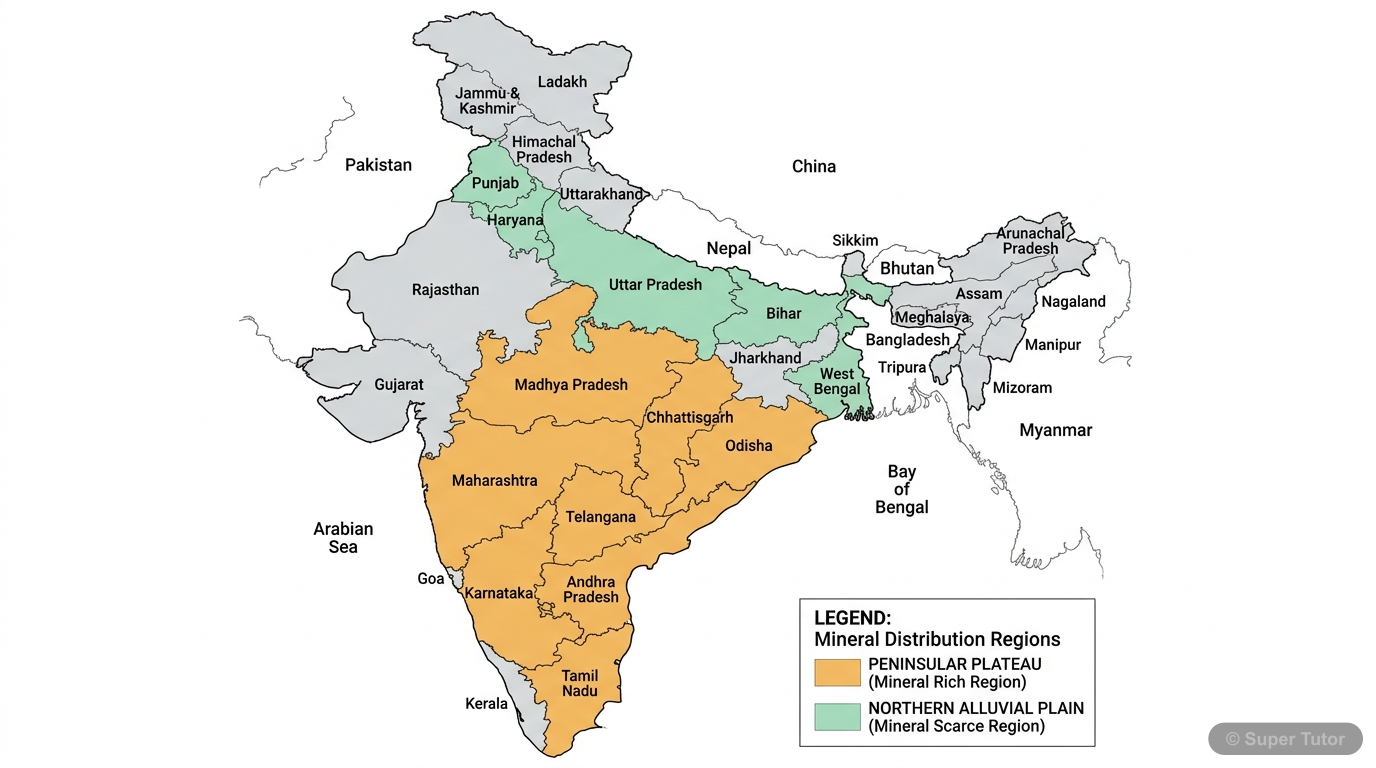
Learn better with visuals Super Tutor pairs illustrations like this with notes and quizzes for Mineral and Energy Resources.
Key Topics to Revise
1. Minerals: meaning, classification, and characteristics
- A mineral is a natural substance of organic or inorganic origin with definite chemical and physical properties.
- Minerals are grouped into metallic and non-metallic minerals.
- Metallic minerals are sources of metals. They are further divided into ferrous and non-ferrous minerals.
2. Distribution of minerals in India
- Most metallic minerals occur in the peninsular plateau region in old crystalline rocks.
- Over 97 per cent of coal reserves occur in the valleys of Damodar, Sone, Mahanadi, and Godavari.
- Petroleum reserves are located in the sedimentary basins of Assam, Gujarat, and Mumbai High in the Arabian Sea.
3. Ferrous minerals: iron ore and manganese
- Iron ore is a ferrous metallic mineral and India has the largest reserve of iron ore in Asia.
- The two main types of iron ore are haematite and magnetite.
- About 95 per cent of India's total iron ore reserves are located in Odisha, Jharkhand, Chhattisgarh, Karnataka, Goa, Telangana, Andhra Pradesh, and Tamil Nadu.
4. Non-ferrous minerals: bauxite, copper, and mica
- India is poorly endowed with non-ferrous metallic minerals except bauxite.
- Bauxite is used in the manufacture of aluminium.
- Bauxite is found mainly in tertiary deposits associated with laterite rocks.
Get complete notes with diagrams and examples
Full NotesKey Concepts
Frequently Asked Questions
What are the important topics in Mineral and Energy Resources for Madhya Pradesh Board Class 12 Geography?
How should I revise Mineral and Energy Resources for the Madhya Pradesh Board Class 12 board exam?
Sources & Official References
Content is aligned to the official syllabus. Refer to the board website for the latest curriculum.
More resources for Mineral and Energy Resources
Practice Quiz
Test yourself with a quick quiz
Important Questions
Exam-style questions with answers
Chapter Summary
Understand the chapter at a glance
Concept Maps
See how topics connect
Study Plan
Step-by-step plan for this chapter
Flashcards
Quick-fire cards for active recall
Syllabus
What topics to cover
NCERT Solutions
Every textbook question solved step by step
For serious students
Get the full Mineral and Energy Resources chapter — start free.
Quizzes, flashcards, an AI doubt solver and a study plan for Madhya Pradesh Board Class 12 Geography. Free to start, no card needed.