Mineral and Energy Resources — Chapter Summary
Madhya Pradesh Board · Class 12 · Geography
Summary of Mineral and Energy Resources for Madhya Pradesh Board Class 12 Geography. Part of the Madhya Pradesh Board Class 12 Geography syllabus.
Interactive on Super Tutor
Studying Mineral and Energy Resources? Get the full interactive chapter.
Quizzes, flashcards, AI doubt-solver and a step-by-step study plan — built for chapter summary and more.
Free trial, no card needed.
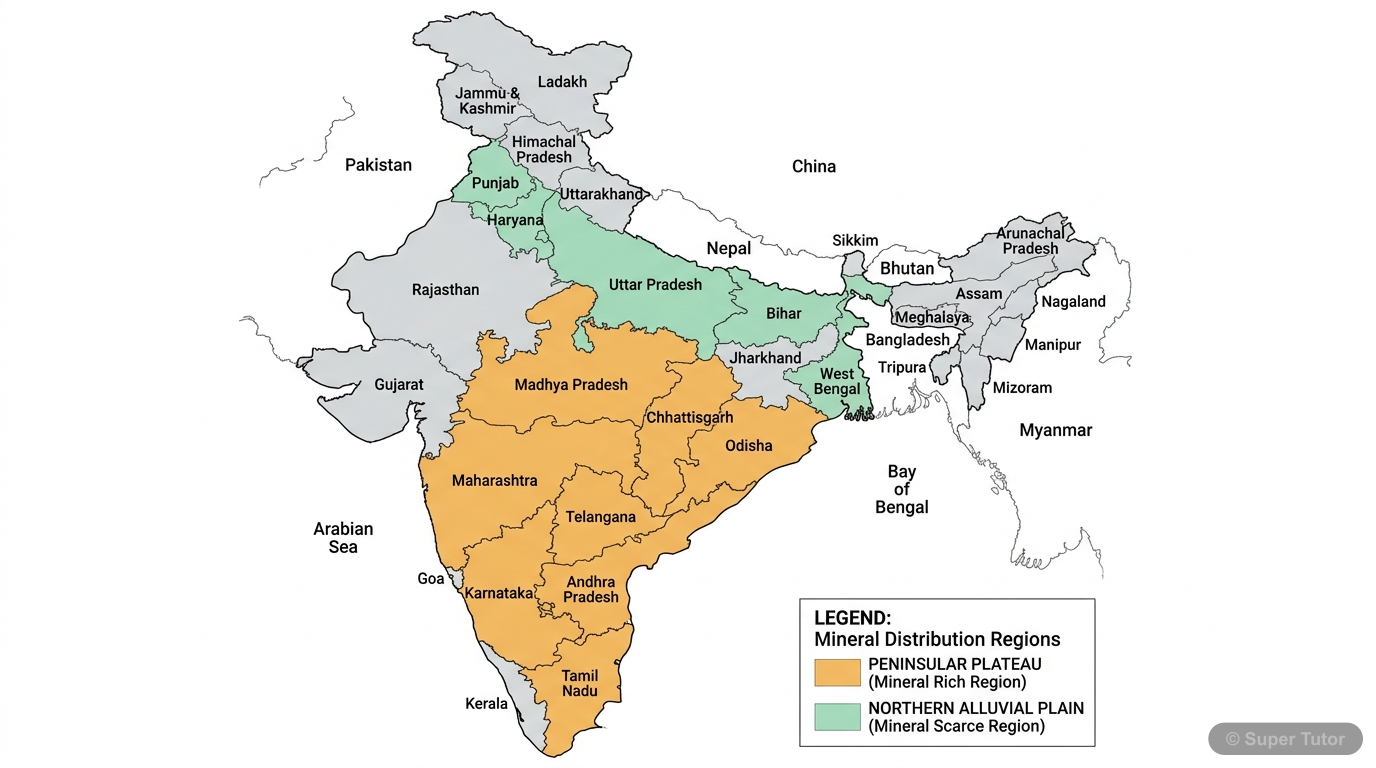
Learn better with visuals Super Tutor pairs illustrations like this with notes and quizzes for Mineral and Energy Resources.
Overview
Mineral and energy resources form the material base for industrial growth, transport, power generation, and modern life. India has a wide variety of minerals because of its varied geological structure, but the resources are unevenly distributed. Most valuable minerals are associated with the peninsu
Key Concepts
A mineral is a natural substance
A mineral is a natural substance of organic or inorganic origin with definite chemical and physical properties.
Minerals are divided into metallic
Minerals are divided into metallic and non-metallic minerals. Metallic minerals are further divided into ferrous and non-ferrous minerals. Non-metalli
Ferrous minerals contain iron
Ferrous minerals contain iron, such as iron ore and manganese. Non-ferrous minerals do not contain iron, such as copper and bauxite.
India has the largest reserve
India has the largest reserve of iron ore in Asia. The two main types are haematite and magnetite. About 95% of total reserves are located in Odisha,
Manganese is used for smelting iron
Manganese is used for smelting iron ore and manufacturing ferro alloys. It is mainly associated with the Dharwar system, though it occurs in almost al
Learning Objectives
- Understand the meaning and classification of minerals
- Identify the main mineral belts of India and their distribution
- Describe major metallic and non-metallic minerals and their uses
- Explain the occurrence and importance of coal, petroleum, natural gas, and nuclear energy minerals
- Distinguish between conventional and non-conventional energy resources
Frequently Asked Questions
What are the important topics in Mineral and Energy Resources for Madhya Pradesh Board Class 12 Geography?
How should I revise Mineral and Energy Resources for the Madhya Pradesh Board Class 12 board exam?
Sources & Official References
Content is aligned to the official syllabus. Refer to the board website for the latest curriculum.
More resources for Mineral and Energy Resources
Practice Quiz
Test yourself with a quick quiz
Important Questions
Exam-style questions with answers
Revision Notes
Key points for last-minute revision
Concept Maps
See how topics connect
Study Plan
Step-by-step plan for this chapter
Flashcards
Quick-fire cards for active recall
Syllabus
What topics to cover
NCERT Solutions
Every textbook question solved step by step
For serious students
Get the full Mineral and Energy Resources chapter — start free.
Quizzes, flashcards, an AI doubt solver and a study plan for Madhya Pradesh Board Class 12 Geography. Free to start, no card needed.