Mineral and Energy Resources — NCERT Solutions
Madhya Pradesh Board · Class 12 · Geography
NCERT Solutions for Mineral and Energy Resources, Madhya Pradesh Board Class 12 Geography: 9 textbook questions solved step by step. Covers Exercises.
Interactive on Super Tutor
Studying Mineral and Energy Resources? Get the full interactive chapter.
Quizzes, flashcards, AI doubt-solver and a step-by-step study plan — built for NCERT solutions and more.
Free trial, no card needed.
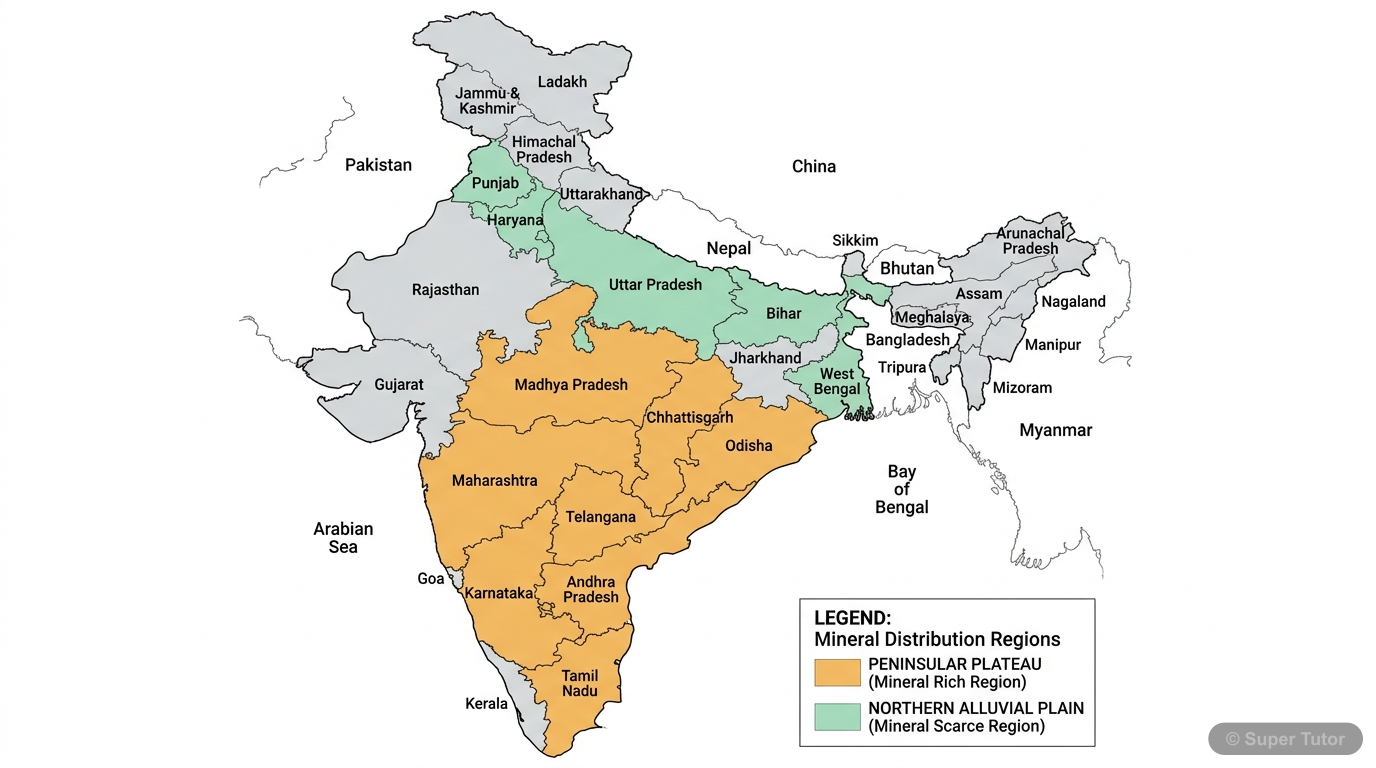
Learn better with visuals Super Tutor pairs illustrations like this with notes and quizzes for Mineral and Energy Resources.
The first 5 solutions are open to read. The other 4 are free with a Super Tutor account.
Exercises
1(i)In which one of the following States are the major oil fields located?
(a) Assam
(b) Bihar
(c) Rajasthan
(d) Tamil NaduShow solution
Correct Answer: (a) Assam
Justification: Assam is one of the oldest and most important petroleum-producing states in India. The Digboi oilfield in Assam is the oldest oil field in Asia (discovered in 1889). Other major oil fields in Assam include Naharkatiya and Moran-Hugrijan. Hence, Assam houses the major oil fields among the given options.
1(ii)At which one of the following places was the first atomic power station started?
(a) Kalpakkam
(b) Narora
(c) Rana Pratap Sagar
(d) TarapurShow solution
Correct Answer: (d) Tarapur
Justification: The Tarapur Atomic Power Station (TAPS) located in Maharashtra was the first nuclear/atomic power station to be established in India. It was set up in 1969 with the help of the United States and remains one of the most important nuclear power plants in the country.
1(iii)Which one of the following is a non-renewable source of energy?
(a) Hydel
(b) Solar
(c) Thermal
(d) Wind powerShow solution
Correct Answer: (c) Thermal
Justification: Thermal power is generated by burning fossil fuels such as coal, oil, and natural gas. These fossil fuels are exhaustible (non-renewable) resources formed over millions of years and cannot be replenished once used. Hydel, solar, and wind power are all renewable sources of energy as they are derived from naturally replenishing processes.
2(i)Give an account of the distribution of mica in India.Show solution
Given: Distribution of mica in India.
Answer:
Mica is a mineral that can be split into thin elastic sheets. It is used extensively in the electrical and electronics industries.
Distribution of Mica in India:
- Jharkhand: The Hazaribagh plateau of Jharkhand is the leading producer of mica in India. The Koderma–Gaya–Hazaribagh belt is the most important mica-producing region.
- Andhra Pradesh: The Nellore district of Andhra Pradesh is another major producer of high-quality mica.
- Rajasthan: Mica is found in the Ajmer district of Rajasthan.
- Bihar: Parts of Bihar also contribute to mica production.
India is one of the largest producers and exporters of mica in the world. The mica belt of Jharkhand–Bihar–Andhra Pradesh is the most significant mica-producing zone in the country.
2(ii)What is nuclear power? Mention the important nuclear power stations in India.Show solution
Given: Definition of nuclear power and important nuclear power stations in India.
Answer:
Nuclear Power: Nuclear power is the energy released during nuclear fission or fusion reactions. In nuclear fission, the nucleus of a heavy atom (such as Uranium-235 or Thorium-232) is split by bombarding it with neutrons, releasing a tremendous amount of heat energy. This heat is used to produce steam, which drives turbines to generate electricity. India has large reserves of thorium and some uranium.
Important Nuclear Power Stations in India:
| Station | State |
|---|---|
| Tarapur Atomic Power Station (TAPS) | Maharashtra |
| Rawatbhata (Rana Pratap Sagar) | Rajasthan |
| Kalpakkam | Tamil Nadu |
| Narora | Uttar Pradesh |
| Kakrapar | Gujarat |
| Kaiga | Karnataka |
India's nuclear power programme is managed by the Nuclear Power Corporation of India Limited (NPCIL).
Free with a Super Tutor account
Free with a Super Tutor account
Free with a Super Tutor account
Free with a Super Tutor account
4 more solved questions in Mineral and Energy Resources
They are free with a Super Tutor account, along with practice quizzes and flashcards for this chapter. Free to start, no card needed.
Frequently Asked Questions
What are the important topics in Mineral and Energy Resources for Madhya Pradesh Board Class 12 Geography?
Are these NCERT Solutions for Mineral and Energy Resources free?
How should I revise Mineral and Energy Resources for the Madhya Pradesh Board Class 12 board exam?
Sources & Official References
Content is aligned to the official syllabus. Refer to the board website for the latest curriculum.
More resources for Mineral and Energy Resources
Practice Quiz
Test yourself with a quick quiz
Important Questions
Exam-style questions with answers
Revision Notes
Key points for last-minute revision
Chapter Summary
Understand the chapter at a glance
Concept Maps
See how topics connect
Study Plan
Step-by-step plan for this chapter
Flashcards
Quick-fire cards for active recall
Syllabus
What topics to cover
For serious students
Get the full Mineral and Energy Resources chapter — start free.
Quizzes, flashcards, an AI doubt solver and a study plan for Madhya Pradesh Board Class 12 Geography. Free to start, no card needed.