Bhakti - Sufi Traditions: Changes in Religious Beliefs and Devotional Texts — Revision Notes
Madhya Pradesh Board · Class 12 · History
Bhakti - Sufi Traditions: Changes in Religious Beliefs and Devotional Texts revision notes for Madhya Pradesh Board Class 12 History: 4 topics in quick.
Interactive on Super Tutor
Studying Bhakti - Sufi Traditions: Changes in Religious Beliefs and Devotional Texts? Get the full interactive chapter.
Quizzes, flashcards, AI doubt-solver and a step-by-step study plan — built for revision notes and more.
Free trial, no card needed.
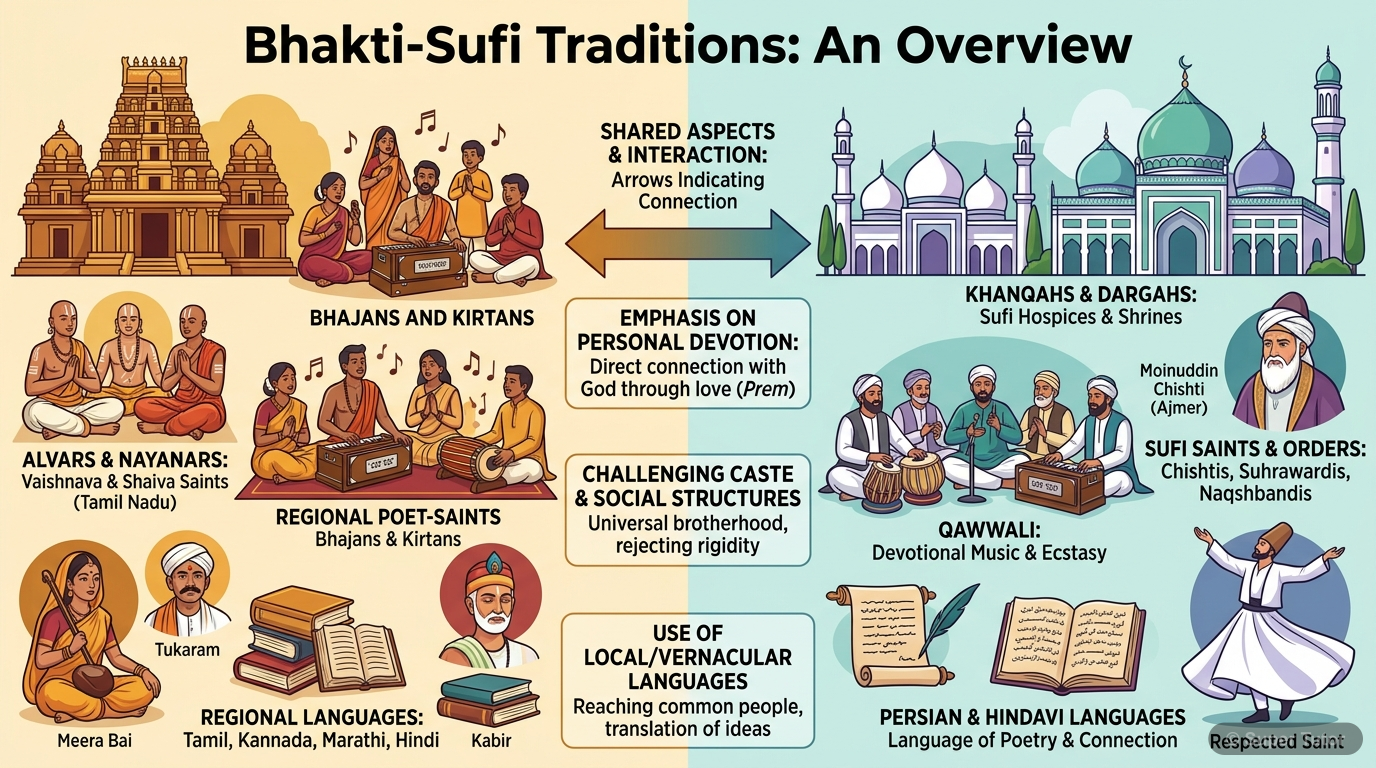
One of 15 illustrations for Bhakti - Sufi Traditions: Changes in Religious Beliefs and Devotional Texts in Super Tutor — alongside flashcards, concept maps and practice questions.
Key Topics to Revise
1. Religious Landscape and the Growth of New Traditions
- By the mid-first millennium CE, the subcontinent had a rich variety of religious structures, including stupas, monasteries, and temples.
- Puranic texts received their present shape around the mid-first millennium CE.
- New devotional compositions were usually oral, used regional languages, and were often set to music.
2. Tamil Bhakti: Alvars and Nayanars
- Some of the earliest bhakti movements were led by the Alvars and Nayanars in Tamil Nadu.
- Alvars were devotees of Vishnu.
- Nayanars were devotees of Shiva.
3. Women Saints and Dissent in Tamil Bhakti
- Women had a visible place in bhakti traditions.
- Andal was a woman Alvar whose compositions were widely sung and continue to be sung.
- Andal saw herself as the beloved of Vishnu.
4. Bhakti, Caste, and Temple Patronage
- Some historians see the Alvars and Nayanars as questioning caste dominance and Brahmanical privilege.
- Tondaradippodi was a Brahmana Alvar who praised servants of Vishnu even if they were born outcastes.
- Appar was a Nayanar saint who questioned the value of gotra, kula, and law-books.
Get complete notes with diagrams and examples
Full NotesKey Concepts
Frequently Asked Questions
What are the important topics in Bhakti - Sufi Traditions: Changes in Religious Beliefs and Devotional Texts for Madhya Pradesh Board Class 12 History?
How should I revise Bhakti - Sufi Traditions: Changes in Religious Beliefs and Devotional Texts for the Madhya Pradesh Board Class 12 board exam?
Sources & Official References
Content is aligned to the official syllabus. Refer to the board website for the latest curriculum.
More resources for Bhakti - Sufi Traditions: Changes in Religious Beliefs and Devotional Texts
Practice Quiz
Test yourself with a quick quiz
Important Questions
Exam-style questions with answers
Chapter Summary
Understand the chapter at a glance
Concept Maps
See how topics connect
Study Plan
Step-by-step plan for this chapter
Flashcards
Quick-fire cards for active recall
Syllabus
What topics to cover
NCERT Solutions
Every textbook question solved step by step
For serious students
Get the full Bhakti - Sufi Traditions: Changes in Religious Beliefs and Devotional Texts chapter — start free.
Quizzes, flashcards, an AI doubt solver and a study plan for Madhya Pradesh Board Class 12 History. Free to start, no card needed.