Bhakti - Sufi Traditions: Changes in Religious Beliefs and Devotional Texts — NCERT Solutions
Madhya Pradesh Board · Class 12 · History
NCERT Solutions for Bhakti - Sufi Traditions: Changes in Religious Beliefs and Devotional Texts, Madhya Pradesh Board Class 12 History: 12 textbook.
Interactive on Super Tutor
Studying Bhakti - Sufi Traditions: Changes in Religious Beliefs and Devotional Texts? Get the full interactive chapter.
Quizzes, flashcards, AI doubt-solver and a step-by-step study plan — built for NCERT solutions and more.
Free trial, no card needed.
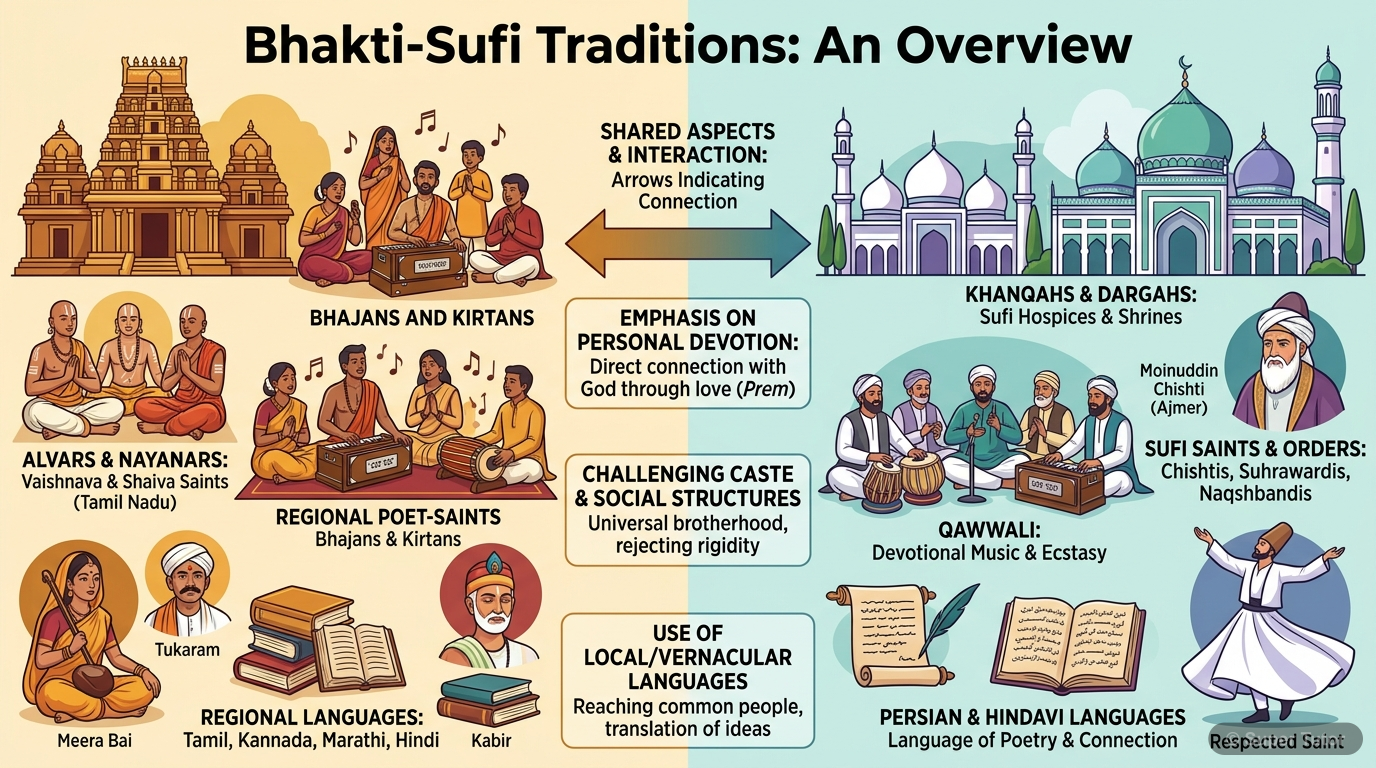
One of 15 illustrations for Bhakti - Sufi Traditions: Changes in Religious Beliefs and Devotional Texts in Super Tutor — alongside flashcards, concept maps and practice questions.
The first 6 solutions are open to read. The other 6 are free with a Super Tutor account.
Answer in 100-150 Words
1Explain with examples what historians mean by the integration of cults.Show solution
Given/Context: The term 'integration of cults' refers to the process by which local or regional religious traditions were absorbed into, or merged with, larger, more dominant religious frameworks.
Explanation with Examples:
Historians use the term 'integration of cults' to describe the process by which local deities, folk traditions, and regional religious practices were gradually absorbed into the broader framework of Brahmanical Hinduism, Buddhism, or other major religious systems.
Examples:
- Goddess/Devi worship: Many local mother goddesses worshipped in villages were gradually integrated into the Brahmanical tradition as forms of Devi or Shakti (e.g., Durga, Kali). Their shrines were incorporated into the temple network.
- Alvars and Nayanars: The poet-saints of Tamil Nadu identified local shrines as abodes of Vishnu or Shiva. Large temples were later built at these sacred places, effectively integrating local sacred sites into the pan-Indian Vaishnava and Shaiva traditions.
- Bhagavata Purana: Ideas of the Tamil Vaishnava bhaktas (Alvars) were incorporated within the Sanskritic tradition, culminating in the composition of the Bhagavata Purana — a classic example of a regional devotional tradition being integrated into mainstream Sanskrit literature.
- Tribal deities: Many tribal or forest deities were reinterpreted as avatars (incarnations) of Vishnu, thereby bringing tribal communities within the fold of Brahmanical religion.
Conclusion: Integration of cults was thus a two-way process — it allowed dominant traditions to expand their reach while also giving local traditions a degree of legitimacy and continuity.
2To what extent do you think the architecture of mosques in the subcontinent reflects a combination of universal ideals and local traditions?Show solution
Given/Context: Mosque architecture in the Indian subcontinent developed over several centuries, blending Islamic architectural principles with local building traditions.
Universal Features of Mosque Architecture:
Certain features of mosques are universal across the Muslim world:
- Orientation towards Mecca (Qibla direction)
- Presence of the mihrab (prayer niche indicating the direction of Mecca)
- Presence of the minbar (pulpit from which the sermon is delivered)
- An open courtyard for congregational prayer
Local/Regional Adaptations:
However, mosque architecture in the subcontinent shows significant local variations:
- Building materials: Locally available materials such as brick, wood, and stone were used. For example, the Shah Hamadan mosque in Srinagar is built in the Kashmiri wooden architectural style, decorated with papier mache and featuring a distinctive spire and carved eaves.
- Roof styles: Flat roofs, domes, and multi-tiered roofs reflecting local traditions were used in different regions.
- Decorative elements: Local artistic motifs and craftsmanship were incorporated.
- The Atiya mosque in Mymensingh, Bangladesh (1609) is built with brick, reflecting the local building tradition of Bengal.
Conclusion: Mosque architecture in the subcontinent thus reflects a creative synthesis — the universal Islamic ideals of orientation, prayer niche, and pulpit are retained, while roofs, building materials, decorative styles, and spatial arrangements reflect strong local traditions. This combination made mosques culturally rooted in their local environments while remaining recognisably Islamic in their essential character.
3What were the similarities and differences between the be-shari'a and ba-shari'a sufi traditions?Show solution
Given/Context: Within Sufism, two broad categories of mystics emerged — those who followed the Islamic law (shari'a) and those who did not.
Similarities:
- Both be-shari'a and ba-shari'a sufis were part of the broader sufi (Islamic mystical) tradition.
- Both sought a direct, personal experience of God (Allah) and aimed at spiritual union with the Divine.
- Both rejected the purely ritualistic or legalistic approach to religion.
- Both attracted followers from various social backgrounds.
Differences:
| Aspect | Ba-shari'a Sufis | Be-shari'a Sufis |
|---|---|---|
| Observance of Islamic law | Followed the shari'a (Islamic law) strictly | Deliberately defied or ignored the shari'a |
| Organisation | Lived in organised khanqahs (hospices) under a pir/shaikh | Scorned the khanqah; took to mendicancy |
| Practices | Followed established sufi rituals like zikr and sama' | Observed extreme forms of asceticism; ignored rituals |
| Celibacy | Not necessarily celibate | Many observed celibacy |
| Examples | Chishtis, Suhrawardis, etc. | Qalandars, Madaris, Malangs, Haidaris |
Conclusion: While both traditions shared the goal of spiritual union with God, they differed fundamentally in their attitude towards Islamic law, institutional organisation, and religious practice.
4Discuss the ways in which the Alvars, Nayanars and Virashaivas expressed critiques of the caste system.Show solution
Given/Context: The Alvars, Nayanars, and Virashaivas were important bhakti movements that challenged the prevailing social and religious orthodoxy, particularly the caste system.
1. Alvars (Devotees of Vishnu, Tamil Nadu):
- The Alvars came from diverse social backgrounds — from Brahmanas to artisans, cultivators, and even those considered 'untouchable'.
- The Alvar Tondaradippodi, himself a Brahmana, declared that Vishnu preferred devotees born as outcastes who expressed love for His feet over learned Brahmanas who were strangers to His service. This directly challenged the idea that birth determined spiritual worth.
- Their anthology, the Nalayira Divyaprabandham, was called the 'Tamil Veda', implying that devotional compositions in Tamil were as sacred as the Sanskrit Vedas — a challenge to Brahmanical monopoly over sacred knowledge.
2. Nayanars (Devotees of Shiva, Tamil Nadu):
- Like the Alvars, the Nayanars also came from varied social backgrounds.
- The Nayanar saint Appar questioned the relevance of gotra (lineage) and kula (family/caste), asking people to simply bow to Shiva as their sole refuge, dismissing those who quoted law books (shastras) to justify caste distinctions.
3. Virashaivas/Lingayats (Karnataka, 12th century):
- Founded by Basavanna, the Virashaivas mounted the most direct challenge to the caste system.
- They explicitly challenged the idea of caste and the notion of 'pollution' attributed to certain groups by Brahmanas.
- They questioned the theory of rebirth, which was used to justify caste hierarchy.
- They encouraged post-puberty marriage and remarriage of widows — practices disapproved by the Dharmashastras.
- Their vachanas (sayings in Kannada) composed by both women and men gave voice to these critiques.
Conclusion: All three traditions, in varying degrees, challenged the caste-based social order by emphasising devotion over birth, including marginalised groups, and questioning Brahmanical authority.
5Describe the major teachings of either Kabir or Baba Guru Nanak, and the ways in which these have been transmitted.Show solution
Major Teachings of Kabir:
Given/Context: Kabir (c. 14th–15th centuries) was one of the most influential poet-saints of the bhakti tradition in northern India.
Major Teachings:
- Oneness of God (Nirguna Bhakti): Kabir believed in a formless, attributeless God (nirguna). He rejected idol worship and elaborate rituals. He described the Ultimate Reality using terms from both Islamic tradition (Allah, Khuda, Hazrat, Pir) and Vedantic tradition (Brahman, Atman, Alakh, Nirakar).
- Rejection of religious distinctions: Kabir argued that God is one, known by many names. He criticised both Hindus and Muslims for fighting over the names of God while missing the essential truth. As he said: 'Gold may be shaped into rings and bangles — isn't it gold all the same?'
- Critique of caste and ritual: Kabir rejected caste distinctions and the authority of both the Vedas and the Quran as the sole path to God. He used the language of weavers and ordinary people to convey his message.
- Use of ulatbansi (upside-down sayings): He used paradoxical expressions like 'the lotus which blooms without flower' to hint at the ineffable nature of the Divine.
- Emphasis on personal devotion: True devotion, according to Kabir, lay in the heart, not in external rituals.
Transmission of Kabir's Teachings:
- His verses were compiled in three traditions: the Kabir Bijak (preserved by the Kabirpanth in Varanasi), the Kabir Granthavali (associated with the Dadupanth in Rajasthan), and compositions in the Adi Granth Sahib.
- His compositions circulated orally for centuries and were later printed in anthologies across Bengal, Gujarat, and Maharashtra.
- The Kabirpanth (sect of Kabir) continues to transmit his teachings to this day.
- His songs are sung by people across social classes, especially the poor and marginalised.
Write a Short Essay (About 250-300 Words)
6Discuss the major beliefs and practices that characterised Sufism.Show solution
Introduction:
Sufism is the mystical dimension of Islam. Sufis sought a direct, personal experience of God, emphasising love and devotion over mere ritual observance of Islamic law. The term 'sufi' is derived from 'suf' (wool), referring to the coarse woollen garment worn by these mystics as a mark of austerity.
Major Beliefs:
- Direct union with God: Sufis believed that the soul could attain union with God (Allah) through intense love and devotion. They emphasised the inner, spiritual dimension of Islam over its external, legalistic aspects.
- God as the Beloved: Sufi poetry frequently used the metaphor of human love to describe the soul's longing for God. God was conceived as the Beloved, and the devotee as the lover yearning for union.
- Concept of Wali (Friend of God): A sufi who attained proximity to Allah was called a Wali (plural: auliya). Such a person was believed to acquire God's grace (barakat) and the power to perform miracles (karamat).
- Silsila (Chain of Spiritual Succession): Sufi orders (silsilas) traced their spiritual lineage from the Prophet Muhammad through a chain of masters (pirs/shaikhs). The relationship between the pir (master) and the murid (disciple) was central to sufi practice.
Major Practices:
- Zikr (Remembrance of God): Sufis recited the Divine Names repeatedly as a form of meditation and devotion.
- Sama' (Mystical Music): Listening to devotional music and poetry to evoke divine ecstasy was a key practice, especially among the Chishtis. Qawwali is the most well-known form of sama'.
- Khanqah (Hospice): The khanqah was the centre of sufi social and spiritual life, where the shaikh lived, taught disciples, and received visitors from all walks of life.
- Ziyarat (Pilgrimage to Shrines): After the death of a sufi saint, his tomb (dargah) became a site of pilgrimage where devotees sought his spiritual intercession and barakat.
- Be-shari'a and Ba-shari'a: While most sufis (ba-shari'a) followed Islamic law, some (be-shari'a), like the Qalandars and Malangs, deliberately defied it, practising extreme asceticism and mendicancy.
Conclusion:
Sufism thus represented a rich tradition of Islamic mysticism that combined rigorous spiritual discipline with an emphasis on love, devotion, and direct experience of the Divine. Its openness to local traditions made it particularly influential in the Indian subcontinent.
Free with a Super Tutor account
Free with a Super Tutor account
Free with a Super Tutor account
Map Work
Free with a Super Tutor account
Projects
Free with a Super Tutor account
Free with a Super Tutor account
6 more solved questions in Bhakti - Sufi Traditions: Changes in Religious Beliefs and Devotional Texts
They are free with a Super Tutor account, along with practice quizzes and flashcards for this chapter. Free to start, no card needed.
Frequently Asked Questions
What are the important topics in Bhakti - Sufi Traditions: Changes in Religious Beliefs and Devotional Texts for Madhya Pradesh Board Class 12 History?
Are these NCERT Solutions for Bhakti - Sufi Traditions: Changes in Religious Beliefs and Devotional Texts free?
How should I revise Bhakti - Sufi Traditions: Changes in Religious Beliefs and Devotional Texts for the Madhya Pradesh Board Class 12 board exam?
Sources & Official References
Content is aligned to the official syllabus. Refer to the board website for the latest curriculum.
More resources for Bhakti - Sufi Traditions: Changes in Religious Beliefs and Devotional Texts
Practice Quiz
Test yourself with a quick quiz
Important Questions
Exam-style questions with answers
Revision Notes
Key points for last-minute revision
Chapter Summary
Understand the chapter at a glance
Concept Maps
See how topics connect
Study Plan
Step-by-step plan for this chapter
Flashcards
Quick-fire cards for active recall
Syllabus
What topics to cover
For serious students
Get the full Bhakti - Sufi Traditions: Changes in Religious Beliefs and Devotional Texts chapter — start free.
Quizzes, flashcards, an AI doubt solver and a study plan for Madhya Pradesh Board Class 12 History. Free to start, no card needed.