Electrostatic Potential and Capacitance — Revision Notes
Madhya Pradesh Board · Class 12 · Physics
Electrostatic Potential and Capacitance revision notes for Madhya Pradesh Board Class 12 Physics: 4 topics in quick points.
Interactive on Super Tutor
Studying Electrostatic Potential and Capacitance? Get the full interactive chapter.
Quizzes, flashcards, AI doubt-solver and a step-by-step study plan — built for revision notes and more.
Free trial, no card needed.
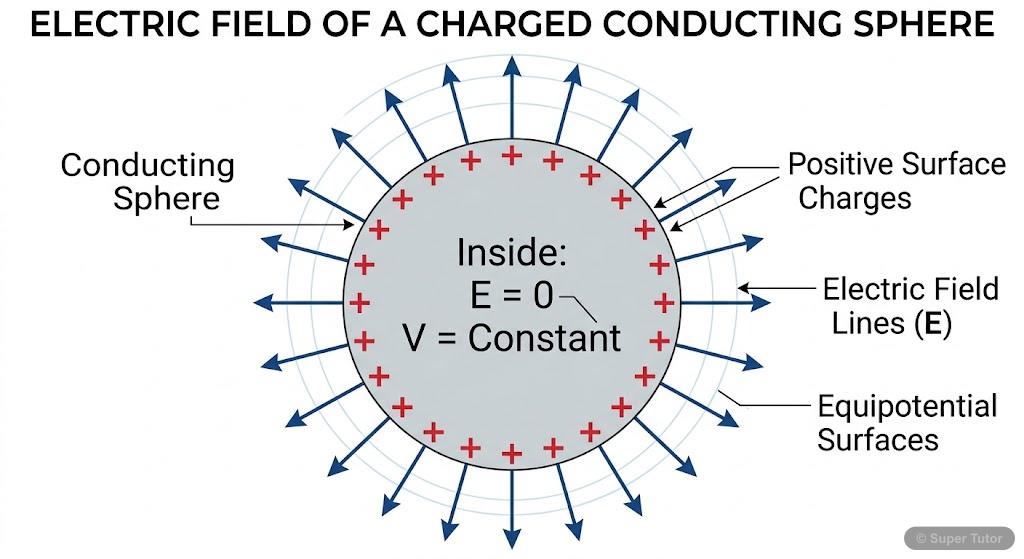
One of 24 illustrations for Electrostatic Potential and Capacitance in Super Tutor — alongside flashcards, concept maps and practice questions.
Key Topics to Revise
1. Electrostatic Potential Energy and Potential
- Coulomb force between stationary charges is a conservative force.
- Work done by an external force in moving charge q from R to P equals the change in potential energy.
- Only potential energy difference is physically significant; absolute potential energy is defined up to an additive constant.
2. Potential Due to Dipole and a System of Charges
- An electric dipole consists of charges +q and -q separated by 2a.
- Dipole moment has magnitude p = q × 2a and points from -q to q.
- Potential due to a dipole depends on both distance r and angle θ.
3. Equipotential Surfaces and Field Relation
- An equipotential surface has the same potential at every point.
- Electric field is always normal to an equipotential surface.
- For a point charge, equipotential surfaces are concentric spheres.
4. Potential Energy of Charge Systems and Dipole in External Field
- Potential energy of two point charges depends on their product and separation.
- For three charges, total potential energy is the sum of all pairwise interaction energies.
- Potential energy of a charge q in an external potential V is qV.
Get complete notes with diagrams and examples
Full NotesKey Concepts
Frequently Asked Questions
What are the important topics in Electrostatic Potential and Capacitance for Madhya Pradesh Board Class 12 Physics?
How should I revise Electrostatic Potential and Capacitance for the Madhya Pradesh Board Class 12 board exam?
Sources & Official References
Content is aligned to the official syllabus. Refer to the board website for the latest curriculum.
More resources for Electrostatic Potential and Capacitance
Practice Quiz
Test yourself with a quick quiz
Important Questions
Exam-style questions with answers
Formula Sheet
The chapter's formulas in one place
Chapter Summary
Understand the chapter at a glance
Concept Maps
See how topics connect
Study Plan
Step-by-step plan for this chapter
Flashcards
Quick-fire cards for active recall
Syllabus
What topics to cover
NCERT Solutions
Every textbook question solved step by step
For serious students
Get the full Electrostatic Potential and Capacitance chapter — start free.
Quizzes, flashcards, an AI doubt solver and a study plan for Madhya Pradesh Board Class 12 Physics. Free to start, no card needed.