Semiconductor Electronics: Materials, Devices and Simple Circuits — Revision Notes
Madhya Pradesh Board · Class 12 · Physics
Semiconductor Electronics: Materials, Devices and Simple Circuits revision notes for Madhya Pradesh Board Class 12 Physics: 4 topics in quick points.
Interactive on Super Tutor
Studying Semiconductor Electronics: Materials, Devices and Simple Circuits? Get the full interactive chapter.
Quizzes, flashcards, AI doubt-solver and a step-by-step study plan — built for revision notes and more.
Free trial, no card needed.
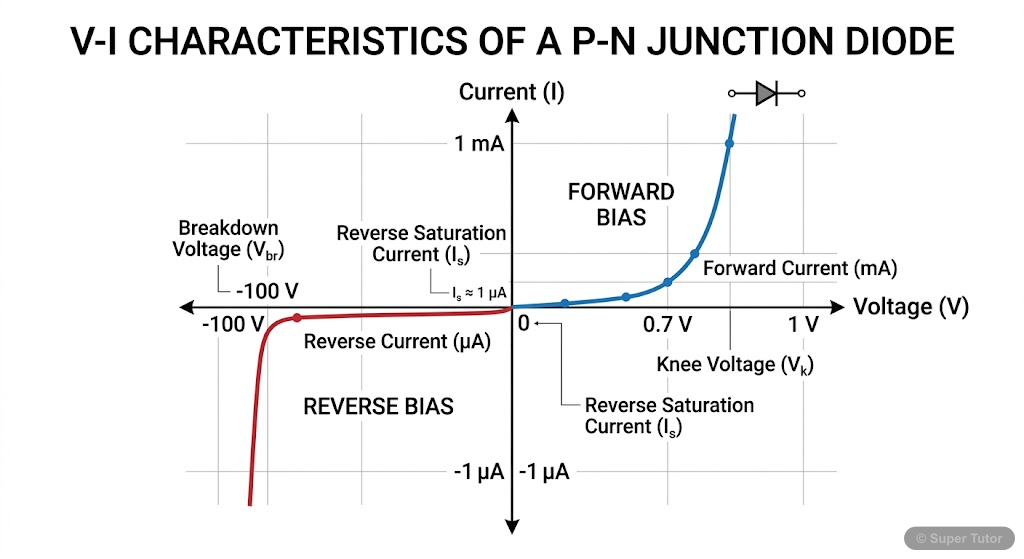
Learn better with visuals Super Tutor pairs illustrations like this with notes and quizzes for Semiconductor Electronics: Materials, Devices and Simple Circuits.
Key Topics to Revise
1. Classification of Solids and Semiconductor Types
- Solids are classified on the basis of resistivity or conductivity.
- Metals have very low resistivity and high conductivity.
- Semiconductors have intermediate resistivity.
2. Intrinsic Semiconductor and Charge Carriers
- An intrinsic semiconductor is a pure semiconductor without deliberate impurities.
- At 0 K, an intrinsic semiconductor behaves like an insulator.
- At temperatures above 0 K, thermal energy breaks some covalent bonds and creates free electrons and holes.
3. Extrinsic Semiconductor and Doping
- Adding a small amount of suitable impurity to a pure semiconductor increases its conductivity manifold.
- This process is called doping.
- The impurity atoms are called dopants.
4. p-n Junction Formation and Depletion Region
- A p-n junction is the metallurgical junction between p-region and n-region of a doped semiconductor wafer.
- It is the basic building block of diodes and many other semiconductor devices.
- Junction formation involves diffusion and drift.
Get complete notes with diagrams and examples
Full NotesKey Concepts
Frequently Asked Questions
What are the important topics in Semiconductor Electronics: Materials, Devices and Simple Circuits for Madhya Pradesh Board Class 12 Physics?
How should I revise Semiconductor Electronics: Materials, Devices and Simple Circuits for the Madhya Pradesh Board Class 12 board exam?
Sources & Official References
Content is aligned to the official syllabus. Refer to the board website for the latest curriculum.
More resources for Semiconductor Electronics: Materials, Devices and Simple Circuits
Practice Quiz
Test yourself with a quick quiz
Important Questions
Exam-style questions with answers
Formula Sheet
The chapter's formulas in one place
Chapter Summary
Understand the chapter at a glance
Concept Maps
See how topics connect
Study Plan
Step-by-step plan for this chapter
Flashcards
Quick-fire cards for active recall
Syllabus
What topics to cover
NCERT Solutions
Every textbook question solved step by step
For serious students
Get the full Semiconductor Electronics: Materials, Devices and Simple Circuits chapter — start free.
Quizzes, flashcards, an AI doubt solver and a study plan for Madhya Pradesh Board Class 12 Physics. Free to start, no card needed.