Alternating Current — Revision Notes
Madhya Pradesh Board · Class 12 · Physics
Alternating Current revision notes for Madhya Pradesh Board Class 12 Physics: 4 topics in quick points. Includes Introduction and Basic Ideas, AC Applied.
Interactive on Super Tutor
Studying Alternating Current? Get the full interactive chapter.
Quizzes, flashcards, AI doubt-solver and a step-by-step study plan — built for revision notes and more.
Free trial, no card needed.
Learn better with visuals Super Tutor pairs illustrations like this with notes and quizzes for Alternating Current.
Key Topics to Revise
1. Introduction and Basic Ideas
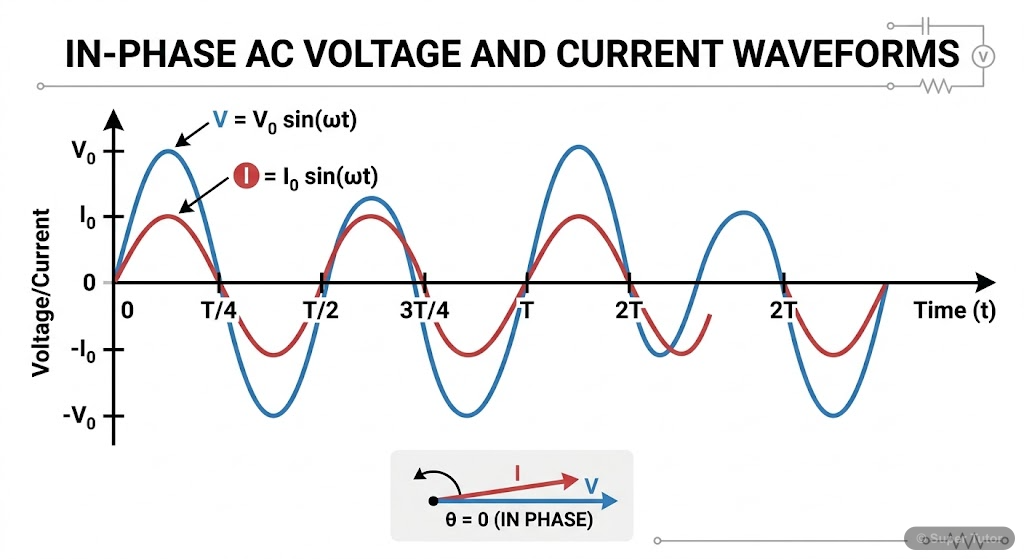
- AC voltage varies sinusoidally with time: v = v_m sin ωt.
- AC current is the current driven by AC voltage.
- AC is preferred for transmission because transformers can easily change voltage levels efficiently.
2. AC Applied to a Resistor
- For a pure resistor, current and voltage are in phase.
- The current through a resistor follows the same sinusoidal form as the voltage.
- Ohm's law works equally well for both AC and DC in a resistor.
3. AC Applied to an Inductor and a Capacitor
- In a pure inductor, current lags voltage by π/2.
- In a pure capacitor, current leads voltage by π/2.
- Phasors are rotating-vector representations, but voltage and current are scalar quantities.
4. Series LCR Circuit, Impedance, and Resonance
- In a series LCR circuit, the same current flows through R, L, and C.
- The current amplitude depends on impedance Z.
- Impedance is Z = √(R² + (X_C - X_L)²).
Get complete notes with diagrams and examples
Full NotesKey Concepts
Frequently Asked Questions
What are the important topics in Alternating Current for Madhya Pradesh Board Class 12 Physics?
How should I revise Alternating Current for the Madhya Pradesh Board Class 12 board exam?
Sources & Official References
Content is aligned to the official syllabus. Refer to the board website for the latest curriculum.
More resources for Alternating Current
Practice Quiz
Test yourself with a quick quiz
Important Questions
Exam-style questions with answers
Formula Sheet
The chapter's formulas in one place
Chapter Summary
Understand the chapter at a glance
Concept Maps
See how topics connect
Study Plan
Step-by-step plan for this chapter
Flashcards
Quick-fire cards for active recall
Syllabus
What topics to cover
NCERT Solutions
Every textbook question solved step by step
For serious students
Get the full Alternating Current chapter — start free.
Quizzes, flashcards, an AI doubt solver and a study plan for Madhya Pradesh Board Class 12 Physics. Free to start, no card needed.