Nucle — Revision Notes
Madhya Pradesh Board · Class 12 · Physics
Nucle revision notes for Madhya Pradesh Board Class 12 Physics: 4 topics in quick points. Part of the Madhya Pradesh Board Class 12 Physics syllabus.
Interactive on Super Tutor
Studying Nucle? Get the full interactive chapter.
Quizzes, flashcards, AI doubt-solver and a step-by-step study plan — built for revision notes and more.
Free trial, no card needed.
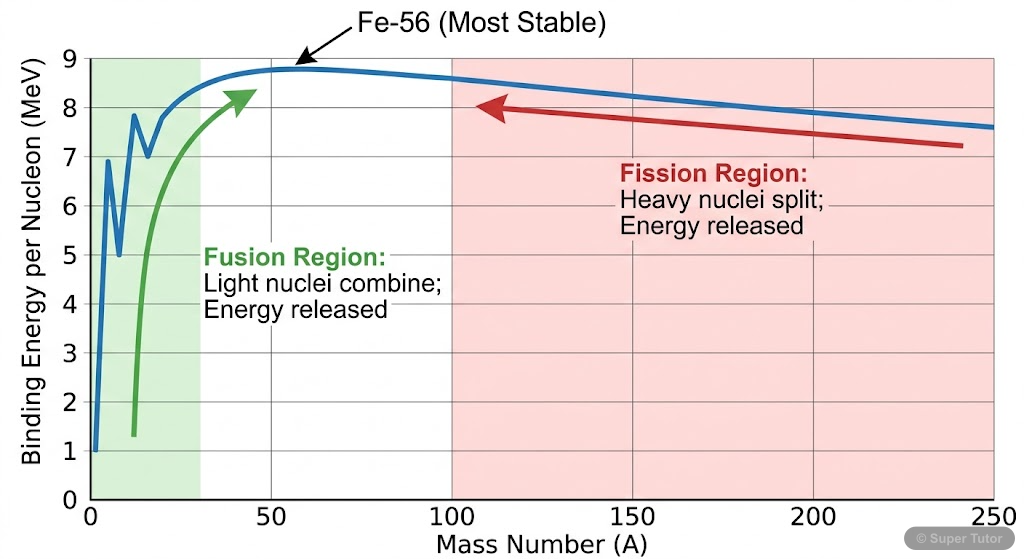
One of 15 illustrations for Nucle in Super Tutor — alongside flashcards, concept maps and practice questions.
Key Topics to Revise
1. Basic structure of the nucleus
- An atom has a small, dense, positively charged nucleus at its centre.
- The radius of a nucleus is about 10^4 times smaller than the radius of an atom.
- The volume of a nucleus is about 10^-12 times the volume of the atom.
2. Atomic masses, isotopes, isobars, and isotones
- Atomic masses are measured in atomic mass unit, u, because kilogram is too large for atomic-scale masses.
- 1 u is defined as 1/12 of the mass of one 12C atom.
- Atomic masses of many elements are close to integral multiples of hydrogen mass, but chlorine is a notable exception with atomic mass 35.46 u.
3. Discovery of neutron and neutron properties
- James Chadwick verified the existence of the neutron in 1932 by bombarding beryllium nuclei with alpha-particles.
- Chadwick was awarded the 1935 Nobel Prize in Physics for the discovery of the neutron.
- A free neutron is unstable and decays into a proton, an electron, and an antineutrino.
4. Nuclear size and density
- Rutherford established the existence of the atomic nucleus through alpha-particle scattering.
- Geiger and Marsden performed the classic alpha-particle scattering experiment on thin gold foils.
- For a 5.5 MeV alpha particle, the distance of closest approach to gold nucleus is about 4.0 × 10^-14 m.
Get complete notes with diagrams and examples
Full NotesKey Concepts
Frequently Asked Questions
What are the important topics in Nucle for Madhya Pradesh Board Class 12 Physics?
How should I revise Nucle for the Madhya Pradesh Board Class 12 board exam?
Sources & Official References
Content is aligned to the official syllabus. Refer to the board website for the latest curriculum.
More resources for Nucle
Practice Quiz
Test yourself with a quick quiz
Important Questions
Exam-style questions with answers
Formula Sheet
The chapter's formulas in one place
Chapter Summary
Understand the chapter at a glance
Concept Maps
See how topics connect
Study Plan
Step-by-step plan for this chapter
Flashcards
Quick-fire cards for active recall
Syllabus
What topics to cover
NCERT Solutions
Every textbook question solved step by step
For serious students
Get the full Nucle chapter — start free.
Quizzes, flashcards, an AI doubt solver and a study plan for Madhya Pradesh Board Class 12 Physics. Free to start, no card needed.