Attitude and Social Cognition — Important Questions
Madhya Pradesh Board · Class 12 · Psychology
50 important questions from Attitude and Social Cognition for Madhya Pradesh Board Class 12 Psychology, with answers. Written for the board exams 2027.
Interactive on Super Tutor
Studying Attitude and Social Cognition? Get the full interactive chapter.
Quizzes, flashcards, AI doubt-solver and a step-by-step study plan — built for important questions and more.
Free trial, no card needed.
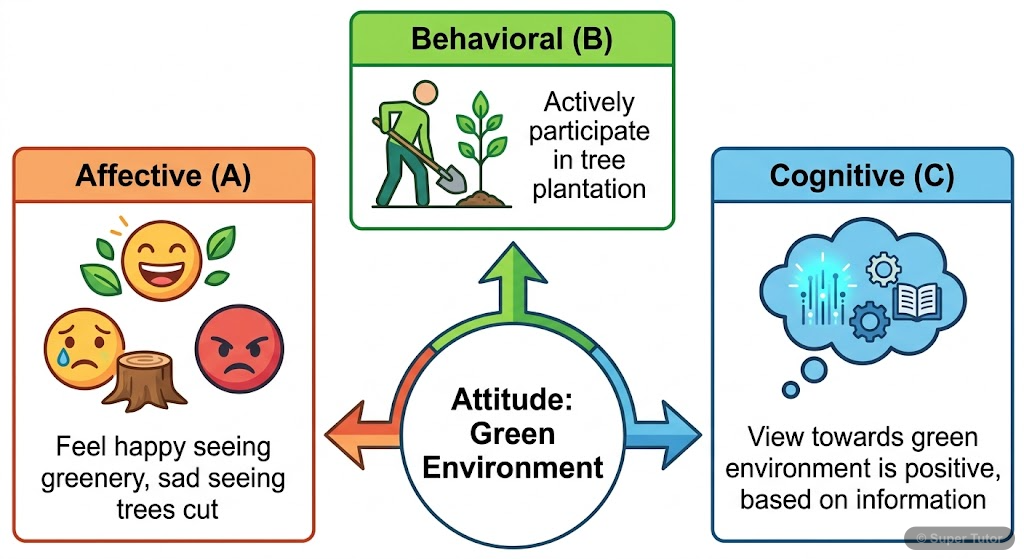
Learn better with visuals Super Tutor pairs illustrations like this with notes and quizzes for Attitude and Social Cognition.
Important Questions from Attitude and Social Cognition
Which of the following are ways attitudes can be formed? (Select all correct answers)
Show answer
Learning by association, Being rewarded or punished, Observing others (modeling), Group or cultural norms
Attitudes are formed through multiple learning processes including association, reinforcement, modeling, and cultural norms. While genetics may have some indirect influence, attitudes are primarily learned through social interaction and experience.
Which factors influence attitude formation? (Select all correct answers)
Show answer
Family and school environment, Reference groups, Personal experiences, Media influences
The main factors influencing attitude formation are family and school environment, reference groups, personal experiences, and media influences. These provide the social context for learning attitudes.
The two-step concept of attitude change was proposed by:
Show answer
S.M. Mohsin
S.M. Mohsin, an Indian psychologist, proposed the two-step concept where attitude change first requires identification with the source, followed by the source showing attitude change themselves.
Prejudice typically includes which components? (Select all correct answers)
Show answer
Stereotypes (cognitive component), Negative emotions like dislike or hatred (affective component), Discrimination (behavioral component)
Prejudice involves stereotypes (cognitive), negative emotions (affective), and may lead to discrimination (behavioral). It is typically negative toward the target group.
+46 more questions on Attitude and Social Cognition (Madhya Pradesh Board Class 12 Psychology)
Practise AllFrequently Asked Questions
What are the important topics in Attitude and Social Cognition for Madhya Pradesh Board Class 12 Psychology?
How many important questions are there in Attitude and Social Cognition?
Sources & Official References
Content is aligned to the official syllabus. Refer to the board website for the latest curriculum.
More resources for Attitude and Social Cognition
Practice Quiz
Test yourself with a quick quiz
Revision Notes
Key points for last-minute revision
Chapter Summary
Understand the chapter at a glance
Concept Maps
See how topics connect
Study Plan
Step-by-step plan for this chapter
Flashcards
Quick-fire cards for active recall
Syllabus
What topics to cover
NCERT Solutions
Every textbook question solved step by step
For serious students
Get the full Attitude and Social Cognition chapter — start free.
Quizzes, flashcards, an AI doubt solver and a study plan for Madhya Pradesh Board Class 12 Psychology. Free to start, no card needed.