Attitude and Social Cognition — Chapter Summary
Madhya Pradesh Board · Class 12 · Psychology
Summary of Attitude and Social Cognition for Madhya Pradesh Board Class 12 Psychology. Part of the Madhya Pradesh Board Class 12 Psychology syllabus.
Interactive on Super Tutor
Studying Attitude and Social Cognition? Get the full interactive chapter.
Quizzes, flashcards, AI doubt-solver and a step-by-step study plan — built for chapter summary and more.
Free trial, no card needed.
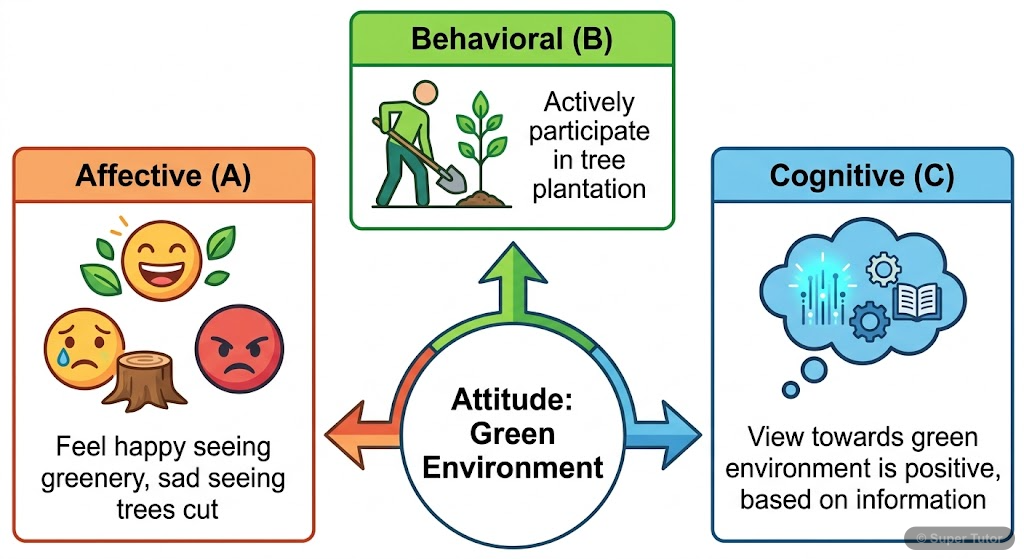
Learn better with visuals Super Tutor pairs illustrations like this with notes and quizzes for Attitude and Social Cognition.
Overview
Social psychology studies how the behaviour of individuals is affected by others and the social environment. Attitudes are important because they are ways of thinking, feeling, and acting toward a person, object, or issue. They cannot be observed directly from outside, yet they strongly influence so
Key Concepts
An attitude is a state
An attitude is a state of mind or a set of views about some attitude object. It has a cognitive component, an affective component, and a behavioural t
The three components of attitude
The three components of attitude are cognitive, affective, and behavioural. The cognitive aspect involves thoughts and beliefs, the affective aspect i
Beliefs form the cognitive ground
Beliefs form the cognitive ground of attitudes. Values contain a 'should' or 'ought' aspect and become harder to change because they become part of a
Valence means whether an attitude
Valence means whether an attitude is positive, negative, or neutral toward the attitude object. A neutral attitude is lowest on extremeness.
Extremeness shows how strongly positive
Extremeness shows how strongly positive or negative an attitude is. Extreme attitudes are harder to change than less extreme ones.
Learning Objectives
- Understand the meaning of attitude and social cognition
- Identify the cognitive, affective, and behavioural components of attitude
- Distinguish attitudes from beliefs and values
- Describe major features of attitudes such as valence, extremeness, simplicity or complexity, and centrality
- Explain how attitudes are formed through learning, experience, norms, media, and reference groups
Frequently Asked Questions
What are the important topics in Attitude and Social Cognition for Madhya Pradesh Board Class 12 Psychology?
How should I revise Attitude and Social Cognition for the Madhya Pradesh Board Class 12 board exam?
Sources & Official References
Content is aligned to the official syllabus. Refer to the board website for the latest curriculum.
More resources for Attitude and Social Cognition
Practice Quiz
Test yourself with a quick quiz
Important Questions
Exam-style questions with answers
Revision Notes
Key points for last-minute revision
Concept Maps
See how topics connect
Study Plan
Step-by-step plan for this chapter
Flashcards
Quick-fire cards for active recall
Syllabus
What topics to cover
NCERT Solutions
Every textbook question solved step by step
For serious students
Get the full Attitude and Social Cognition chapter — start free.
Quizzes, flashcards, an AI doubt solver and a study plan for Madhya Pradesh Board Class 12 Psychology. Free to start, no card needed.