Attitude and Social Cognition — Syllabus
Madhya Pradesh Board · Class 12 · Psychology
What Attitude and Social Cognition covers in Madhya Pradesh Board Class 12 Psychology: 4 topics, for the 2026-27 session.
Interactive on Super Tutor
Studying Attitude and Social Cognition? Get the full interactive chapter.
Quizzes, flashcards, AI doubt-solver and a step-by-step study plan — built for syllabus and more.
Free trial, no card needed.
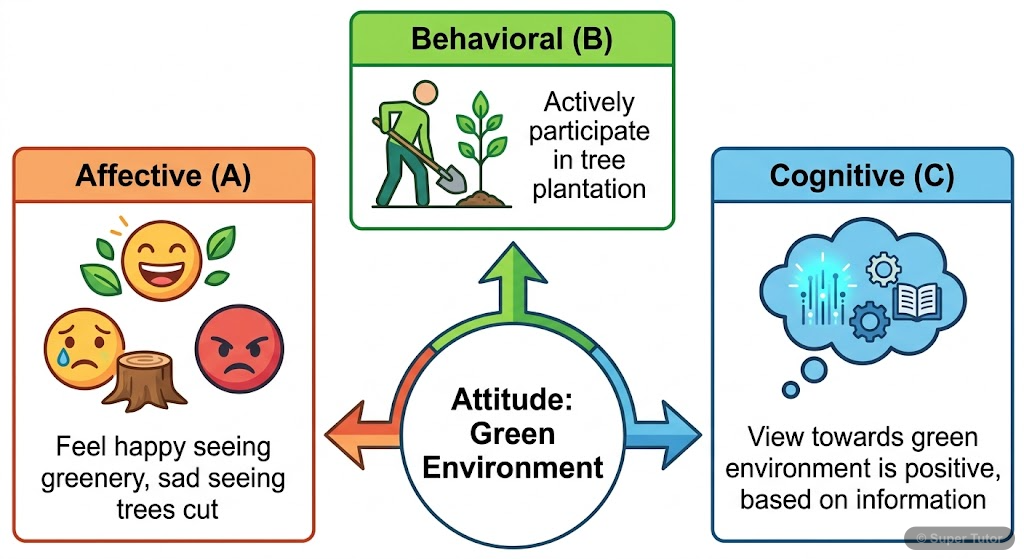
Learn better with visuals Super Tutor pairs illustrations like this with notes and quizzes for Attitude and Social Cognition.
Topics in Attitude and Social Cognition
Nature and Components of Attitudes
- Attitudes are states of mind or sets of views about an attitude object.
- An attitude has three components: cognitive, affective, and behavioural.
- The cognitive component is the thought or belief aspect.
Attitude Formation
- Attitudes towards different topics, things and people are formed as people interact with others.
- Attitudes are learned through personal experience and social interaction.
- Genetic factors influence attitudes only indirectly, along with learning.
Attitude Change
- Attitudes that are still forming are easier to change than firmly established attitudes.
- Positive attitudes are easier to change than negative attitudes.
- Extreme and central attitudes are harder to change than less extreme and peripheral attitudes.
Major Theories and Studies of Attitude Change
- Fritz Heider proposed the concept of balance.
- Balance theory uses the P-O-X triangle.
- Leon Festinger proposed cognitive dissonance.
Key Concepts
Central concept: Attitude and Social Cognition
Work through every topic in Attitude and Social Cognition with notes and quizzes
Start This ChapterFrequently Asked Questions
What are the important topics in Attitude and Social Cognition for Madhya Pradesh Board Class 12 Psychology?
How should I revise Attitude and Social Cognition for the Madhya Pradesh Board Class 12 board exam?
Sources & Official References
Content is aligned to the official syllabus. Refer to the board website for the latest curriculum.
More resources for Attitude and Social Cognition
Practice Quiz
Test yourself with a quick quiz
Important Questions
Exam-style questions with answers
Revision Notes
Key points for last-minute revision
Chapter Summary
Understand the chapter at a glance
Concept Maps
See how topics connect
Study Plan
Step-by-step plan for this chapter
Flashcards
Quick-fire cards for active recall
NCERT Solutions
Every textbook question solved step by step
For serious students
Get the full Attitude and Social Cognition chapter — start free.
Quizzes, flashcards, an AI doubt solver and a study plan for Madhya Pradesh Board Class 12 Psychology. Free to start, no card needed.