Variations in Psychological Attributes — NCERT Solutions
Madhya Pradesh Board · Class 12 · Psychology
NCERT Solutions for Variations in Psychological Attributes, Madhya Pradesh Board Class 12 Psychology: 14 textbook questions solved step by step.
Interactive on Super Tutor
Studying Variations in Psychological Attributes? Get the full interactive chapter.
Quizzes, flashcards, AI doubt-solver and a step-by-step study plan — built for NCERT solutions and more.
Free trial, no card needed.
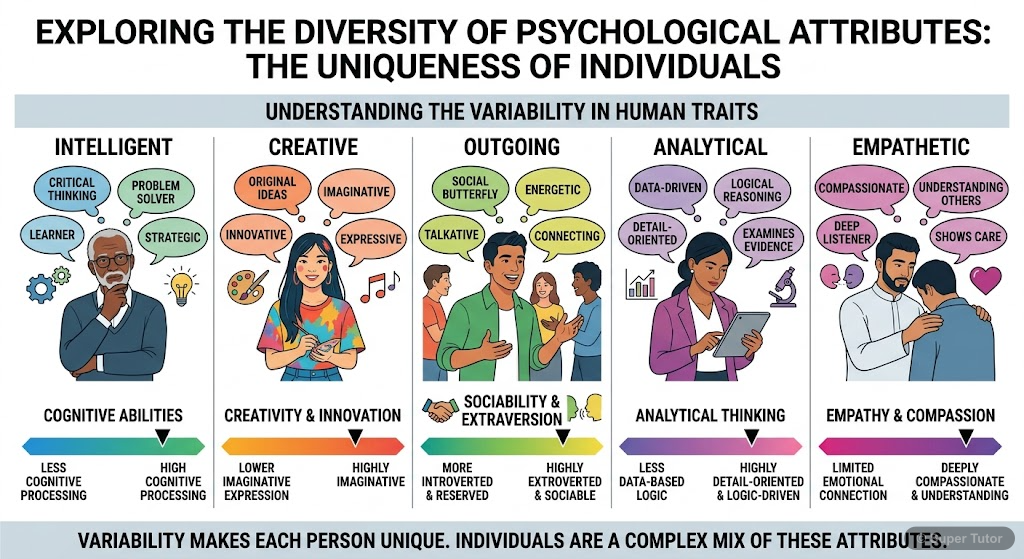
One of 16 illustrations for Variations in Psychological Attributes in Super Tutor — alongside flashcards, concept maps and practice questions.
The first 7 solutions are open to read. The other 7 are free with a Super Tutor account.
Review Questions — Chapter 1: Variations in Psychological Attributes
1How do psychologists characterise and define intelligence?Show solution
Given/Context: The question asks about the psychological characterisation and definition of intelligence.
Answer:
Psychologists have defined and characterised intelligence in several ways:
- General Definition: Intelligence refers to an individual's capacity to understand the world, think rationally, and use resources effectively when faced with challenges or demands of life.
- Psychometric Approach: Early psychologists like Binet and later Spearman characterised intelligence as a measurable set of abilities. Spearman proposed a two-factor theory — a general factor () underlying all intellectual tasks, and specific factors () for particular tasks.
- Multiple Abilities View: Thurstone identified Primary Mental Abilities (verbal comprehension, numerical ability, spatial ability, etc.), suggesting intelligence is not a single entity but a cluster of distinct abilities.
- Information-Processing Approach: Sternberg defined intelligence as the mental processes used to plan and solve problems. Das described it through the PASS model (Planning, Attention-Arousal, Simultaneous, Successive processing).
- Multiple Intelligences (Gardner): Howard Gardner characterised intelligence as eight distinct types of abilities (linguistic, logical-mathematical, spatial, musical, bodily-kinaesthetic, interpersonal, intrapersonal, naturalist).
- Emotional Intelligence (Goleman): Intelligence also includes the ability to perceive, manage, and regulate emotions in oneself and others.
Conclusion: In summary, psychologists characterise intelligence as a multi-dimensional construct involving cognitive abilities, problem-solving skills, adaptability, and even emotional competence. It is both a product of heredity and environment.
2To what extent is our intelligence the result of heredity (nature) and environment (nurture)? Discuss.Show solution
Given/Context: The question asks about the relative contributions of heredity (nature) and environment (nurture) to intelligence.
Answer:
The debate over nature vs. nurture is one of the oldest in psychology. Both factors contribute significantly to intellectual development.
Role of Heredity (Nature):
- Studies on twins show that identical twins (MZ twins) reared apart have more similar IQ scores than fraternal twins (DZ twins) reared together, indicating a strong genetic component.
- Adopted children's IQ scores correlate more strongly with their biological parents than with their adoptive parents.
- Heritability estimates suggest that genetics accounts for approximately 50–70% of the variance in IQ scores in adults.
Role of Environment (Nurture):
- Children raised in enriched, stimulating environments tend to score higher on intelligence tests.
- Studies show that malnutrition, poverty, lack of education, and poor healthcare can significantly lower intellectual performance.
- The Flynn Effect — the steady rise in average IQ scores across generations worldwide — is attributed to environmental improvements (better nutrition, education, healthcare), not genetic changes.
- Early childhood interventions (e.g., Head Start programmes) have been shown to raise IQ scores in disadvantaged children.
Interaction of Nature and Nurture:
- Intellectual development is best understood as a complex interplay of genetic potential and environmental conditions.
- A child may be born with high genetic potential, but without a supportive environment, that potential may not be realised.
- Conversely, a rich environment can help a child with average genetic endowment achieve higher intellectual performance.
Conclusion: Neither heredity nor environment alone determines intelligence. It is the dynamic interaction between the two that shapes an individual's intellectual capacity. Most psychologists today agree that both nature and nurture are essential and inseparable contributors to intelligence.
3Explain briefly the multiple intelligences identified by Gardner.Show solution
Given/Context: Howard Gardner proposed the Theory of Multiple Intelligences, challenging the notion of a single, general intelligence.
Answer:
Howard Gardner proposed that there are eight distinct types of intelligence, each representing a different way of processing information:
| Intelligence | Description | Example |
|---|---|---|
| 1. Linguistic | Ability to use language effectively, both written and spoken. | Poets, writers, orators |
| 2. Logical-Mathematical | Ability to think logically, reason abstractly, and solve mathematical problems. | Scientists, mathematicians |
| 3. Spatial | Ability to perceive the visual-spatial world accurately and to transform perceptions. | Architects, painters, navigators |
| 4. Musical | Sensitivity to pitch, melody, rhythm, and tone; ability to produce and appreciate music. | Musicians, composers |
| 5. Bodily-Kinaesthetic | Ability to use one's body skillfully and to handle objects adroitly. | Dancers, athletes, surgeons |
| 6. Interpersonal | Ability to understand other people — their moods, motivations, and intentions. | Teachers, counsellors, politicians |
| 7. Intrapersonal | Ability to understand oneself — one's own feelings, fears, and motivations. | Philosophers, psychologists |
| 8. Naturalist | Ability to recognise and categorise objects in nature (plants, animals, minerals). | Biologists, farmers, naturalists |
Key Points:
- Gardner argued that traditional IQ tests measure only linguistic and logical-mathematical intelligence, ignoring the other six.
- Each intelligence is relatively independent of the others.
- Every individual possesses all eight intelligences to varying degrees.
Conclusion: Gardner's theory broadened our understanding of intelligence by recognising diverse human talents and abilities beyond academic skills.
4How does the triarchic theory help us to understand intelligence?Show solution
Given/Context: Robert Sternberg proposed the Triarchic Theory of Intelligence, which describes intelligence in terms of three broad components.
Answer:
Sternberg's Triarchic Theory proposes that intelligence comprises three distinct but interrelated abilities:
1. Componential Intelligence (Analytical Intelligence):
- This refers to the mental components used to solve problems.
- It involves three types of mental processes:
- Metacomponents — higher-order processes used for planning and decision-making.
- Performance components — processes used to execute the plan.
- Knowledge-acquisition components — processes used to learn new information.
- This is the type of intelligence measured by traditional IQ tests.
- Example: Analysing a poem, solving a logical puzzle.
2. Experiential Intelligence (Creative Intelligence):
- This refers to the ability to deal with novel situations and to use past experience creatively.
- Intelligent people can automate routine tasks and apply existing knowledge to new problems.
- Example: A scientist designing a new experiment, an artist creating an original work.
3. Contextual Intelligence (Practical Intelligence):
- This refers to the ability to adapt to, shape, or select real-world environments — often called 'street smartness'.
- It involves three strategies:
- Adaptation — adjusting oneself to the environment.
- Shaping — changing the environment to suit oneself.
- Selection — choosing a new environment.
- Example: A businessperson negotiating a deal, a person managing social relationships effectively.
How it helps us understand intelligence:
- The triarchic theory goes beyond IQ and explains why some people who score low on IQ tests are highly successful in real life.
- It recognises that intelligence is not just about academic ability but also about creativity and practical problem-solving.
- It provides a more comprehensive and realistic picture of human intelligence.
Conclusion: Sternberg's triarchic theory helps us understand that intelligence is multifaceted, encompassing analytical, creative, and practical dimensions, all of which are necessary for success in life.
5"Any intellectual activity involves the independent functioning of three neurological systems". Explain with reference to PASS model.Show solution
Given/Context: J.P. Das and his colleagues proposed the PASS model of intelligence based on Luria's neuropsychological work.
Answer:
The PASS Model (proposed by J.P. Das, Jack Naglieri, and Kirby) stands for Planning, Attention-Arousal, Simultaneous processing, and Successive processing. It is based on the idea that the brain has three functional units, each responsible for different aspects of cognitive processing.
The Three Neurological Systems (Functional Units):
1. Attention-Arousal (First Functional Unit):
- Located in the brain stem and reticular activating system.
- Responsible for maintaining alertness, arousal, and focused attention.
- Without proper attention, no cognitive task can be performed effectively.
- Example: Staying alert while reading a complex text.
2. Simultaneous and Successive Processing (Second Functional Unit):
- Located in the occipital, parietal, and temporal lobes of the brain.
- Simultaneous Processing: Integrating stimuli into a whole or group at one time. Spatial and logical tasks require this.
- Example: Understanding a map, solving a geometry problem.
- Successive Processing: Arranging stimuli in a specific serial order, one after another.
- Example: Remembering a sequence of numbers, following step-by-step instructions.
3. Planning (Third Functional Unit):
- Located in the frontal lobe of the brain.
- Responsible for setting goals, selecting strategies, monitoring progress, and evaluating outcomes.
- It is the highest level of cognitive functioning.
- Example: Planning how to study for an examination, deciding the steps to solve a complex problem.
How the Three Systems Work Together:
- Any intellectual activity requires the coordinated but independent functioning of all three systems.
- For example, solving a mathematics problem requires: Attention (to focus on the problem), Simultaneous/Successive processing (to understand relationships or follow steps), and Planning (to decide the method of solution).
Conclusion: The PASS model provides a neurologically grounded explanation of intelligence, showing that intellectual activity is not a single process but involves three distinct yet interacting brain systems. This model is particularly useful in identifying learning disabilities and designing remedial programmes.
6Are there cultural differences in the conceptualisation of intelligence?Show solution
Given/Context: The question asks whether different cultures define and understand intelligence differently.
Answer:
Yes, there are significant cultural differences in the conceptualisation of intelligence. What is considered 'intelligent behaviour' varies across cultures.
Western Conceptualisation:
- Western cultures (particularly American and European) emphasise 'technological intelligence'.
- Key features valued:
- Speed of mental processing
- Analytical and logical thinking
- Individual achievement and competition
- Performance on standardised tests
- Intelligence is largely seen as a cognitive, individual attribute measured by IQ scores.
Non-Western Conceptualisation:
- Non-western cultures place greater value on social and emotional competence.
- Key features valued:
- Self-reflection and wisdom
- Cooperation and social harmony
- Emotional regulation
- Practical knowledge relevant to daily life
- For example, in many African cultures, intelligence includes being responsible, cooperative, and considerate of others.
- In Chinese culture, intelligence involves humility, awareness of social situations, and self-knowledge.
Indian Conceptualisation:
- Indian culture promotes 'integral intelligence' (also called Buddhi).
- It emphasises:
- Connectivity with people and the larger social world
- Moral and spiritual development
- Sensitivity to others' needs
- Cognitive abilities combined with social and emotional wisdom
- The concept of intelligence in India is more holistic, integrating cognitive, social, emotional, and moral dimensions.
Implications:
- Most standardised intelligence tests are developed in Western contexts and may be culturally biased.
- A person who scores low on a Western IQ test may still be highly intelligent in the context of their own culture.
- This has led to the development of culturally-fair tests that attempt to minimise cultural bias.
Conclusion: Intelligence is not a culturally neutral concept. Different cultures define, value, and nurture different aspects of intelligent behaviour, reflecting their unique social, historical, and philosophical traditions.
7What is IQ? How do psychologists classify people on the basis of their IQ scores?Show solution
Given/Context: The question asks about the concept of IQ and the classification of individuals based on IQ scores.
Answer:
What is IQ?
IQ stands for Intelligence Quotient. It is a numerical measure of a person's intelligence relative to others of the same age group.
Originally, IQ was calculated using the formula proposed by William Stern and later used by Terman:
- Mental Age (MA): The level of intellectual functioning corresponding to a given age group.
- Chronological Age (CA): The actual biological age of the person.
Example: If a child has a mental age of 12 years but a chronological age of 10 years:
Modern IQ tests use Deviation IQ, which compares an individual's score to the average score of their age group, with a mean of 100 and a standard deviation of 15.
Classification of People Based on IQ Scores:
| IQ Range | Classification |
|---|---|
| 130 and above | Gifted / Very Superior |
| 120 – 129 | Superior |
| 110 – 119 | High Average |
| 90 – 109 | Average (Normal) |
| 80 – 89 | Low Average |
| 70 – 79 | Borderline |
| Below 70 | Intellectually Disabled (Mental Retardation) |
Key Points:
- The majority of people (about 68%) fall in the average range (IQ 85–115).
- IQ scores follow a normal distribution (bell curve).
- At the two extremes are the intellectually gifted (IQ above 130) and the intellectually disabled (IQ below 70).
- Intellectually disabled individuals are further classified into mild, moderate, severe, and profound categories.
Conclusion: IQ is a widely used but not the only measure of intelligence. It provides a standardised way to compare intellectual abilities across individuals of the same age group.
Free with a Super Tutor account
Free with a Super Tutor account
Free with a Super Tutor account
Free with a Super Tutor account
Free with a Super Tutor account
Activities
Free with a Super Tutor account
Free with a Super Tutor account
7 more solved questions in Variations in Psychological Attributes
They are free with a Super Tutor account, along with practice quizzes and flashcards for this chapter. Free to start, no card needed.
Frequently Asked Questions
What are the important topics in Variations in Psychological Attributes for Madhya Pradesh Board Class 12 Psychology?
Are these NCERT Solutions for Variations in Psychological Attributes free?
How should I revise Variations in Psychological Attributes for the Madhya Pradesh Board Class 12 board exam?
Sources & Official References
Content is aligned to the official syllabus. Refer to the board website for the latest curriculum.
More resources for Variations in Psychological Attributes
Practice Quiz
Test yourself with a quick quiz
Important Questions
Exam-style questions with answers
Revision Notes
Key points for last-minute revision
Chapter Summary
Understand the chapter at a glance
Concept Maps
See how topics connect
Study Plan
Step-by-step plan for this chapter
Flashcards
Quick-fire cards for active recall
Syllabus
What topics to cover
For serious students
Get the full Variations in Psychological Attributes chapter — start free.
Quizzes, flashcards, an AI doubt solver and a study plan for Madhya Pradesh Board Class 12 Psychology. Free to start, no card needed.