Self and Personality — NCERT Solutions
Madhya Pradesh Board · Class 12 · Psychology
NCERT Solutions for Self and Personality, Madhya Pradesh Board Class 12 Psychology: 11 textbook questions solved step by step.
Interactive on Super Tutor
Studying Self and Personality? Get the full interactive chapter.
Quizzes, flashcards, AI doubt-solver and a step-by-step study plan — built for NCERT solutions and more.
Free trial, no card needed.
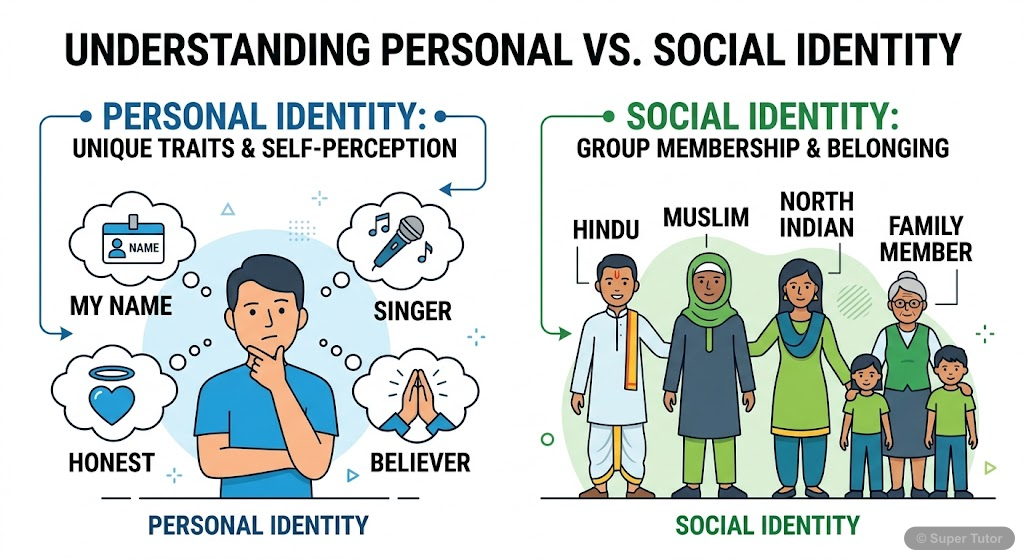
One of 26 illustrations for Self and Personality in Super Tutor — alongside flashcards, concept maps and practice questions.
The first 6 solutions are open to read. The other 5 are free with a Super Tutor account.
Review Questions — Chapter 2: Self and Personality
1What is self? How does the Indian notion of self differ from the Western notion?Show solution
What is Self?
The self refers to the totality of an individual's conscious experiences, ideas, thoughts, and feelings with regard to herself or himself. It is the awareness of one's own identity — who one is, what one values, and how one relates to others and the world.
The self has several components:
- Personal self – one's private identity, unique traits, and inner experiences.
- Social self – how one presents oneself in social situations.
- Relational self – identity defined through relationships with others.
Indian Notion of Self vs. Western Notion:
| Dimension | Western Notion | Indian Notion |
|---|---|---|
| Basic orientation | Individualistic — the self is seen as independent, autonomous, and separate from others. | Collectivistic / Spiritual — the self is seen as interdependent, embedded in family, community, and cosmos. |
| Boundaries | Self has clear, firm boundaries; personal goals and achievements are prioritised. | Self has fluid boundaries; group harmony and social duties are prioritised. |
| Identity | Identity is defined by personal attributes, achievements, and uniqueness. | Identity is defined by roles, relationships, and one's place in the social/cosmic order. |
| Ultimate goal | Self-actualisation and personal fulfilment. | Moksha (liberation) — transcending the individual ego to merge with the universal self (Atman = Brahman). |
| Locus | The individual is the basic unit of analysis. | The group (family, community) is the basic unit; the individual self is subordinate to it. |
| Nature of self | The self is relatively stable and fixed. | The self is seen as changeable and ultimately illusory (Maya); the true self is spiritual. |
Conclusion: The Western notion emphasises individuality, autonomy, and self-expression, whereas the Indian notion emphasises interconnectedness, duty (dharma), and spiritual transcendence of the ego-self.
2What is meant by delay of gratification? Why is it considered important for adult development?Show solution
Delay of Gratification:
Delay of gratification refers to the ability to resist an immediate, smaller reward in order to obtain a larger, more valuable reward at a later time. It is a form of self-regulation or self-control — the capacity to manage one's impulses and defer immediate pleasure for long-term benefit.
Example: A student who resists watching television and instead studies for an examination is delaying gratification.
The concept was famously studied by Walter Mischel through the Marshmallow Test, in which young children were offered one marshmallow immediately or two marshmallows if they waited.
Importance for Adult Development:
- Academic and professional success: Children who could delay gratification were found to have better academic performance, higher SAT scores, and greater professional achievements in adulthood.
- Emotional regulation: The ability to delay gratification is linked to better emotional control, lower levels of frustration, and greater resilience under stress.
- Social competence: Individuals who can delay gratification tend to be more socially skilled, cooperative, and better at maintaining relationships.
- Health and well-being: It is associated with healthier lifestyle choices — avoiding substance abuse, maintaining a balanced diet, and exercising regularly.
- Goal-directed behaviour: It enables individuals to set long-term goals and work persistently towards them, which is essential for adult achievement and fulfilment.
Conclusion: Delay of gratification is a critical component of self-regulation and is considered a strong predictor of positive outcomes across multiple domains of adult life.
3How do you define personality? What are the main approaches to the study of personality?Show solution
Definition of Personality:
Personality refers to the relatively stable and enduring psychophysical characteristics of a person that make her/him unique and determine how she/he thinks, feels, and behaves across different situations and over time.
Key features of personality:
- It is relatively stable (consistent across situations and time).
- It is unique to each individual.
- It involves both psychological (mental) and physical (biological) characteristics.
- It helps the individual adapt to the environment.
Main Approaches to the Study of Personality:
- Typological Approach:
- Attempts to classify people into a few distinct types based on a cluster of traits.
- Example: Sheldon's body-type theory (endomorph, mesomorph, ectomorph); Hippocrates' four humours.
- Allport, Cattell, and Eysenck advocated the trait approach, which identifies stable dimensions of personality (e.g., Eysenck's Introversion–Extraversion and Neuroticism).
- Psychodynamic Approach (Freud):
- Personality is shaped by unconscious conflicts among the id (instinctual drives), ego (rational mediator), and superego (moral conscience).
- Development occurs through psychosexual stages: oral, anal, phallic, latency, and genital.
- Post-Freudians (Jung, Adler, Horney, Erikson) emphasised social and ego forces.
- Behavioural Approach:
- Personality is the sum total of an individual's learned responses to environmental stimuli.
- The structural unit is the response, emitted to satisfy a specific need.
- Bandura's Social Learning Theory added the role of observation and self-efficacy.
- Cultural Approach:
- Personality is shaped by the cultural demands placed on individuals by their economic and social environment.
- Different cultures produce different personality patterns through child-rearing practices and social norms.
- Humanistic Approach:
- Focuses on subjective experience, free will, and the potential for growth.
- Rogers emphasised congruence between the real self and the ideal self.
- Maslow proposed a hierarchy of needs, with self-actualisation at the top.
Conclusion: Each approach offers a different lens to understand personality, and together they provide a comprehensive picture of human individuality.
4What is trait approach to personality? How does it differ from type approach?Show solution
Trait Approach to Personality:
A trait is a relatively stable, consistent, and enduring characteristic or disposition that influences an individual's behaviour across a variety of situations. The trait approach attempts to identify, describe, and measure these stable dimensions of personality.
Key theorists:
- Gordon Allport classified traits into cardinal traits (dominant), central traits (general characteristics), and secondary traits (situational).
- Raymond Cattell used factor analysis to identify 16 source traits (measured by the 16PF questionnaire).
- Hans Eysenck identified two major dimensions: Introversion–Extraversion and Neuroticism–Stability, later adding Psychoticism.
- The Big Five model (OCEAN) identifies five broad traits: Openness, Conscientiousness, Extraversion, Agreeableness, and Neuroticism.
Type Approach to Personality:
The type approach classifies people into a small number of discrete categories or types, each characterised by a specific cluster of traits. A person either belongs to a type or does not.
Examples:
- Hippocrates' four temperament types (sanguine, choleric, melancholic, phlegmatic).
- Sheldon's somatotypes (endomorph, mesomorph, ectomorph).
- Jung's introvert vs. extrovert types.
Differences between Trait Approach and Type Approach:
| Dimension | Trait Approach | Type Approach |
|---|---|---|
| Nature | Describes personality along continuous dimensions (a matter of degree). | Classifies people into discrete categories (either/or). |
| Flexibility | More flexible; recognises that people differ in the degree to which they possess a trait. | Less flexible; places people into fixed boxes. |
| Complexity | Captures the complexity and uniqueness of individuals. | Oversimplifies personality by forcing people into a few categories. |
| Measurement | Traits are measured on scales (e.g., high to low extraversion). | Types are assigned categorically. |
| View of individual | Offers a unified, multidimensional view of a person. | Provides a broad, generalised description. |
Conclusion: The trait approach is more nuanced and scientifically rigorous than the type approach, as it acknowledges that personality characteristics exist on a continuum rather than in fixed categories.
5How does Freud explain the structure of personality?Show solution
Freud's Structural Model of Personality:
Sigmund Freud, the founder of psychoanalysis, proposed that personality is structured into three distinct but interacting systems: the Id, the Ego, and the Superego. Personality emerges from the constant dynamic conflict among these three systems.
1. Id (The Pleasure Principle):
- The id is the most primitive part of personality, present from birth.
- It is entirely unconscious and contains all the basic biological drives and instincts (hunger, sex, aggression).
- It operates on the pleasure principle — it seeks immediate gratification of desires without regard for reality or morality.
- It uses primary process thinking (wish-fulfilment, fantasy).
- Example: A newborn crying immediately when hungry is driven purely by the id.
2. Ego (The Reality Principle):
- The ego develops from the id as the child interacts with the real world (around age 2–3).
- It operates on the reality principle — it mediates between the demands of the id, the superego, and external reality.
- It uses secondary process thinking (logical, rational thought).
- The ego decides when, how, and whether to satisfy id impulses in a socially acceptable manner.
- It operates at conscious, preconscious, and unconscious levels.
- Example: A person who is hungry waits until an appropriate time to eat rather than grabbing food immediately.
3. Superego (The Morality Principle):
- The superego develops around age 4–5 through internalisation of parental and societal values and moral standards.
- It represents the moral conscience and the ego ideal (what one aspires to be).
- It operates on the morality principle — it strives for perfection and punishes the ego with guilt when moral standards are violated.
- It is partly conscious and partly unconscious.
- Example: Feeling guilty after lying is the superego at work.
Interaction among Id, Ego, and Superego:
- A healthy personality results when the ego successfully balances the demands of the id and superego.
- When the ego fails, anxiety results, and the ego employs defence mechanisms (repression, projection, rationalisation, etc.) to manage it.
Psychosexual Stages: Freud also proposed that personality develops through five stages — oral, anal, phallic, latency, and genital — and that unresolved conflicts at any stage lead to fixation and later psychological problems.
Conclusion: Freud's structural model highlights that personality is the product of dynamic, largely unconscious conflicts, and that understanding these conflicts is key to understanding human behaviour.
6How would Horney's explanation of depression be different from that of Alfred Adler?Show solution
Horney's Explanation of Depression:
Karen Horney was a Neo-Freudian who emphasised social and cultural factors in personality development. She rejected Freud's biological determinism and focused on interpersonal relationships and anxiety.
According to Horney:
- Depression arises from basic anxiety — a feeling of being isolated and helpless in a potentially hostile world, rooted in disturbed parent-child relationships (lack of warmth, love, and security in childhood).
- To cope with this anxiety, individuals adopt neurotic needs and three coping strategies: moving towards people (compliance), moving against people (aggression), or moving away from people (withdrawal).
- Depression results when these neurotic strategies fail to provide security, leading to a conflict between the idealised self (an unrealistic, glorified self-image) and the real self.
- The person becomes depressed because they cannot live up to their idealised self-image, leading to self-hatred and despair.
- Cultural and social pressures (especially on women) contribute significantly to depression.
Adler's Explanation of Depression:
Alfred Adler developed Individual Psychology and emphasised the role of social interest, inferiority feelings, and striving for superiority.
According to Adler:
- All humans are born with a sense of inferiority (due to their helplessness as children), which motivates them to strive for superiority or perfection.
- Depression arises when an individual develops an inferiority complex — an exaggerated, paralysing sense of inferiority that prevents healthy striving.
- A depressed person has a mistaken lifestyle — they have set unrealistic goals and, when they fail to achieve them, retreat into helplessness.
- Depression is also linked to a lack of social interest (Gemeinschaftsgefühl) — a failure to connect with and contribute to the community.
- The depressed person uses their symptoms as an excuse to avoid the tasks of life (work, love, and social relationships).
Key Differences:
| Dimension | Horney's View | Adler's View |
|---|---|---|
| Root cause | Basic anxiety from disturbed early relationships and cultural pressures. | Inferiority complex and mistaken lifestyle. |
| Central concept | Conflict between real self and idealised self; neurotic needs. | Striving for superiority gone wrong; lack of social interest. |
| Role of culture | Strong emphasis on cultural and gender-based social forces. | Less emphasis on culture; more on individual goal-setting and social interest. |
| Mechanism | Failure of neurotic coping strategies leads to self-hatred and depression. | Unrealistic goals + inferiority complex + withdrawal from social tasks leads to depression. |
Conclusion: While both Horney and Adler moved beyond Freud's biological focus, Horney attributed depression primarily to interpersonal anxiety and cultural conflict, whereas Adler attributed it to feelings of inferiority and a failure of social interest.
Free with a Super Tutor account
Free with a Super Tutor account
Free with a Super Tutor account
Free with a Super Tutor account
Free with a Super Tutor account
5 more solved questions in Self and Personality
They are free with a Super Tutor account, along with practice quizzes and flashcards for this chapter. Free to start, no card needed.
Frequently Asked Questions
What are the important topics in Self and Personality for Madhya Pradesh Board Class 12 Psychology?
Are these NCERT Solutions for Self and Personality free?
How should I revise Self and Personality for the Madhya Pradesh Board Class 12 board exam?
Sources & Official References
Content is aligned to the official syllabus. Refer to the board website for the latest curriculum.
More resources for Self and Personality
Practice Quiz
Test yourself with a quick quiz
Important Questions
Exam-style questions with answers
Revision Notes
Key points for last-minute revision
Chapter Summary
Understand the chapter at a glance
Concept Maps
See how topics connect
Study Plan
Step-by-step plan for this chapter
Flashcards
Quick-fire cards for active recall
Syllabus
What topics to cover
For serious students
Get the full Self and Personality chapter — start free.
Quizzes, flashcards, an AI doubt solver and a study plan for Madhya Pradesh Board Class 12 Psychology. Free to start, no card needed.