Therapeutic Approaches — NCERT Solutions
Madhya Pradesh Board · Class 12 · Psychology
NCERT Solutions for Therapeutic Approaches, Madhya Pradesh Board Class 12 Psychology: 9 textbook questions solved step by step. Covers Review Questions.
Interactive on Super Tutor
Studying Therapeutic Approaches? Get the full interactive chapter.
Quizzes, flashcards, AI doubt-solver and a step-by-step study plan — built for NCERT solutions and more.
Free trial, no card needed.
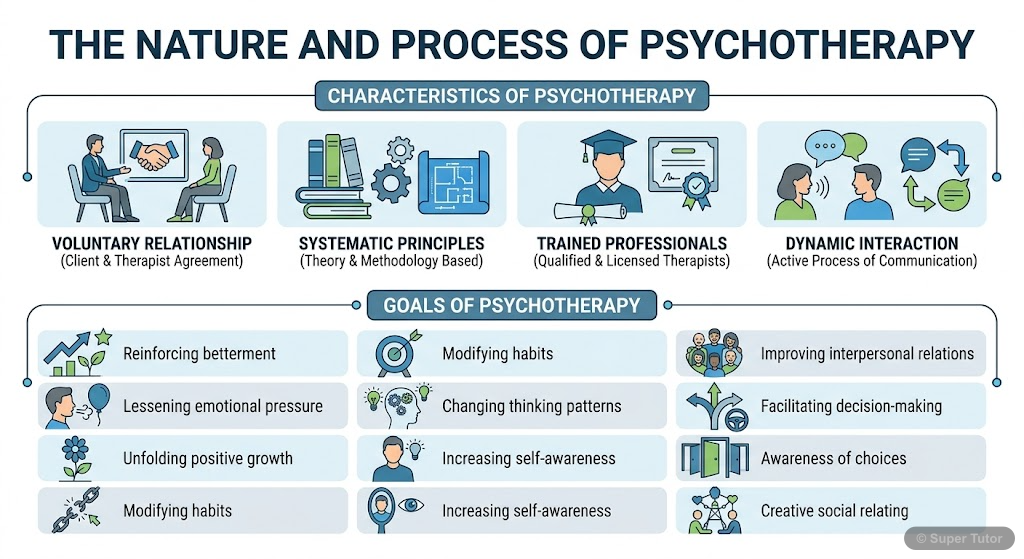
One of 19 illustrations for Therapeutic Approaches in Super Tutor — alongside flashcards, concept maps and practice questions.
The first 5 solutions are open to read. The other 4 are free with a Super Tutor account.
Review Questions
1Describe the nature and scope of psychotherapy. Highlight the importance of therapeutic relationship in psychotherapy.Show solution
Psychotherapy is a voluntary relationship between the client and the therapist whose purpose is to help the client solve psychological problems. It is a corrective and helping process that aims at changing maladaptive behaviours, reducing personal distress, and helping the client adapt better to the environment. It is used for problems like anxiety, phobias, depression, relationship difficulties, and other psychological disorders.
Its scope is broad because it includes many different approaches, such as psychodynamic therapy, behaviour therapy, cognitive therapy, humanistic-existential therapy, and alternative therapies. Psychotherapy can help with emotional problems, faulty habits, distorted thinking, and difficulties in social, marital, and occupational adjustment.
The therapeutic relationship or alliance is central to psychotherapy. It is a confidential, interpersonal, dynamic, and professional relationship. The client trusts the therapist and can freely discuss personal problems. The therapist shows acceptance, empathy, genuineness, warmth, and unconditional positive regard. The therapist must keep strict confidentiality and must not exploit the client’s trust. This relationship is important because it becomes the vehicle for change and helps healing occur.
2What are the different types of psychotherapy? On what basis are they classified?Show solution
Psychotherapies are classified into three broad groups:
- Psychodynamic therapies
- Behaviour therapies
- Existential therapies
The chapter says they are classified on the basis of these parameters:
- What is the cause of the problem?
- Psychodynamic: intrapsychic conflicts
- Behaviour: faulty learning of behaviours and cognitions
- Existential: problems about meaning of life and existence
- How did the cause come into existence?
- Psychodynamic: unfulfilled childhood desires and unresolved childhood fears
- Behaviour: faulty conditioning, learning, and thinking
- Existential: current feelings of loneliness, alienation, and futility
- What is the chief method of treatment?
- Psychodynamic: free association and dream analysis
- Behaviour: correcting faulty behaviour through learning principles, reinforcement, conditioning, etc.
- Existential: providing a warm, accepting, non-judgmental environment where the client finds meaning
- Nature of therapeutic relationship
- Psychodynamic and behaviour therapies assume the therapist can understand or correct the client’s problem
- Existential therapies stress the therapist as a facilitator
- Chief benefit to the client
- Psychodynamic: emotional insight
- Behaviour: adaptive behaviour and thought patterns
- Humanistic-existential: personal growth
- Duration of treatment
- Classical psychoanalysis: several years
- Recent psychodynamic therapies: 10–15 sessions
- Behaviour, cognitive behaviour, and existential therapies: a few months
3Discuss the various techniques used in behaviour therapy.Show solution
Behaviour therapy is based on the idea that psychological distress arises from faulty behaviour patterns or faulty thought patterns. Its techniques aim to reduce arousal, change behaviour through conditioning, and use learning procedures.
The main techniques discussed in the chapter are:
- Behavioural analysis
- The therapist interviews the client and family to identify:
- malfunctioning behaviours (behaviours causing distress),
- antecedent factors (causes that predispose the behaviour), and
- maintaining factors (factors that keep the behaviour going).
- Antecedent operations and consequent operations
- Antecedent operations change something that comes before the behaviour.
- Consequent operations change the consequence after the behaviour.
- Example: reducing tea-time food to increase hunger at dinner, and praising the child for eating properly.
- Negative reinforcement
- A response that helps a person escape or avoid pain or unpleasantness is strengthened.
- Example: wearing woollen clothes to avoid cold.
- Aversive conditioning
- An undesired response is repeatedly paired with an unpleasant consequence.
- Example: alcohol smell paired with a mild electric shock.
- Positive reinforcement
- A desired behaviour is rewarded to increase it.
- Example: giving a child a favourite dish when homework is done on time.
- Token economy
- Tokens are given as rewards for desired behaviour and later exchanged for a reward.
- Relaxation procedures
- Used to reduce anxiety.
- Includes progressive muscular relaxation and meditation.
- Differential reinforcement
- Reinforce wanted behaviour and ignore or reduce unwanted behaviour.
- Example: rewarding polite requests and ignoring sulking.
- Systematic desensitisation
- Used for phobias and irrational fears.
- The client is taught relaxation and then exposed in imagination to a hierarchy of fear-provoking situations, from least to most frightening.
- Principle of reciprocal inhibition
- Relaxation and fear cannot occur strongly at the same time; relaxation inhibits anxiety.
- Modelling
- The client learns by observing a role model or therapist.
These techniques are selected according to the client’s symptoms and diagnosis.
4Explain with the help of an example how cognitive distortions take place.Show solution
Cognitive distortions are ways of thinking that are general in nature but distort reality negatively. They lead to irrational thoughts, anxiety, and depression.
An example from the chapter is this: a child who was neglected by the parents develops the core schema “I am not wanted.” Later, if the child is publicly ridiculed by a teacher, that critical incident activates the core schema. The child then begins to have negative automatic thoughts such as:
- “Nobody loves me”
- “I am ugly”
- “I am stupid”
- “I will not succeed”
These thoughts are not based on the actual situation, but on the negative schema. That is how the person distorts the reality of the event. The repeated thoughts create feelings of anxiety and depression.
So, cognitive distortion takes place when a past experience creates a faulty belief, and later events are interpreted through that belief in a negative and unrealistic way.
5Which therapy encourages the client to seek personal growth and actualise their potential? Write about the therapies which are based on this principle.Show solution
The therapy that encourages the client to seek personal growth and actualise her/his potential is humanistic-existential therapy.
The therapies based on this principle are:
- Humanistic therapy
- Existential therapy
- Client-centred therapy
- Gestalt therapy
- Logotherapy
Humanistic therapy
It postulates that psychological distress arises from the frustration of self-actualisation, loneliness, alienation, and inability to find meaning and fulfilment. It values personal growth as the chief benefit. The therapist provides a permissive, accepting, and non-judgmental atmosphere so the client can express emotions freely and grow.
Existential therapy / Logotherapy
Victor Frankl’s Logotherapy helps the client find meaning in life and responsibility in one’s existence, even in difficult circumstances. The therapist is a facilitator and helps the client discover meaning.
Client-centred therapy
Given by Carl Rogers, it uses empathy, warmth, and unconditional positive regard. The therapist reflects the client’s feelings and helps the client become the real self.
Gestalt therapy
Given by Fritz Perls, it focuses on increasing self-awareness and self-acceptance. The client is helped to recognise blocked feelings and emotions.
All these therapies stress the person’s freedom, growth, and responsibility, and help the client move towards fuller self-development.
Free with a Super Tutor account
Free with a Super Tutor account
Free with a Super Tutor account
Free with a Super Tutor account
4 more solved questions in Therapeutic Approaches
They are free with a Super Tutor account, along with practice quizzes and flashcards for this chapter. Free to start, no card needed.
Frequently Asked Questions
What are the important topics in Therapeutic Approaches for Madhya Pradesh Board Class 12 Psychology?
Are these NCERT Solutions for Therapeutic Approaches free?
How should I revise Therapeutic Approaches for the Madhya Pradesh Board Class 12 board exam?
Sources & Official References
Content is aligned to the official syllabus. Refer to the board website for the latest curriculum.
More resources for Therapeutic Approaches
Practice Quiz
Test yourself with a quick quiz
Important Questions
Exam-style questions with answers
Revision Notes
Key points for last-minute revision
Chapter Summary
Understand the chapter at a glance
Concept Maps
See how topics connect
Study Plan
Step-by-step plan for this chapter
Flashcards
Quick-fire cards for active recall
Syllabus
What topics to cover
For serious students
Get the full Therapeutic Approaches chapter — start free.
Quizzes, flashcards, an AI doubt solver and a study plan for Madhya Pradesh Board Class 12 Psychology. Free to start, no card needed.