Social Institutions: Continuity and Change — Important Questions
Madhya Pradesh Board · Class 12 · Sociology
43 important questions from Social Institutions: Continuity and Change for Madhya Pradesh Board Class 12 Sociology, with answers.
Interactive on Super Tutor
Studying Social Institutions: Continuity and Change? Get the full interactive chapter.
Quizzes, flashcards, AI doubt-solver and a step-by-step study plan — built for important questions and more.
Free trial, no card needed.
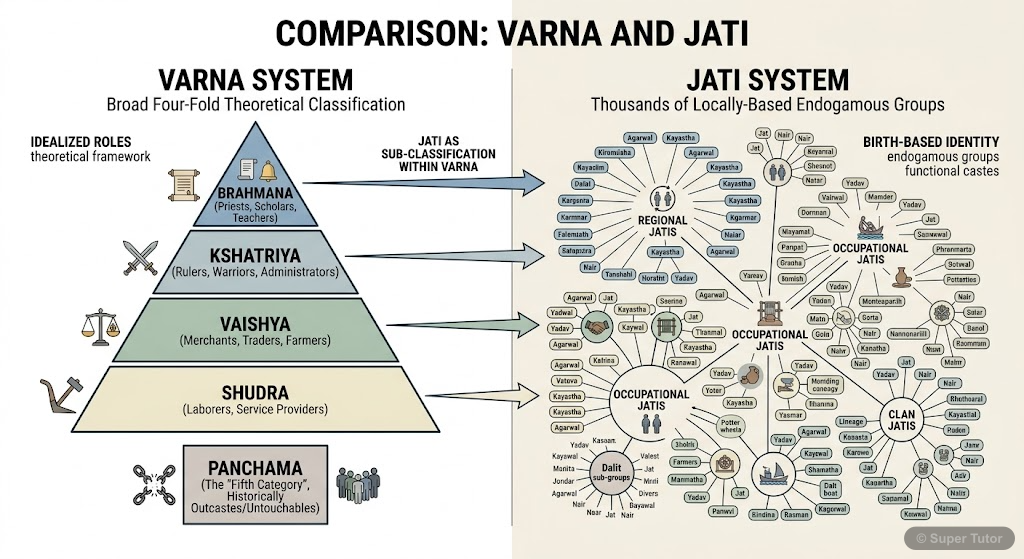
Learn better with visuals Super Tutor pairs illustrations like this with notes and quizzes for Social Institutions: Continuity and Change.
Important Questions from Social Institutions: Continuity and Change
Which of the following are defining features of the traditional caste system?
Show answer
Caste is determined by birth, Marriage is restricted within the caste (endogamy), Occupations are hereditary, Hierarchical arrangement of castes
The traditional caste system has several defining features: birth determines caste membership, marriage is restricted within caste groups (endogamy), occupations are passed down through generations, and castes are arranged hierarchically. Caste cannot be changed through individual choice.
Which of the following are characteristics used to define tribal communities?
Show answer
No written religious text, No sharp class divisions, No state or political form of normal kind
Tribes in India have been defined by what they were not: they did not practice a religion with written text, did not have sharp class divisions, and did not have a state or political form of the normal kind. Urban lifestyle and industrial occupations are not traditional tribal characteristics.
The Government of India Act of 1935 gave legal recognition to which categories?
Show answer
Scheduled Castes and Scheduled Tribes
The Government of India Act of 1935 gave legal recognition to the lists or 'schedules' of castes and tribes marked for special treatment by the state. This is how the terms 'Scheduled Castes' and 'Scheduled Tribes' came into being.
True or False: A nuclear family consists of more than two generations living together.
Show answer
False
False. A nuclear family consists of only one set of parents and their children. It is the extended family (joint family) that has more than two generations living together, such as grandparents, parents, and children.
+39 more questions on Social Institutions: Continuity and Change (Madhya Pradesh Board Class 12 Sociology)
Practise AllFrequently Asked Questions
What are the important topics in Social Institutions: Continuity and Change for Madhya Pradesh Board Class 12 Sociology?
How many important questions are there in Social Institutions: Continuity and Change?
Sources & Official References
Content is aligned to the official syllabus. Refer to the board website for the latest curriculum.
More resources for Social Institutions: Continuity and Change
Practice Quiz
Test yourself with a quick quiz
Revision Notes
Key points for last-minute revision
Chapter Summary
Understand the chapter at a glance
Concept Maps
See how topics connect
Study Plan
Step-by-step plan for this chapter
Flashcards
Quick-fire cards for active recall
Syllabus
What topics to cover
NCERT Solutions
Every textbook question solved step by step
For serious students
Get the full Social Institutions: Continuity and Change chapter — start free.
Quizzes, flashcards, an AI doubt solver and a study plan for Madhya Pradesh Board Class 12 Sociology. Free to start, no card needed.