Social Institutions: Continuity and Change — Syllabus
Madhya Pradesh Board · Class 12 · Sociology
What Social Institutions: Continuity and Change covers in Madhya Pradesh Board Class 12 Sociology: 4 topics, for the 2026-27 session.
Interactive on Super Tutor
Studying Social Institutions: Continuity and Change? Get the full interactive chapter.
Quizzes, flashcards, AI doubt-solver and a step-by-step study plan — built for syllabus and more.
Free trial, no card needed.
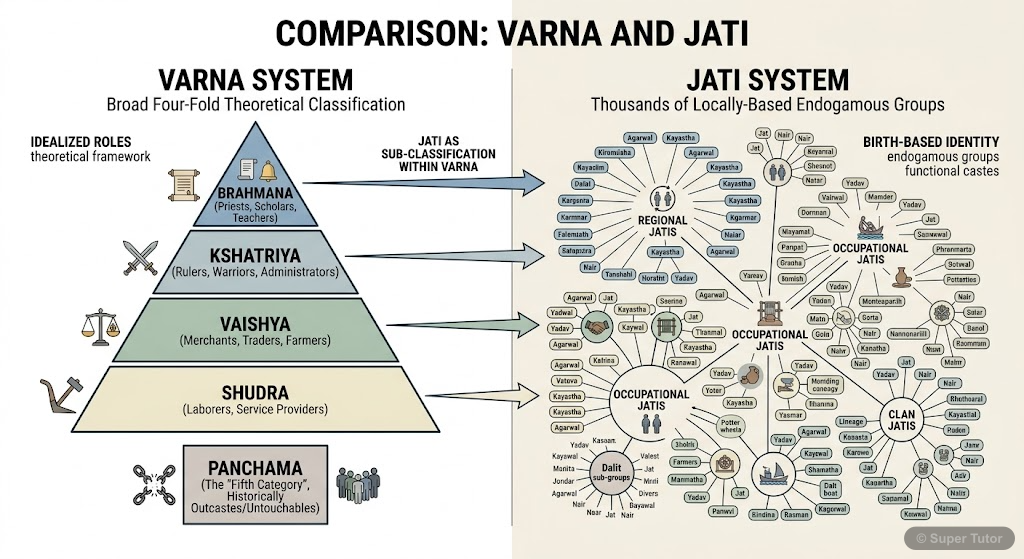
Learn better with visuals Super Tutor pairs illustrations like this with notes and quizzes for Social Institutions: Continuity and Change.
Topics in Social Institutions: Continuity and Change
1. Caste: Meaning, Features, and Historical Change
- Caste is uniquely associated with the Indian sub-continent, though similar social effects exist elsewhere.
- Caste, though characteristic of Hindu society, has spread to Muslims, Christians, and Sikhs.
- The word caste comes from the Portuguese casta, meaning pure breed.
2. Social Reformers and Anti-Caste Movements
- Ayyankali was a leader of the lower castes and Dalits in Kerala; his efforts won Dalits freedom to walk on public roads and allowed Dalit children to join schools.
- Jotirao Govindrao Phule denounced caste injustice and purity and pollution rules.
- Phule founded the Satyashodhak Samaj in 1873 for human rights and social justice for low-caste people.
3. Caste in the Present: Politics, Class, and Social Visibility
- Independent India abolished caste in principle, but the state did not dismantle the economic basis of caste inequality.
- Government jobs were treated in a caste-blind manner, except for reservations for Scheduled Castes and Scheduled Tribes.
- Modern industry and urbanisation created new spaces where old caste rules became weaker.
4. Tribal Communities: Meaning, Classification, and Change
- Tribe is a modern term for very old communities, among the oldest inhabitants of the sub-continent.
- Tribes were defined negatively: they did not practice a religion with a written text, did not have a normal state form, and did not have sharp class divisions.
- By the 1970s, major definitions of tribe were shown to be faulty because size, isolation, religion, and livelihood did not fit all tribes.
Key Concepts
Central concept: Social institutions in India change over time while also showing continuity in caste, tribe, family, and kinship
Work through every topic in Social Institutions: Continuity and Change with notes and quizzes
Start This ChapterFrequently Asked Questions
What are the important topics in Social Institutions: Continuity and Change for Madhya Pradesh Board Class 12 Sociology?
How should I revise Social Institutions: Continuity and Change for the Madhya Pradesh Board Class 12 board exam?
Sources & Official References
Content is aligned to the official syllabus. Refer to the board website for the latest curriculum.
More resources for Social Institutions: Continuity and Change
Practice Quiz
Test yourself with a quick quiz
Important Questions
Exam-style questions with answers
Revision Notes
Key points for last-minute revision
Chapter Summary
Understand the chapter at a glance
Concept Maps
See how topics connect
Study Plan
Step-by-step plan for this chapter
Flashcards
Quick-fire cards for active recall
NCERT Solutions
Every textbook question solved step by step
For serious students
Get the full Social Institutions: Continuity and Change chapter — start free.
Quizzes, flashcards, an AI doubt solver and a study plan for Madhya Pradesh Board Class 12 Sociology. Free to start, no card needed.