Social Institutions: Continuity and Change — Chapter Summary
Madhya Pradesh Board · Class 12 · Sociology
Summary of Social Institutions: Continuity and Change for Madhya Pradesh Board Class 12 Sociology. Indian society is shaped by social institutions that.
Interactive on Super Tutor
Studying Social Institutions: Continuity and Change? Get the full interactive chapter.
Quizzes, flashcards, AI doubt-solver and a step-by-step study plan — built for chapter summary and more.
Free trial, no card needed.
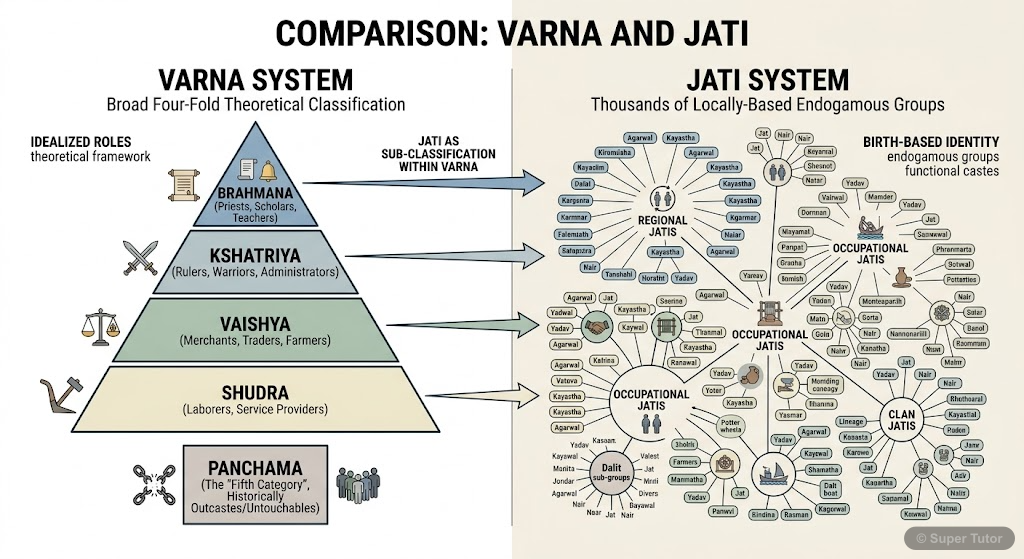
Learn better with visuals Super Tutor pairs illustrations like this with notes and quizzes for Social Institutions: Continuity and Change.
Overview
Indian society is shaped by social institutions that organise life, identity, power, and relationships. Caste, tribe, and family are central institutions that have changed over time while still remaining deeply important. Caste shows how hierarchy and separation can structure society; tribal communi
Key Concepts
Caste is a uniquely Indian social
Caste is a uniquely Indian social institution, although similar effects exist elsewhere. It is linked with birth, endogamy, hierarchy, food rules, occ
Varna is the broad all
Varna is the broad all-India four-fold division of society into brahmana, kshatriya, vaishya, and shudra. Jati is the local or regional, more complex
The census became a regular ten
The census became a regular ten-yearly exercise from 1881 onwards, and the 1901 Census under Herbert Risley collected information on caste hierarchy.
After Independence
After Independence, the state tried to reduce caste inequality, but caste remained powerful in social life. Government jobs were caste-blind except fo
Dominant caste refers to intermediate castes
Dominant caste refers to intermediate castes that gained land rights after partial land reforms and acquired economic and political power because of l
Learning Objectives
- Understand the meaning and main features of caste in Indian society.
- Explain how caste changed during the colonial and post-Independence periods.
- Describe how caste remains important in social life, politics, work, and marriage.
- Identify how tribal communities are classified by region, language, physical traits, and livelihood.
- Recognise why the idea of tribes as isolated and primitive is inaccurate.
Frequently Asked Questions
What are the important topics in Social Institutions: Continuity and Change for Madhya Pradesh Board Class 12 Sociology?
How should I revise Social Institutions: Continuity and Change for the Madhya Pradesh Board Class 12 board exam?
Sources & Official References
Content is aligned to the official syllabus. Refer to the board website for the latest curriculum.
More resources for Social Institutions: Continuity and Change
Practice Quiz
Test yourself with a quick quiz
Important Questions
Exam-style questions with answers
Revision Notes
Key points for last-minute revision
Concept Maps
See how topics connect
Study Plan
Step-by-step plan for this chapter
Flashcards
Quick-fire cards for active recall
Syllabus
What topics to cover
NCERT Solutions
Every textbook question solved step by step
For serious students
Get the full Social Institutions: Continuity and Change chapter — start free.
Quizzes, flashcards, an AI doubt solver and a study plan for Madhya Pradesh Board Class 12 Sociology. Free to start, no card needed.