Mass Media and Communications — Study Plan
Madhya Pradesh Board · Class 12 · Sociology
A step-by-step study plan for Mass Media and Communications, Madhya Pradesh Board Class 12 Sociology: what to learn first, what to practise and when.
Interactive on Super Tutor
Studying Mass Media and Communications? Get the full interactive chapter.
Quizzes, flashcards, AI doubt-solver and a step-by-step study plan — built for study plan and more.
Free trial, no card needed.
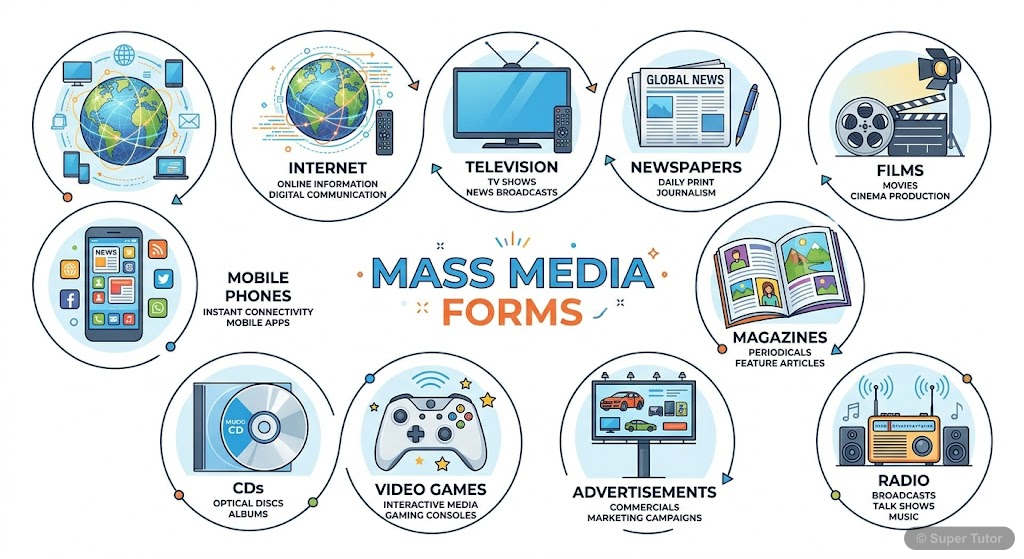
Learn better with visuals Super Tutor pairs illustrations like this with notes and quizzes for Mass Media and Communications.
Study Plan
Learn the Theory
Read the textbook chapter carefully. Note down definitions, formulas and key ideas. Focus on: 1. Meaning and Nature of Mass Media, 2. Beginning of Modern Mass Media and Print Culture, 3. Media under Colonial Rule.
Practise
Solve the textbook exercises and extra practice questions. There are 45 questions available for this chapter.
Revise & Test
Revise key points without looking at your notes. Take a practice quiz and mark weak areas for another pass.
Spaced Revision
Come back to Mass Media and Communications after a week. Use flashcards for quick recall and try past exam questions on this chapter.
What to Focus On
- Mass media reaches large audiences.
- Mass communication needs formal organisation, capital, production, and management.
- The state and the market strongly influence media systems.
- Johann Gutenberg developed modern printing technology in 1440.
- Print media helped the spread of ideas and public debate.
- Benedict Anderson linked print media with nationalism and imagined community.
- The colonial government used censorship to control the press.
- Nationalist newspapers played a major role in the freedom movement.
- Sambad-Kaumudi and Mirat-Ul-Akbar were early nationalist publications.
Common Mistakes to Avoid
Radio, newspapers, and films were all controlled in the same way under British rule.
Sambad-Kaumudi and Mirat-Ul-Akbar were the same paper or were started in the same language and year.
Bombay Samachar was started after the other early Indian newspapers and was not especially important.
Memory Tips
Johann Gutenberg developed the first modern printing technology in Europe in 1440
Print media helped create nationalism through a shared sense of belonging
Benedict Anderson described the nation as an imagined community
Raja Rammohun Roy started Sambad-Kaumudi in Bengali in 1821 and Mirat-Ul-Akbar in Persian in 1822
Want a personalised study plan?
Super Tutor builds a day-by-day plan for Madhya Pradesh Board Class 12 Sociology that fits your exam date and pace.
Create My Study PlanFrequently Asked Questions
What are the important topics in Mass Media and Communications for Madhya Pradesh Board Class 12 Sociology?
How should I revise Mass Media and Communications for the Madhya Pradesh Board Class 12 board exam?
Sources & Official References
Content is aligned to the official syllabus. Refer to the board website for the latest curriculum.
More resources for Mass Media and Communications
Practice Quiz
Test yourself with a quick quiz
Important Questions
Exam-style questions with answers
Revision Notes
Key points for last-minute revision
Chapter Summary
Understand the chapter at a glance
Concept Maps
See how topics connect
Flashcards
Quick-fire cards for active recall
Syllabus
What topics to cover
NCERT Solutions
Every textbook question solved step by step
For serious students
Get the full Mass Media and Communications chapter — start free.
Quizzes, flashcards, an AI doubt solver and a study plan for Madhya Pradesh Board Class 12 Sociology. Free to start, no card needed.