Mass Media and Communications — Chapter Summary
Madhya Pradesh Board · Class 12 · Sociology
Summary of Mass Media and Communications for Madhya Pradesh Board Class 12 Sociology. Part of the Madhya Pradesh Board Class 12 Sociology syllabus.
Interactive on Super Tutor
Studying Mass Media and Communications? Get the full interactive chapter.
Quizzes, flashcards, AI doubt-solver and a step-by-step study plan — built for chapter summary and more.
Free trial, no card needed.
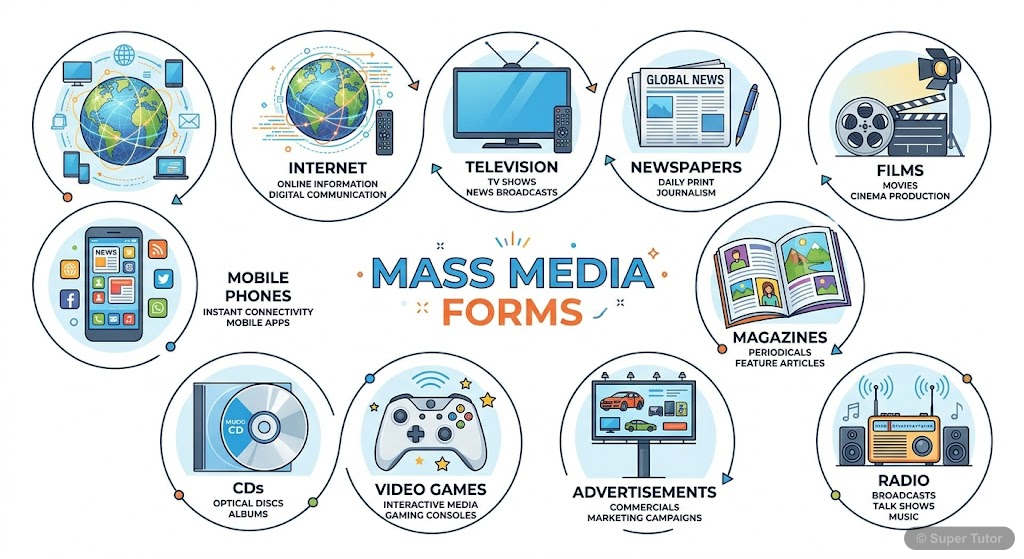
Learn better with visuals Super Tutor pairs illustrations like this with notes and quizzes for Mass Media and Communications.
Overview
Mass media includes television, newspapers, films, magazines, radio, advertisements, video games and CDs. It reaches very large audiences, so it plays a major role in public life, social change and development. The growth of mass media in India moved from print to radio to television and then to the
Key Concepts
Mass media refers to communication forms
Mass media refers to communication forms that reach very large numbers of people. It includes print, radio, television and newer digital forms. Mass c
Johann Gutenberg developed the modern printing
Johann Gutenberg developed the modern printing technology in Europe in 1440. Printing made the mass production of books and later newspapers possible.
Print media helped spread reform ideas
Print media helped spread reform ideas and nationalist feeling. Benedict Anderson explained that print media helped create a sense of belonging or 'we
During British rule
During British rule, radio was wholly owned by the state, while newspapers and films were autonomous but strictly monitored. Censorship was imposed du
Jawaharlal Nehru called on the media
Jawaharlal Nehru called on the media to act as the watchdog of democracy and to support self-reliance, national development and rational social reform
Learning Objectives
- Understand the meaning and scope of mass media and mass communication.
- Trace the development of modern media from print to radio, television and globalised media.
- Explain the role of media in colonial India, independent India and the period of globalisation.
- Identify key personalities, institutions and milestones in Indian media history.
- Recognise how media supports democracy, development, entertainment and public debate.
Frequently Asked Questions
What are the important topics in Mass Media and Communications for Madhya Pradesh Board Class 12 Sociology?
How should I revise Mass Media and Communications for the Madhya Pradesh Board Class 12 board exam?
Sources & Official References
Content is aligned to the official syllabus. Refer to the board website for the latest curriculum.
More resources for Mass Media and Communications
Practice Quiz
Test yourself with a quick quiz
Important Questions
Exam-style questions with answers
Revision Notes
Key points for last-minute revision
Concept Maps
See how topics connect
Study Plan
Step-by-step plan for this chapter
Flashcards
Quick-fire cards for active recall
Syllabus
What topics to cover
NCERT Solutions
Every textbook question solved step by step
For serious students
Get the full Mass Media and Communications chapter — start free.
Quizzes, flashcards, an AI doubt solver and a study plan for Madhya Pradesh Board Class 12 Sociology. Free to start, no card needed.