Tissues — NCERT Solutions
Madhya Pradesh Board · Class 9 · Science
NCERT Solutions for Tissues, Madhya Pradesh Board Class 9 Science: 15 textbook questions solved step by step. Covers Exercises — Chapter: Tissues.
Interactive on Super Tutor
Studying Tissues? Get the full interactive chapter.
Quizzes, flashcards, AI doubt-solver and a step-by-step study plan — built for NCERT solutions and more.
Free trial, no card needed.
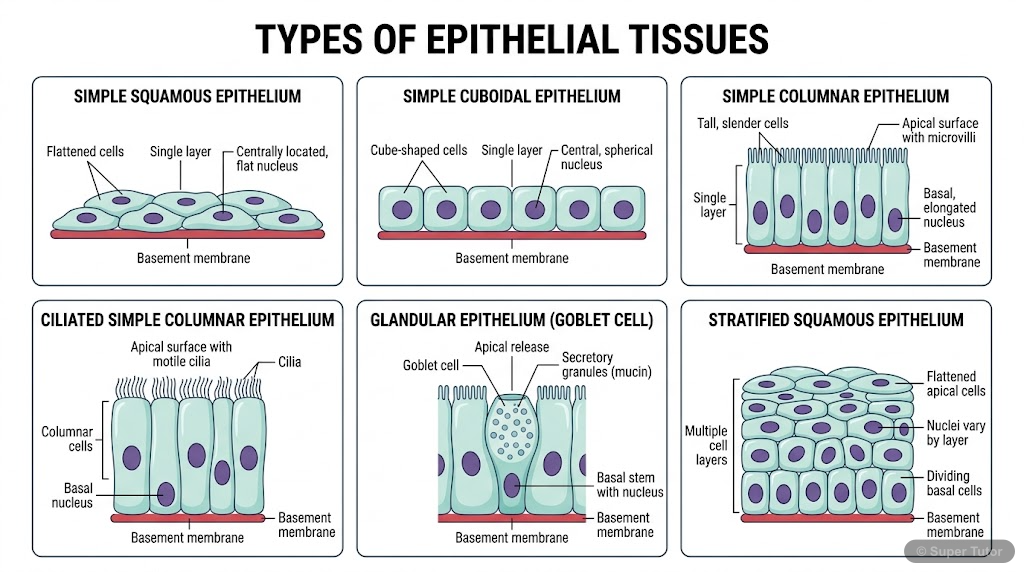
One of 6 illustrations for Tissues in Super Tutor — alongside flashcards, concept maps and practice questions.
The first 8 solutions are open to read. The other 7 are free with a Super Tutor account.
Exercises — Chapter: Tissues (Class 9 Science)
1Define the term "tissue".Show solution
Definition: A tissue is a group of cells that are similar in structure, origin, and function, and work together to perform a specific function in the body.
Example: Muscle tissue is made up of muscle cells that work together to bring about movement.
2How many types of elements together make up the xylem tissue? Name them.Show solution
Given: Xylem is a complex permanent tissue in plants.
Answer: Xylem tissue is made up of four types of elements:
- Tracheids – elongated cells with tapering ends that help in water conduction.
- Vessels (Tracheae) – tube-like structures formed by a row of cells placed end to end; main water-conducting elements.
- Xylem parenchyma – living cells that store food and help in lateral conduction of water.
- Xylem fibres (Sclerenchymatous fibres) – dead cells that provide mechanical support.
Conclusion: Together, these four elements form the xylem tissue.
3How are simple tissues different from complex tissues in plants?Show solution
| Feature | Simple Tissues | Complex Tissues |
|---|---|---|
| Composition | Made up of only one type of cell. | Made up of more than one type of cell. |
| Function | Perform a single, uniform function. | Perform multiple functions together. |
| Examples | Parenchyma, Collenchyma, Sclerenchyma | Xylem, Phloem |
| Location | Found in pith, cortex, epidermis, etc. | Found in vascular bundles. |
Conclusion: Simple tissues are homogeneous (one cell type), while complex tissues are heterogeneous (multiple cell types) and perform more specialised functions like transport of water and food.
4Differentiate between parenchyma, collenchyma and sclerenchyma on the basis of their cell wall.Show solution
| Feature | Parenchyma | Collenchyma | Sclerenchyma |
|---|---|---|---|
| Cell wall composition | Thin cell wall made of cellulose. | Cell wall is unevenly thickened at corners; made of cellulose and pectin. | Cell wall is uniformly thick and heavily lignified (lignin deposits). |
| Nature of cell wall | Thin and uniform. | Thick at corners, thin elsewhere. | Very thick and hard throughout. |
| Living/Dead | Living cells. | Living cells. | Dead cells (at maturity). |
Conclusion: The degree of cell wall thickening increases from parenchyma → collenchyma → sclerenchyma, with sclerenchyma having the thickest, lignified walls.
5What are the functions of the stomata?Show solution
Stomata are tiny pores present on the surface of leaves (epidermis). Their functions are:
- Gaseous exchange: They allow the exchange of gases ( and ) between the plant and the atmosphere, which is essential for photosynthesis and respiration.
- Transpiration: They allow the loss of excess water in the form of water vapour (transpiration), which helps in the upward movement of water and minerals from roots to leaves.
- Regulation: Guard cells surrounding the stomata regulate the opening and closing of the stomatal pore, thus controlling water loss.
6Diagrammatically show the difference between the three types of muscle fibres.Show solution
Note: Diagrams are described in detail below as required for board exams.
(a) Striated (Skeletal/Voluntary) Muscle Fibre:
- Draw a long, cylindrical, unbranched fibre.
- Show alternating dark (A-band) and light (I-band) bands → giving a striated appearance.
- Show multiple nuclei (multinucleate) at the periphery of the cell.
- Label: Striations, Nucleus, Muscle fibre.
(b) Unstriated (Smooth/Involuntary) Muscle Fibre:
- Draw a long, spindle-shaped (narrow at both ends) cell.
- No striations (smooth appearance).
- Show a single, centrally placed nucleus.
- Label: Spindle-shaped cell, Nucleus (central).
(c) Cardiac Muscle Fibre:
- Draw cylindrical, branched fibres.
- Show faint striations.
- Show a single, centrally placed nucleus.
- Show intercalated discs at junctions between cells.
- Label: Branching, Intercalated disc, Nucleus, Striations.
7What is the specific function of the cardiac muscle?Show solution
Specific function of cardiac muscle:
Cardiac muscle is found exclusively in the walls of the heart. Its specific function is to contract and relax rhythmically and continuously throughout life (without fatigue) to pump blood to all parts of the body.
- It works involuntarily (not under conscious control).
- It contracts approximately 72 times per minute in a normal adult.
- The rhythmic contraction ensures a continuous supply of oxygenated blood to all organs.
8Differentiate between striated, unstriated and cardiac muscles on the basis of their structure and site/location in the body.Show solution
| Feature | Striated Muscle | Unstriated Muscle | Cardiac Muscle |
|---|---|---|---|
| Shape | Long, cylindrical, unbranched fibres | Long, spindle-shaped (narrow at ends), unbranched | Cylindrical, branched fibres |
| Striations | Distinct alternating dark and light bands (striated) | No striations (smooth) | Faint striations present |
| Nucleus | Multiple nuclei (multinucleate), peripheral | Single nucleus, centrally placed | Single nucleus, centrally placed |
| Control | Voluntary (under conscious control) | Involuntary (not under conscious control) | Involuntary |
| Fatigue | Fatigues easily | Does not fatigue easily | Never fatigues |
| Intercalated discs | Absent | Absent | Present (at junctions between cells) |
| Location/Site | Attached to bones (limbs, tongue, etc.) | Walls of hollow organs — stomach, intestine, urinary bladder, blood vessels | Walls of the heart only |
Free with a Super Tutor account
(a) Tissue that forms the inner lining of our mouth.
(b) Tissue that connects muscle to bone in humans.
(c) Tissue that transports food in plants.
(d) Tissue that stores fat in our body.
(e) Connective tissue with a fluid matrix.
(f) Tissue present in the brain.
Free with a Super Tutor account
Free with a Super Tutor account
Free with a Super Tutor account
Free with a Super Tutor account
Free with a Super Tutor account
Free with a Super Tutor account
7 more solved questions in Tissues
They are free with a Super Tutor account, along with practice quizzes and flashcards for this chapter. Free to start, no card needed.
Frequently Asked Questions
What are the important topics in Tissues for Madhya Pradesh Board Class 9 Science?
Are these NCERT Solutions for Tissues free?
How should I revise Tissues for Class 9 exams?
Sources & Official References
Content is aligned to the official syllabus. Refer to the board website for the latest curriculum.
More resources for Tissues
Practice Quiz
Test yourself with a quick quiz
Important Questions
Exam-style questions with answers
Revision Notes
Key points for last-minute revision
Chapter Summary
Understand the chapter at a glance
Concept Maps
See how topics connect
Study Plan
Step-by-step plan for this chapter
Flashcards
Quick-fire cards for active recall
Syllabus
What topics to cover
For serious students
Get the full Tissues chapter — start free.
Quizzes, flashcards, an AI doubt solver and a study plan for Madhya Pradesh Board Class 9 Science. Free to start, no card needed.