Banking Services — Practice Quiz
NIOS · Class 10 · Business Studies
Try a 4-question quiz on Banking Services for NIOS Class 10 Business Studies: tap an answer to check it and see why. 44 questions in the full chapter test.
Interactive on Super Tutor
Studying Banking Services? Get the full interactive chapter.
Quizzes, flashcards, AI doubt-solver and a step-by-step study plan — built for practice quiz and more.
Free trial, no card needed.
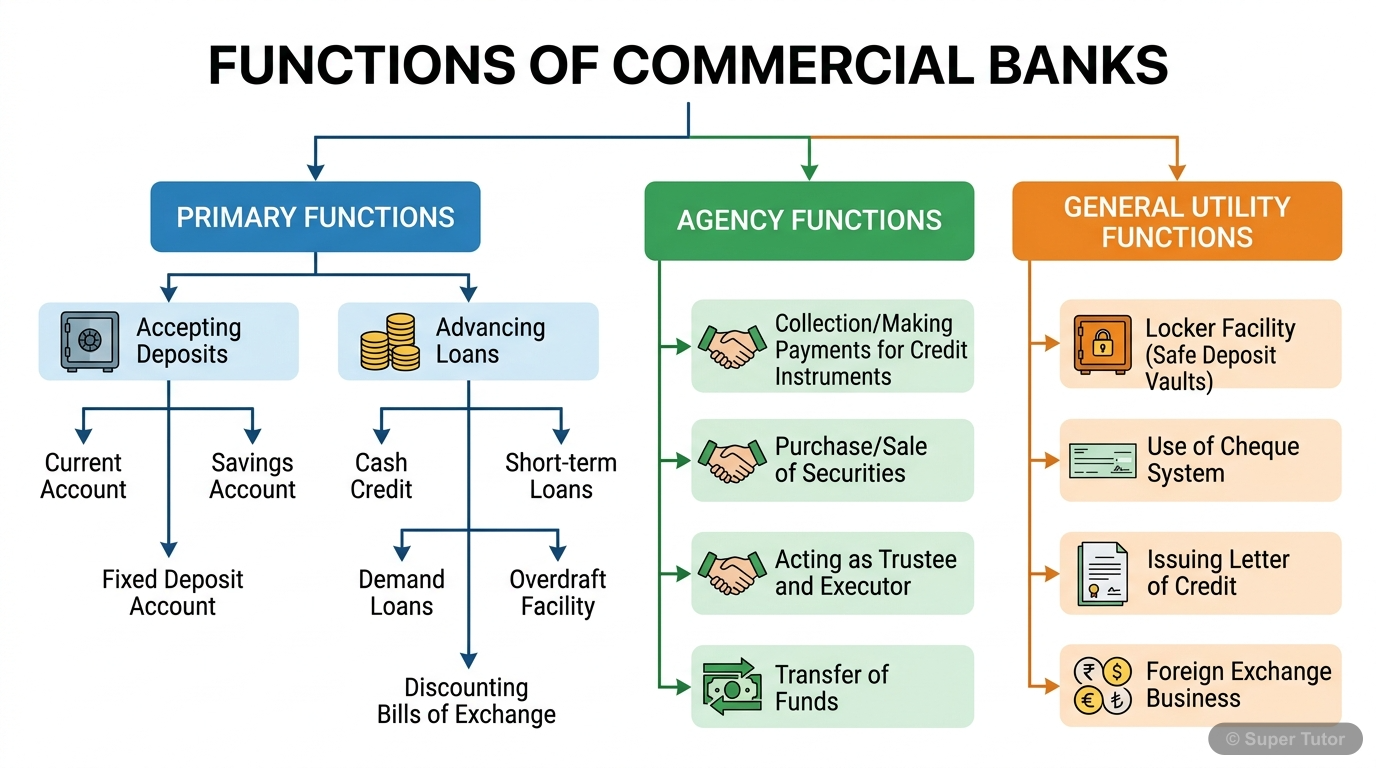
An illustration from Super Tutor's Banking Services chapter — alongside flashcards, concept maps and practice questions.
Quick Quiz: Banking Services
0/4Tap an answer to check it instantly. No sign-up needed for these 4.
The Reserve Bank of India was established on April 1, 1935. Its Central Office was initially set up in Calcutta but was permanently moved to Mumbai in 1937. Since which year has the RBI been fully owned by the Government of India?
A customer has a Current Account in a bank. He has a balance of ₹10,000 but needs to pay ₹14,000 urgently. Which banking facility allows him to make this payment?
SIDBI was established with a specific focus area. Which of the following best describes the PRIMARY aim of SIDBI?
In the context of bank advances, what is the key difference between 'Cash Credit' and 'Overdraft'?
Sample Questions
Which of the following correctly describes the THREE-TIER structure of Co-operative Banks in India from the lowest to the highest level?
Show answer
Primary Credit Societies → Central Co-operative Banks → State Co-operative Banks
Step 1: Co-operative banks in India are organised at three levels. Step 2: At the village or town level, Primary Credit Societies are formed — this is the lowest (grassroots) level. Step 3: At the district level, Central Co-operative Banks operate. They provide loans to primary credit societies and act as a link between the primary societies and state-level banks. Step 4: At the highest (apex) level are State Co-operative Banks, which mobilise funds and channel them through the system down to individual borrowers. Step 5: The flow of money is from State Co-operative Banks → Central Co-operativ
A trader has a bill of exchange that will mature (become payable) after 90 days, but he needs funds immediately. He approaches his bank. Which banking service will help him get funds before the due date?
Show answer
Discounting of Bills of Exchange
Step 1: The trader holds a bill of exchange maturing after 90 days — meaning he will receive the money only after 90 days. Step 2: But he needs money now. Discounting of Bills allows the bank to pay the trader the bill amount before maturity, after deducting a discount (fee). Step 3: The bank then collects the full amount from the party liable to pay the bill on the due date. Step 4: Overdraft is for current account holders to withdraw beyond their balance — not for encashing bills. Step 5: Fixed Deposit is a savings product, not a credit facility. Cash Credit is a pre-approved credit limit, n
Which of the following statements correctly distinguishes between a Debit Card and a Credit Card?
Show answer
When a Debit Card is used, the amount is immediately deducted from the account, while a Credit Card allows the user to borrow and repay later
Step 1: A Debit Card is linked directly to the customer's savings or current account. When used, the amount is instantly debited (deducted) from the account. Step 2: A Credit Card is a borrowing instrument — the bank pays on behalf of the customer, who repays within a credit period. High interest is charged if repayment is delayed. Step 3: Option A is incorrect — Debit Cards can be issued to both savings and current account holders. Step 4: Option C is incorrect — Credit Cards typically charge very high interest rates on late payment, while Debit Cards do not involve interest (no credit is tak
Mr. Sharma wants to save ₹2,000 every month for the next 3 years to accumulate money for his daughter's education. Which type of bank account is MOST suitable for him?
Show answer
Recurring Deposit Account
Step 1: Mr. Sharma wants to deposit a FIXED amount (₹2,000) every MONTH for a specific PERIOD (3 years). Step 2: This pattern — fixed amount, monthly, for a set period — is exactly the feature of a Recurring Deposit Account. Step 3: At maturity, the total deposit along with interest is payable. Step 4: Fixed Deposit requires depositing the entire amount at once, not monthly — so it does not suit his plan. Step 5: Savings Account has no fixed monthly commitment and earns lower interest. Current Account pays no interest and is designed for businesses with frequent transactions, not for regular m
+40 more questions on Banking Services (NIOS Class 10 Business Studies)
Practise AllFrequently Asked Questions
What are the important topics in Banking Services for NIOS Class 10 Business Studies?
How many practice questions are there for Banking Services?
Sources & Official References
Content is aligned to the official syllabus. Refer to the board website for the latest curriculum.
More resources for Banking Services
Important Questions
Exam-style questions with answers
Revision Notes
Key points for last-minute revision
Chapter Summary
Understand the chapter at a glance
Concept Maps
See how topics connect
Study Plan
Step-by-step plan for this chapter
Flashcards
Quick-fire cards for active recall
Syllabus
What topics to cover
For serious students
Get the full Banking Services chapter — start free.
Quizzes, flashcards, an AI doubt solver and a study plan for NIOS Class 10 Business Studies. Free to start, no card needed.