Central Problems of An Economy — Practice Quiz
NIOS · Class 10 · Economics
Try a 4-question quiz on Central Problems of An Economy for NIOS Class 10 Economics: tap an answer to check it and see why.
Interactive on Super Tutor
Studying Central Problems of An Economy? Get the full interactive chapter.
Quizzes, flashcards, AI doubt-solver and a step-by-step study plan — built for practice quiz and more.
Free trial, no card needed.
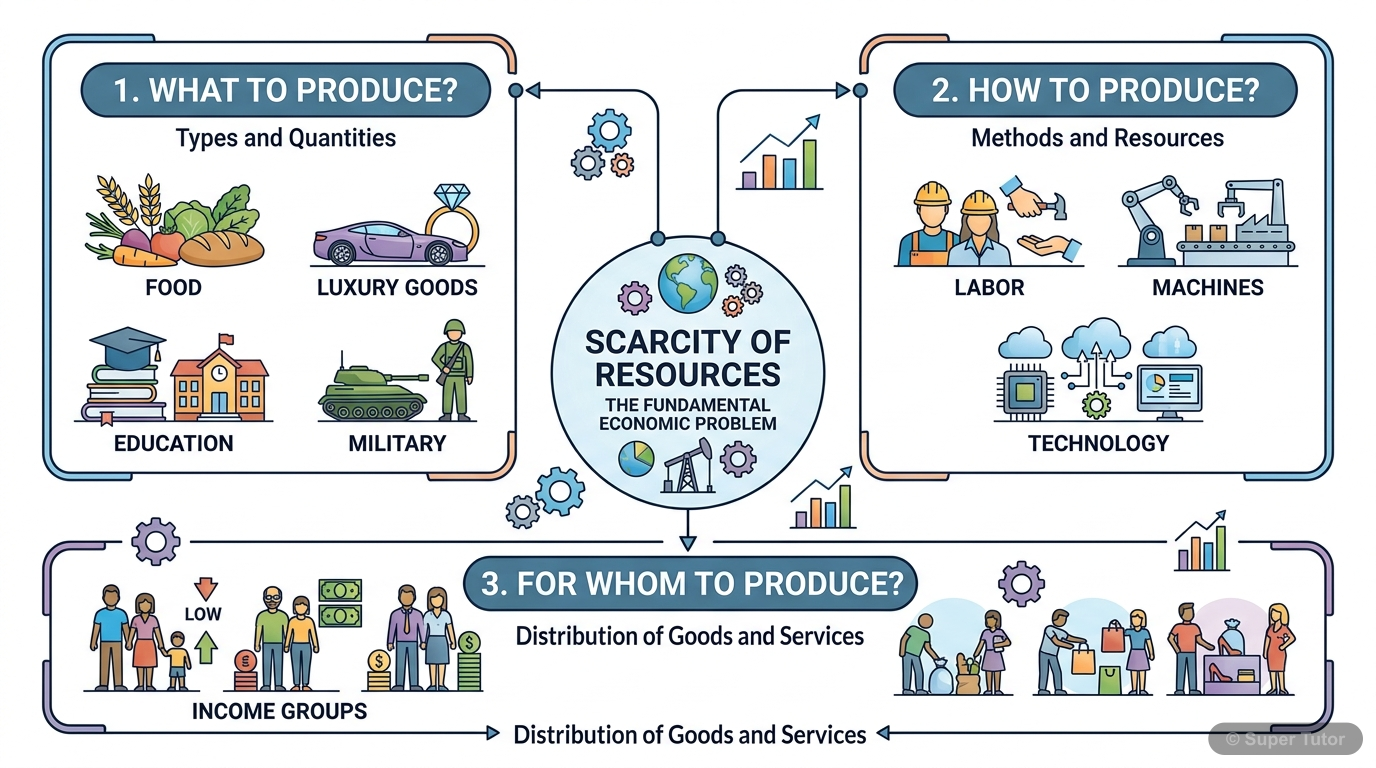
Learn better with visuals Super Tutor pairs illustrations like this with notes and quizzes for Central Problems of An Economy.
Quick Quiz: Central Problems of An Economy
0/4Tap an answer to check it instantly. No sign-up needed for these 4.
In a capitalist economy, if consumers stop buying formal shirts and start preferring t-shirts, which of the following BEST explains why a profit-seeking producer will shift to t-shirt production?
An economy can produce either 20 quintals of wheat and 0 bicycles, or 0 wheat and 100 bicycles, or combinations in between. If the economy moves from producing 8 quintals of wheat and 30 bicycles to producing 5 quintals of wheat and 60 bicycles, what economic concept does this movement illustrate?
Which of the following CORRECTLY distinguishes the 'How to produce' problem from the 'What to produce' problem?
A factory owner decides to produce cloth using 10 workers and 2 machines (costing Rs. 100 per unit) rather than 4 workers and 8 machines (costing Rs. 130 per unit). This decision reflects which method of production and why?
Sample Questions
In a planned economy, the government decides to produce more tractors and fewer cars, even though consumers prefer cars. Which fundamental economic problem does this situation highlight as a weakness of the planned economy?
Show answer
Resources may not be allocated ideally as production ignores consumer preferences
Step 1: In a planned economy, the central planning authority decides WHAT to produce based on what the government thinks people should have, NOT what consumers actually want. Step 2: The scenario describes consumers wanting cars, but the government producing more tractors — a mismatch between supply and consumer demand. Step 3: This is a well-known criticism of planned economies: resources (land, labour, capital) are directed toward goods that people may not actually prefer. Step 4: Option A (For whom) is about distribution of goods — not about the mismatch in type of goods produced. Step 5: O
Why does the problem of choice arise in an economy? Which TWO conditions together make choice necessary?
Show answer
Resources are scarce AND resources have alternative uses
Step 1: The problem of choice arises from TWO simultaneous conditions. Step 2: Condition 1 — Resources are SCARCE: We do not have unlimited money, land, labour, or capital. With Rs. 110, you cannot buy everything worth Rs. 435. Step 3: Condition 2 — Resources have ALTERNATIVE USES: The same Rs. 110 can be used to buy a book OR a gift OR a movie ticket. It can be used in multiple ways. Step 4: If resources were unlimited (Option B), we could satisfy all wants and no choice would be needed. If resources had only ONE use, scarcity alone wouldn't create a choice problem. Step 5: Options C and D de
A mixed economy is said to 'combine efficiency of production with justice of distribution.' Which of the following BEST explains this statement?
Show answer
Private sector produces efficiently for profit while government produces to meet social needs
Step 1: A mixed economy is a combination of both market (capitalist) and planned (socialist) systems. Step 2: 'Efficiency of production' comes from the PRIVATE SECTOR — private firms are driven by profit motive, so they produce goods at minimum cost and maximum quality to compete in the market. Step 3: 'Justice of distribution' comes from the GOVERNMENT SECTOR — the government produces goods and services (like roads, health, education) to ensure everyone gets basic needs regardless of their ability to pay. Step 4: Option A describes a purely planned economy, not a mixed one. Option C describes
If an economy is producing at a point BELOW its production possibilities (e.g., only 3 quintals of wheat and 20 bicycles instead of maximum possible), what does this indicate?
Show answer
Resources are being under-utilised or are unemployed
Step 1: The production possibilities table shows the MAXIMUM output possible when ALL resources are fully and efficiently employed. Step 2: If the economy is producing BELOW this maximum (only 3 quintals wheat and 20 bicycles, when it could do more), it means not all resources are being used. Step 3: This is called under-utilisation of resources — land is lying idle, workers are unemployed, machines are not being used to their full capacity. Step 4: Option A (growth of resources) would actually EXPAND the production possibilities outward — enabling MORE of both goods, not less. Option C (trade
+40 more questions on Central Problems of An Economy (NIOS Class 10 Economics)
Practise AllFrequently Asked Questions
What are the important topics in Central Problems of An Economy for NIOS Class 10 Economics?
How many practice questions are there for Central Problems of An Economy?
Sources & Official References
Content is aligned to the official syllabus. Refer to the board website for the latest curriculum.
More resources for Central Problems of An Economy
Important Questions
Exam-style questions with answers
Revision Notes
Key points for last-minute revision
Chapter Summary
Understand the chapter at a glance
Concept Maps
See how topics connect
Study Plan
Step-by-step plan for this chapter
Flashcards
Quick-fire cards for active recall
Syllabus
What topics to cover
For serious students
Get the full Central Problems of An Economy chapter — start free.
Quizzes, flashcards, an AI doubt solver and a study plan for NIOS Class 10 Economics. Free to start, no card needed.