Demand — Practice Quiz
NIOS · Class 10 · Economics
Try a 4-question quiz on Demand for NIOS Class 10 Economics: tap an answer to check it and see why. 43 questions in the full chapter test.
Interactive on Super Tutor
Studying Demand? Get the full interactive chapter.
Quizzes, flashcards, AI doubt-solver and a step-by-step study plan — built for practice quiz and more.
Free trial, no card needed.
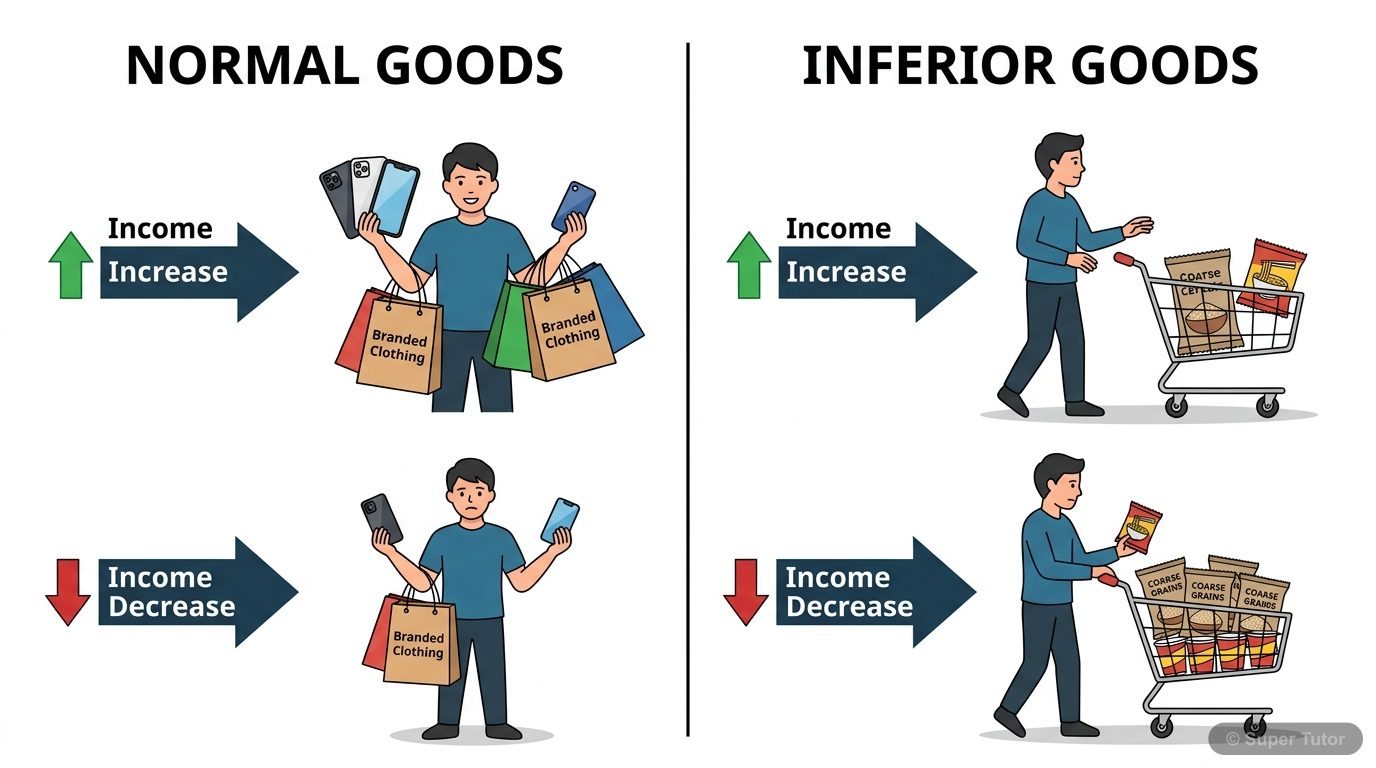
One of 3 illustrations for Demand in Super Tutor — alongside flashcards, concept maps and practice questions.
Quick Quiz: Demand
0/4Tap an answer to check it instantly. No sign-up needed for these 4.
Which of the following is the correct definition of demand?
Varsha desires to buy a car but does not have money to pay for it. This situation is an example of:
Which of the following is NOT a component of demand?
The law of demand states that when the price of a commodity falls, its quantity demanded:
Sample Questions
An individual demand schedule shows the relationship between:
Show answer
Price of a commodity and quantity demanded by one buyer at different prices
Step 1: An individual demand schedule is a table prepared for a single buyer. Step 2: It shows how much quantity that one buyer is willing to purchase at various price levels. Step 3: For example, Varsha's demand schedule for mangoes showed that she buys 2 kg at Rs. 50, 2.5 kg at Rs. 40, and so on — these are all quantities demanded by one person (Varsha). Step 4: Option A is incorrect because a demand schedule focuses on price, not income changes. Step 5: Option C describes market demand (all buyers together), not individual demand. Option D relates to production, which is irrelevant here. Th
Tea and coffee are examples of which type of related goods?
Show answer
Substitute goods
Step 1: Related goods are of two types — substitute goods and complementary goods. Step 2: Substitute goods are those that can be used in place of each other to satisfy the same need. For example, if you want a hot drink, you can choose either tea or coffee. Step 3: Tea and coffee satisfy the same want and can replace each other, so they are substitute goods. Step 4: Complementary goods are used together (like car and petrol), not as alternatives. So that option is wrong. Step 5: Inferior goods and normal goods are based on income effects, not the relationship between two goods. Hence, the cor
Car and petrol are examples of:
Show answer
Complementary goods
Step 1: Complementary goods are those that are used together to satisfy a particular want. You cannot use a car without petrol — both are needed together. Step 2: Car and petrol are used jointly; one is incomplete without the other. This is the definition of complementary goods. Step 3: If the price of petrol rises sharply, people may think twice before buying a car — so demand for car falls when price of petrol rises. This inverse relationship confirms they are complementary. Step 4: Substitute goods (like Coke and Pepsi) replace each other — car and petrol do not. Step 5: Inferior and normal
Goods whose demand increases when the income of the buyer increases are called:
Show answer
Normal goods
Step 1: Goods can be classified based on how their demand changes with a change in the buyer's income. Step 2: Normal goods are those for which demand increases when income increases. For example, when your income rises, you tend to buy more fruits, full cream milk, and butter. Step 3: Inferior goods are the opposite — when income increases, people switch to better quality goods and demand for inferior goods (like jowar, bajra, toned milk) falls. Step 4: Substitute goods and complementary goods are classified based on their relationship with other goods, not income. Step 5: Since the question
+39 more questions on Demand (NIOS Class 10 Economics)
Practise AllFrequently Asked Questions
What are the important topics in Demand for NIOS Class 10 Economics?
How many practice questions are there for Demand?
Sources & Official References
Content is aligned to the official syllabus. Refer to the board website for the latest curriculum.
More resources for Demand
Important Questions
Exam-style questions with answers
Revision Notes
Key points for last-minute revision
Chapter Summary
Understand the chapter at a glance
Concept Maps
See how topics connect
Study Plan
Step-by-step plan for this chapter
Flashcards
Quick-fire cards for active recall
Syllabus
What topics to cover
For serious students
Get the full Demand chapter — start free.
Quizzes, flashcards, an AI doubt solver and a study plan for NIOS Class 10 Economics. Free to start, no card needed.