Basic Economic Activies — Practice Quiz
NIOS · Class 10 · Economics
Try a 4-question quiz on Basic Economic Activies for NIOS Class 10 Economics: tap an answer to check it and see why. 43 questions in the full chapter test.
Interactive on Super Tutor
Studying Basic Economic Activies? Get the full interactive chapter.
Quizzes, flashcards, AI doubt-solver and a step-by-step study plan — built for practice quiz and more.
Free trial, no card needed.
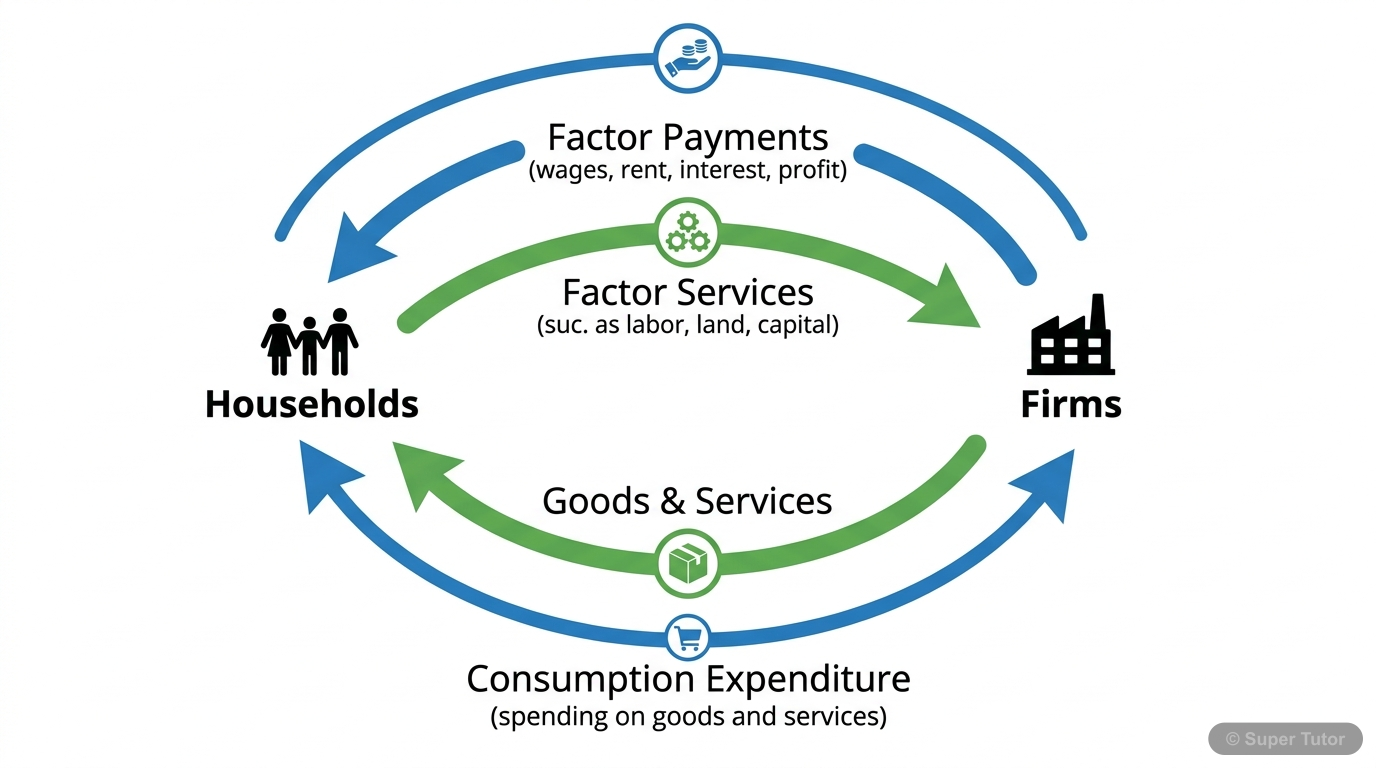
Learn better with visuals Super Tutor pairs illustrations like this with notes and quizzes for Basic Economic Activies.
Quick Quiz: Basic Economic Activies
0/4Tap an answer to check it instantly. No sign-up needed for these 4.
Which of the following is the correct definition of Production?
Which of the following is NOT a factor of production?
The income earned by a landlord for providing land for production is called:
Which of the following best describes 'Capital' as a factor of production?
Sample Questions
Seeds and fertilizers used in farming are examples of which type of capital?
Show answer
Working capital
Step 1: The chapter divides capital into Fixed Capital and Working Capital. Step 2: Fixed Capital includes items used in production for many years — like tractors, buildings, sewing machines. Step 3: Working Capital includes raw materials that are used up during the production process — like seeds, fertilizers, cotton yarn, clay. Step 4: Seeds and fertilizers are consumed in the process of growing crops, so they are Working Capital. Step 5: 'Natural capital' and 'Human capital' are not the categories discussed in this chapter.
The person who organizes the factors of production and bears the risk of business is called:
Show answer
Entrepreneur
Step 1: The chapter defines Entrepreneurship as the art of organizing production activity. Step 2: The person who makes key decisions about production, combines land, labour, and capital, and bears risks is called an Entrepreneur. Step 3: A Labourer provides physical or mental effort. Step 4: A Landlord owns land and earns rent. Step 5: A Consumer uses goods and services for satisfaction. Only the Entrepreneur organizes and bears risk, so 'Entrepreneur' is the correct answer.
What is the factor income earned by an entrepreneur?
Show answer
Profit
Step 1: Each factor of production earns a specific income. Step 2: Land earns Rent, Labour earns Wages, Capital earns Interest. Step 3: The Entrepreneur organizes production, takes all the business risks, and is rewarded with Profit. Step 4: Profit is what remains after paying all other factors (rent, wages, interest). Step 5: It is the reward for risk-taking and organizing the production process. So the correct answer is 'Profit'.
Consumption activity means:
Show answer
Use of goods and services for direct satisfaction of human wants
Step 1: The chapter clearly defines Consumption as the use of goods and services for the direct satisfaction of individual or collective human wants or needs. Step 2: 'Producing goods for sale' describes Production activity. Step 3: 'Saving income in bank' is related to Capital Formation. Step 4: 'Adding to existing capital stock' is the definition of Capital Formation/Investment. Step 5: When a person buys food, clothing, or visits a doctor, they are engaging in Consumption.
+39 more questions on Basic Economic Activies (NIOS Class 10 Economics)
Practise AllFrequently Asked Questions
What are the important topics in Basic Economic Activies for NIOS Class 10 Economics?
How many practice questions are there for Basic Economic Activies?
Sources & Official References
Content is aligned to the official syllabus. Refer to the board website for the latest curriculum.
More resources for Basic Economic Activies
Important Questions
Exam-style questions with answers
Revision Notes
Key points for last-minute revision
Chapter Summary
Understand the chapter at a glance
Concept Maps
See how topics connect
Study Plan
Step-by-step plan for this chapter
Flashcards
Quick-fire cards for active recall
Syllabus
What topics to cover
For serious students
Get the full Basic Economic Activies chapter — start free.
Quizzes, flashcards, an AI doubt solver and a study plan for NIOS Class 10 Economics. Free to start, no card needed.