Economy - its Meaning Types — Practice Quiz
NIOS · Class 10 · Economics
Try a 4-question quiz on Economy - its Meaning Types for NIOS Class 10 Economics: tap an answer to check it and see why.
Interactive on Super Tutor
Studying Economy - its Meaning Types? Get the full interactive chapter.
Quizzes, flashcards, AI doubt-solver and a step-by-step study plan — built for practice quiz and more.
Free trial, no card needed.
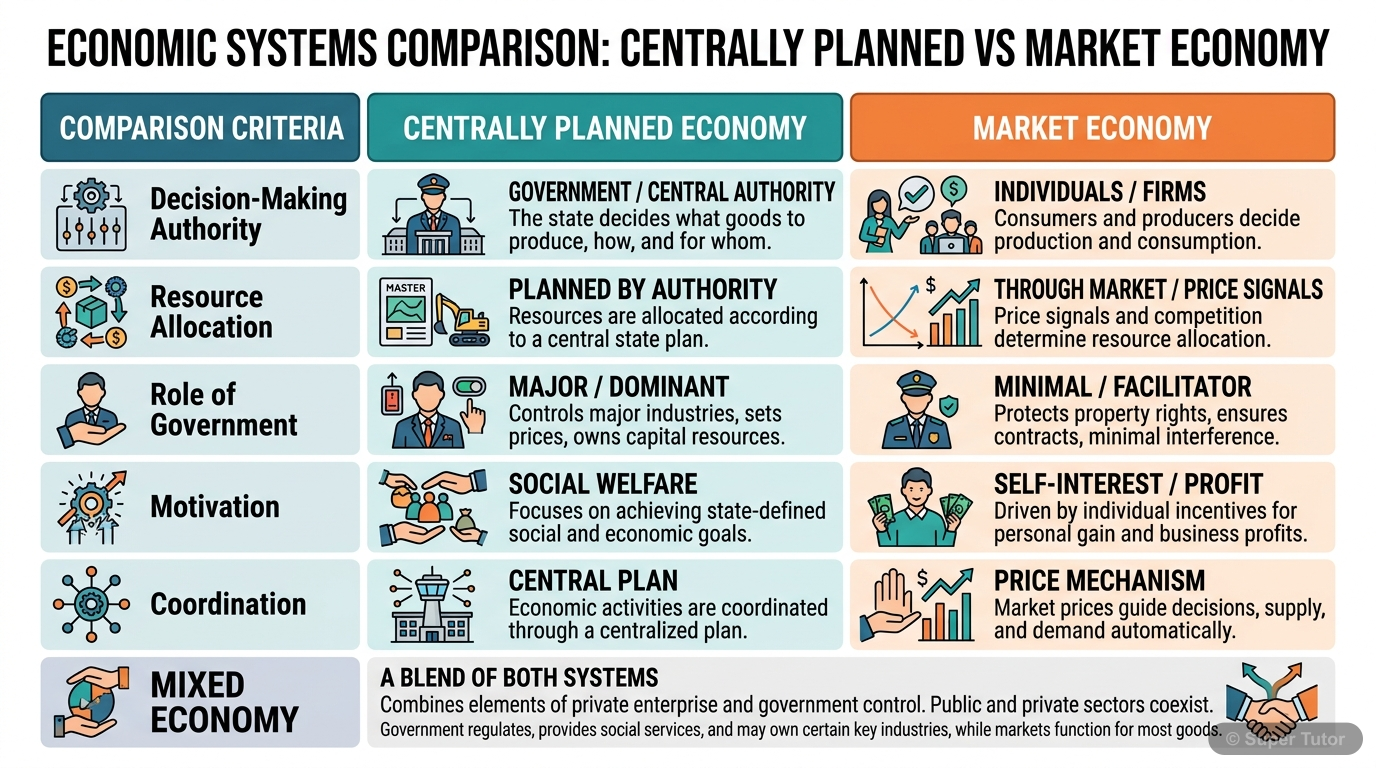
Learn better with visuals Super Tutor pairs illustrations like this with notes and quizzes for Economy - its Meaning Types.
Quick Quiz: Economy - its Meaning Types
0/4Tap an answer to check it instantly. No sign-up needed for these 4.
According to A.J. Brown, which of the following best describes an economy?
Which of the following is NOT a salient feature of an economy?
The policy of 'Laissez Faire' is associated with which type of economy?
In a capitalist economy, the freedom of consumers to spend their income on goods that give them maximum satisfaction is called:
Sample Questions
Which of the following is the MOST important feature that safeguards consumers against exploitation in a capitalist economy?
Show answer
Competition
Step 1: The chapter explicitly states that 'competition is the fundamental feature of capitalist economy and essential to safeguard against consumer's exploitation.' Step 2: When many producers compete with each other to sell products, no single firm can charge very high prices or provide poor quality — consumers benefit. Step 3: Private Property gives ownership rights to individuals but doesn't directly protect consumers. Step 4: Profit Motive drives businesses to be efficient but alone it doesn't protect consumers — in fact, unchecked profit motive could lead to exploitation. Step 5: Freedom
In a socialist economy, all means of production are owned by:
Show answer
The government on behalf of the people
Step 1: The chapter clearly states that in a socialist economy, 'means of production are owned by the government on behalf of the people.' Step 2: The key phrase is 'on behalf of the people' — the government acts as a trustee for the entire society, not for individual benefit. Step 3: The institution of private property is abolished in socialism, so private individuals cannot own production units. Step 4: Foreign ownership is not relevant here — socialist economies typically restrict foreign control. Step 5: Option D describes a mixed economy where both private and public sectors coexist. In p
Which of the following correctly explains why a socialist economy reduces inequalities of income and wealth?
Show answer
By abolishing private property and the right of inheritance
Step 1: The chapter explains that 'the institutions of private property and inheritance are at the root of inequalities of income and wealth in a capitalist economy.' Step 2: In capitalism, the rich can accumulate wealth and pass it on to their children, making the rich richer over generations. Step 3: By abolishing these two institutions (private property and inheritance), a socialist system removes the key sources of inequality. Step 4: Options A, C, and D are features of a capitalist economy — competition, consumer freedom, and price mechanisms are all capitalist characteristics that can ac
Which type of economy combines the features of both capitalism and socialism?
Show answer
Mixed Economy
Step 1: The chapter defines a mixed economy as one that 'combines the best features of capitalism and socialism.' Step 2: In a mixed economy, both public and private sectors coexist — the private sector operates on profit motive (capitalist feature) and the public sector operates for social welfare (socialist feature). Step 3: Developed and Developing economies are classifications based on the LEVEL of development, not on ownership structure. Step 4: A capitalist economy only has private sector dominance without socialist features. Step 5: Therefore, Mixed Economy is the correct answer — India
+41 more questions on Economy - its Meaning Types (NIOS Class 10 Economics)
Practise AllFrequently Asked Questions
What are the important topics in Economy - its Meaning Types for NIOS Class 10 Economics?
How many practice questions are there for Economy - its Meaning Types?
Sources & Official References
Content is aligned to the official syllabus. Refer to the board website for the latest curriculum.
More resources for Economy - its Meaning Types
Important Questions
Exam-style questions with answers
Revision Notes
Key points for last-minute revision
Chapter Summary
Understand the chapter at a glance
Concept Maps
See how topics connect
Study Plan
Step-by-step plan for this chapter
Flashcards
Quick-fire cards for active recall
Syllabus
What topics to cover
For serious students
Get the full Economy - its Meaning Types chapter — start free.
Quizzes, flashcards, an AI doubt solver and a study plan for NIOS Class 10 Economics. Free to start, no card needed.