Supply — Practice Quiz
NIOS · Class 10 · Economics
Try a 4-question quiz on Supply for NIOS Class 10 Economics: tap an answer to check it and see why. 43 questions in the full chapter test.
Interactive on Super Tutor
Studying Supply? Get the full interactive chapter.
Quizzes, flashcards, AI doubt-solver and a step-by-step study plan — built for practice quiz and more.
Free trial, no card needed.
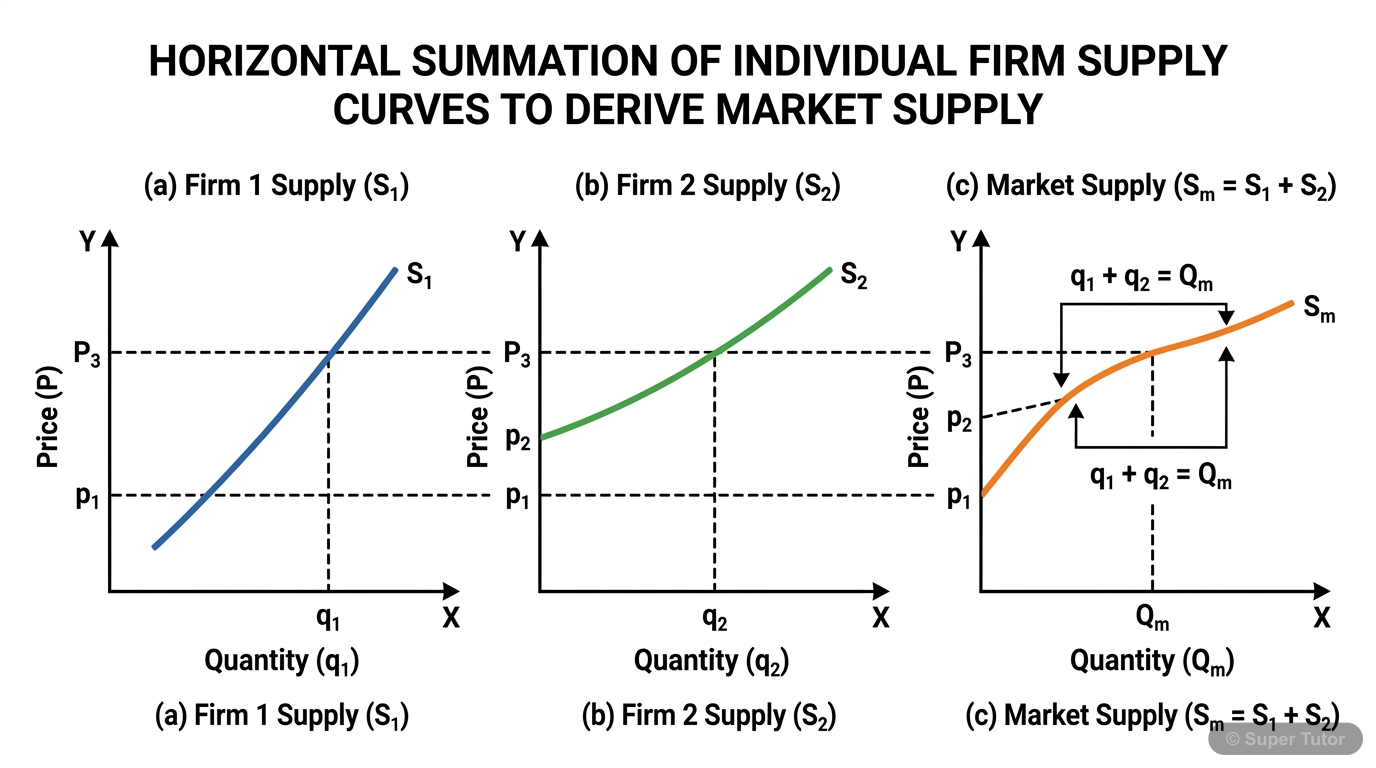
One of 3 illustrations for Supply in Super Tutor — alongside flashcards, concept maps and practice questions.
Quick Quiz: Supply
0/4Tap an answer to check it instantly. No sign-up needed for these 4.
Which of the following best defines 'supply' of a commodity?
A grain merchant has 820 quintals of rice stored in his warehouse on 1st August. This quantity is an example of:
When the price of a commodity increases, what happens to its quantity supplied according to the Law of Supply?
A farmer produces both wheat and rice. If the price of rice increases, what will happen to the supply of wheat?
Sample Questions
If a new and improved technology is adopted by a firm in its production process, what is the most likely effect on supply?
Show answer
Supply increases because cost of production per unit falls
Step 1: Technology of production is one of the key determinants of supply. Step 2: Improved technology makes production more efficient — the same inputs produce more output or the same output is produced at a lower cost. Step 3: When cost of production per unit falls, the profit margin per unit increases. Step 4: Higher profits motivate the firm to produce and supply more of the commodity. Step 5: Options A and D focus on unrelated or indirect effects. Option B is incorrect because technology directly affects cost and therefore supply. The correct answer is C — improved technology → lower cost
The government increases the rate of sales tax on a commodity. What will be the effect on its supply?
Show answer
Supply will decrease
Step 1: Government policy is one of the important determinants of supply. Step 2: When the government increases sales tax, it adds to the overall cost of production per unit for the firm. Step 3: Higher cost of production per unit reduces the profit margin of the firm. Step 4: With lower profits, the firm is less motivated to produce and supply more of the commodity. Step 5: Therefore, an increase in sales tax leads to a decrease in supply. The opposite is also true — a reduction in tax lowers cost and increases supply.
In an individual supply schedule, what do the two columns typically represent?
Show answer
Price of the commodity and the quantity supplied at each price
Step 1: An individual supply schedule is a tabular presentation of the supply data for one firm or seller. Step 2: It shows the relationship between price and quantity supplied — the two main variables in the law of supply. Step 3: The other factors (technology, input prices, etc.) are assumed to be constant and hence not shown in the table. Step 4: Options A, C, and D are incorrect — income of seller, cost of production, or number of sellers are not the standard columns in an individual supply schedule. Step 5: The correct answer is B — price in one column and quantity supplied in the other,
According to the Law of Supply, the relationship between price of a commodity and its quantity supplied is:
Show answer
Direct relationship
Step 1: The Law of Supply clearly states: 'Other factors determining supply remaining constant, the price of a commodity and its quantity supplied are directly related.' Step 2: A direct relationship means both variables move in the same direction — when price goes up, quantity supplied goes up; when price falls, quantity supplied falls. Step 3: An inverse relationship (Option A) is what the Law of Demand describes — it does not apply to supply. Step 4: Option B is incorrect because there is clearly a defined relationship. Step 5: Option D (proportional) is not the correct term used — the law
+39 more questions on Supply (NIOS Class 10 Economics)
Practise AllFrequently Asked Questions
What are the important topics in Supply for NIOS Class 10 Economics?
How many practice questions are there for Supply?
Sources & Official References
Content is aligned to the official syllabus. Refer to the board website for the latest curriculum.
More resources for Supply
Important Questions
Exam-style questions with answers
Revision Notes
Key points for last-minute revision
Chapter Summary
Understand the chapter at a glance
Concept Maps
See how topics connect
Study Plan
Step-by-step plan for this chapter
Flashcards
Quick-fire cards for active recall
Syllabus
What topics to cover
For serious students
Get the full Supply chapter — start free.
Quizzes, flashcards, an AI doubt solver and a study plan for NIOS Class 10 Economics. Free to start, no card needed.