Stealing and Atonement — Practice Quiz
NIOS · Class 10 · English
Try a 4-question quiz on Stealing and Atonement for NIOS Class 10 English: tap an answer to check it and see why. 44 questions in the full chapter test.
Interactive on Super Tutor
Studying Stealing and Atonement? Get the full interactive chapter.
Quizzes, flashcards, AI doubt-solver and a step-by-step study plan — built for practice quiz and more.
Free trial, no card needed.
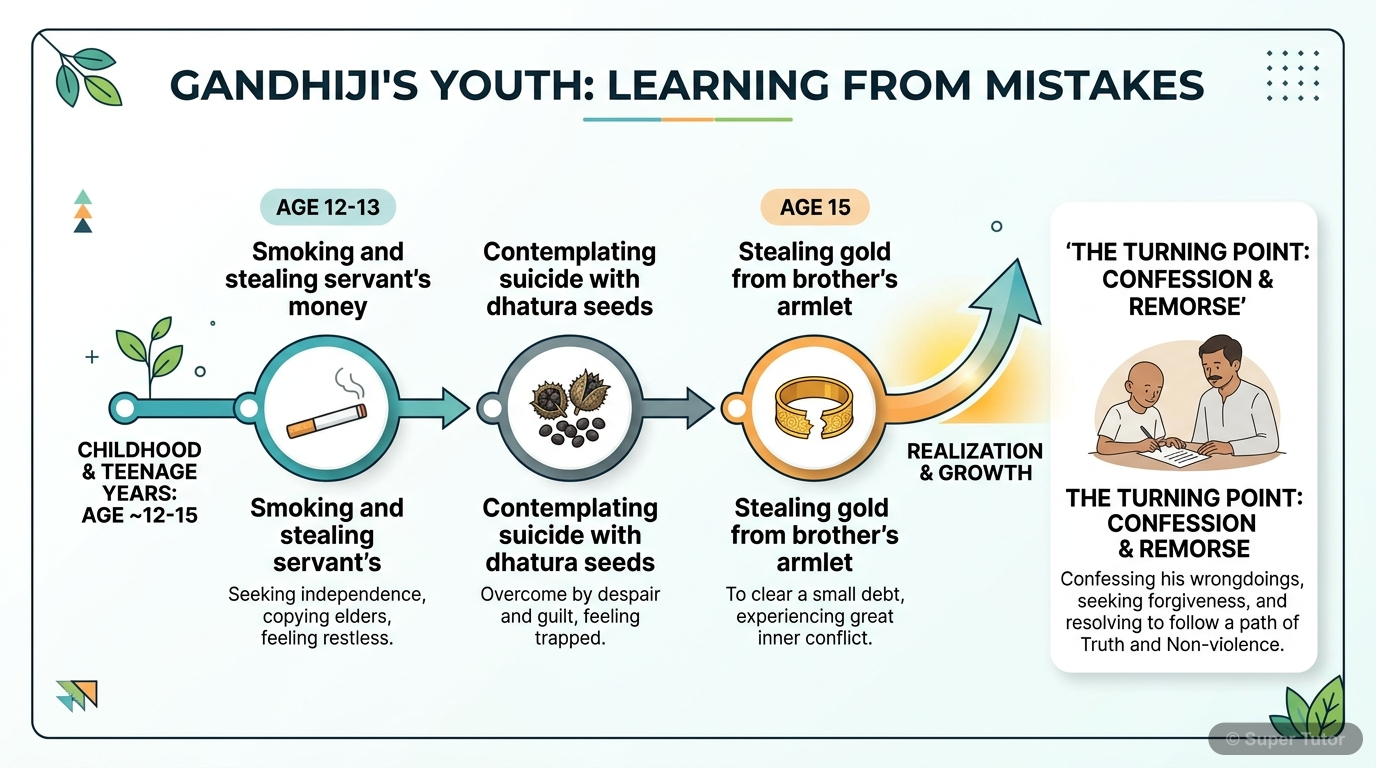
One of 3 illustrations for Stealing and Atonement in Super Tutor — alongside flashcards, concept maps and practice questions.
Quick Quiz: Stealing and Atonement
0/4Tap an answer to check it instantly. No sign-up needed for these 4.
Who did Gandhiji try to imitate when he started smoking?
What did Gandhiji and his friend initially collect to smoke?
Why did Gandhiji and his friend consider suicide?
What seeds did they believe were poisonous?
Sample Questions
How old was Gandhiji when he committed the more serious theft?
Show answer
Fifteen years old
The text states 'The other theft was committed when I was fifteen.' This refers to the theft of gold from his brother's armlet, which Gandhi describes as much more serious than the earlier theft of coins at age twelve or thirteen. The age specification helps readers understand the timeline of Gandhi's moral development and shows that even at fifteen, he was still making mistakes but was more capable of serious moral reflection. The other ages mentioned are either for the earlier, less serious theft or not mentioned at all.
What was Gandhiji's brother's debt amount?
Show answer
Twenty-five rupees
The text clearly states that 'This brother had run into a debt of about twenty-five rupees.' This specific amount provides context for why Gandhi felt compelled to help by stealing gold from the armlet. Twenty-five rupees would have been a significant amount during that time period, making the debt a serious family concern. The exactness of this detail in Gandhi's memory shows the impact this incident had on him. The other amounts are not mentioned in the text and would either underestimate or overestimate the debt's significance.
What did Gandhiji's father do after reading the confession letter?
Show answer
He cried and tore up the letter
The text describes the father's reaction in detail: 'He read it through, and tears trickled down his cheeks, wetting the paper. For a moment he closed his eyes in thought and then tore up the note.' This peaceful, loving response instead of anger or punishment taught Gandhi about Ahimsa. The father's tears showed both pain and love, and his act of tearing up the letter symbolized forgiveness and closure. The other options contradict the text - he didn't scold, beat, or ignore Gandhi, but responded with pure love and forgiveness.
According to Gandhi, what is the purest type of repentance?
Show answer
A clean confession combined with a promise never to repeat the sin
Gandhi explicitly states in the text: 'A clean confession, combined with a promise never to commit the sin again, is the purest type of repentance.' This definition combines honesty (clean confession) with genuine resolution to change (promise never to repeat). This two-part formula shows that true repentance requires both acknowledgment of wrongdoing and commitment to moral improvement. The other options represent incomplete forms of repentance - silent regret lacks communication, asking forgiveness without commitment to change is superficial, and accepting punishment without confession misse
+40 more questions on Stealing and Atonement (NIOS Class 10 English)
Practise AllFrequently Asked Questions
What are the important topics in Stealing and Atonement for NIOS Class 10 English?
How many practice questions are there for Stealing and Atonement?
Sources & Official References
Content is aligned to the official syllabus. Refer to the board website for the latest curriculum.
More resources for Stealing and Atonement
Important Questions
Exam-style questions with answers
Revision Notes
Key points for last-minute revision
Chapter Summary
Understand the chapter at a glance
Concept Maps
See how topics connect
Study Plan
Step-by-step plan for this chapter
Flashcards
Quick-fire cards for active recall
Syllabus
What topics to cover
For serious students
Get the full Stealing and Atonement chapter — start free.
Quizzes, flashcards, an AI doubt solver and a study plan for NIOS Class 10 English. Free to start, no card needed.