The Truth — Practice Quiz
NIOS · Class 10 · English
Try a 4-question quiz on The Truth for NIOS Class 10 English: tap an answer to check it and see why. 42 questions in the full chapter test.
Interactive on Super Tutor
Studying The Truth? Get the full interactive chapter.
Quizzes, flashcards, AI doubt-solver and a step-by-step study plan — built for practice quiz and more.
Free trial, no card needed.
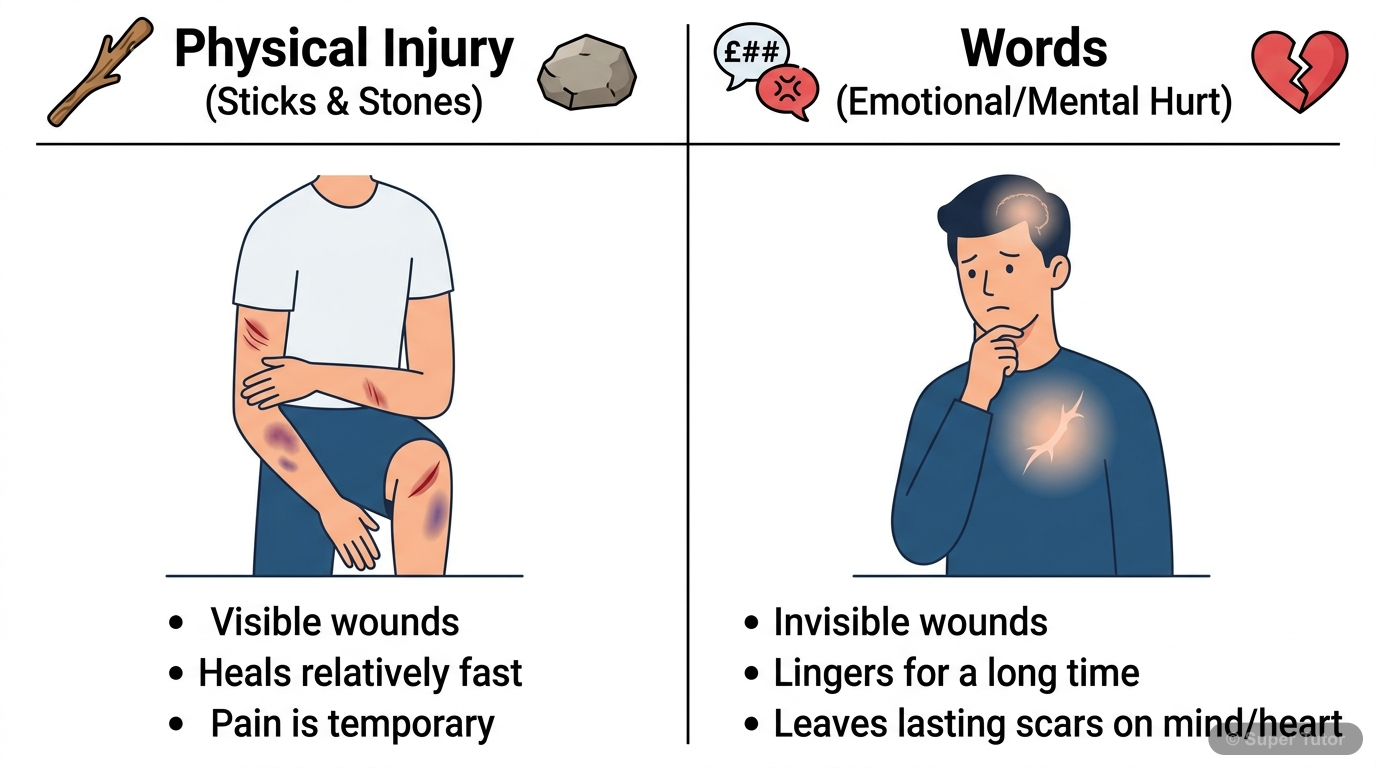
One of 3 illustrations for The Truth in Super Tutor — alongside flashcards, concept maps and practice questions.
Quick Quiz: The Truth
0/4Tap an answer to check it instantly. No sign-up needed for these 4.
What is the central theme of the poem 'The Truth' by Barrie Wade?
In the first stanza, what are 'words' compared to?
What does the word 'mortify' mean in the context of the poem?
According to the poem, what happens to physical cuts and bruises?
Sample Questions
Which literary device is used in the phrase 'Bats and bricks may ache through bones'?
Show answer
Alliteration
The phrase 'Bats and bricks may ache through bones' uses alliteration - the repetition of the initial 'b' sound in 'Bats,' 'bricks,' and 'bones.' Alliteration creates a musical effect and helps emphasize the words. The poet uses this device throughout the poem to create rhythm and make the verses more memorable and impactful.
Where does the pain from words leave its scar according to the poem?
Show answer
On the mind and heart
In the third stanza, the poet explicitly states 'Pain from words has left its scar / On mind and heart that's tender.' This shows that unlike physical weapons that scar the body, harsh words leave invisible but lasting marks on our emotions and thoughts. The use of 'tender' emphasizes how sensitive our minds and hearts are to verbal attacks.
What does the poet mean by 'word swords' in the second stanza?
Show answer
Sharp, hurtful words that cut like swords
The phrase 'word swords' is a metaphor comparing harsh, hurtful words to swords. Just as swords are sharp weapons that can cut and pierce, the poet suggests that cruel words can 'pierce and stick inside' us emotionally. The metaphor emphasizes that words can be as dangerous and painful as physical weapons, causing deep emotional wounds.
Why are the word swords described as 'slant and curved'?
Show answer
They attack indirectly and unexpectedly
The description 'slant and curved' suggests that hurtful words often don't come as direct attacks but arrive in indirect, unexpected ways. Like a curved sword that approaches from an angle, harsh words can catch us off guard and penetrate our defenses when we least expect them. This makes them even more painful because we're unprepared for the emotional blow.
+38 more questions on The Truth (NIOS Class 10 English)
Practise AllFrequently Asked Questions
What are the important topics in The Truth for NIOS Class 10 English?
How many practice questions are there for The Truth?
Sources & Official References
Content is aligned to the official syllabus. Refer to the board website for the latest curriculum.
More resources for The Truth
Important Questions
Exam-style questions with answers
Revision Notes
Key points for last-minute revision
Chapter Summary
Understand the chapter at a glance
Concept Maps
See how topics connect
Study Plan
Step-by-step plan for this chapter
Flashcards
Quick-fire cards for active recall
Syllabus
What topics to cover
For serious students
Get the full The Truth chapter — start free.
Quizzes, flashcards, an AI doubt solver and a study plan for NIOS Class 10 English. Free to start, no card needed.